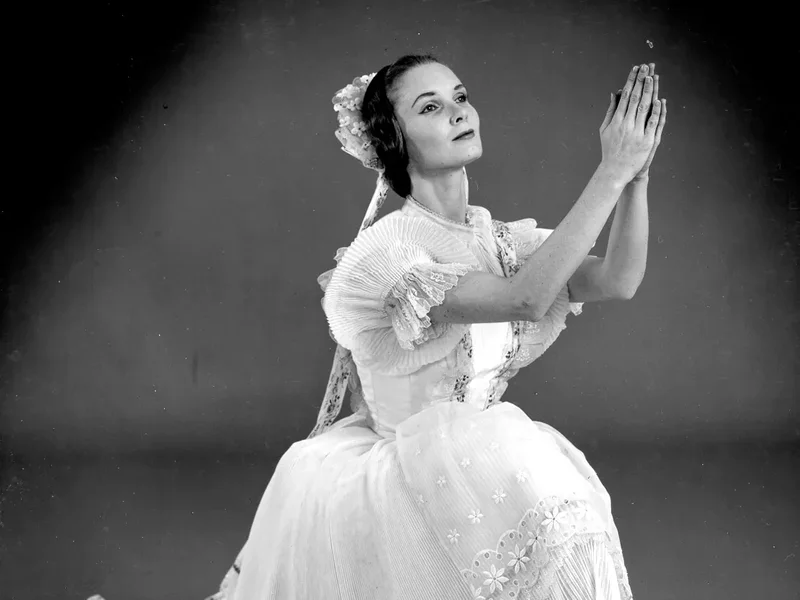
Sally Brayley Bliss, a storied, standout Canadian dancer who went on to a long career at the nexus of ballet and American politics, died June 18 in St. Louis, Mo., after an illness. She was 89.
After beginning her career with the National Ballet of Canada, she danced on New York’s major stages before becoming a global advocate for the art form, teaching the son of a U.S. president and holding leadership positions at The Joffrey Ballet, the Antony Tudor Ballet Trust and Dance St. Louis.
Born on May 15, 1937, in London, England, Sally Brayley moved with her family several times as a child, following the career of her father, Canadian Press journalist Jack Brayley. His postings in New York and Montreal offered opportunities for his young daughter to dance, but the options were more limited in Halifax, where the family settled by the early 1950s. Mr. Brayley eventually became bureau chief there and his wife, the artist Zeversa (Gibbon) Brayley, a founding member of the Nova Scotia College of Art and Design.
In 1956, Ms. Brayley left home for Toronto and “went to class every day,” with Betty Oliphant, the instructor whose Sherbourne Street studio fed directly to the National Ballet.
By her own account, Ms. Brayley was behind in her training and was put in a class with younger dancers, but she was determined to catch up. She took on theatre and concert gigs and competed on the CBC talent show Pick the Stars in April, 1956.
“My goal was to dance with the National Ballet of Canada,” she is quoted as saying in Early Days, Early Dancers, author Jocelyn Terell Allen’s history of the company’s development, published in 2020. But the dancer’s accession was never a given. “How are your typist skills?” company founder Celia Franca once asked her, according to her son Tim Bliss. “That fuelled her,” he said.
After six months of classes, Ms. Brayley was invited to join the fledgling company, and she remained with the troupe through six years of low pay and relentless touring. In Early Days, Early Dancers, she described a particularly long drive to Vermont when the dancers applied their makeup on the bus.
“When we finally arrived, the whole audience was out on the street cheering us on,” she recalled. The theatre was small, the floors dirty, but the show went on. Afterward, she said, she ate her first slice of pizza. It was “delicious.”
Her roles included both the bold and spirited Swanhilde in Coppélia and a poised Victorian party guest in Antony Tudor’s one-act ballet Lilac Garden. Mr. Tudor, who had been a mentor to Ms. Franca when she danced with the British company now known as Rambert Dance, allowed the National Ballet of Canada to perform his ballets royalty-free. This was a boon for the cash-strapped company and put Ms. Brayley on the choreographer’s radar. (After Mr. Tudor’s death in 1987, she became sole trustee of his ballets and co-executor of his estate.)
In 1963, Ms. Brayley left Toronto for New York to dance with the Metropolitan Opera Ballet, newly helmed by famed Ballets Russes and Royal Ballet star Alicia Markova. At the time, Ms. Brayley was ending her brief marriage to a musician, and Anthony Bliss, a lawyer and prominent Metropolitan Opera board member, was winding down his second marriage to the actor Jo Ann Sayers.
When Mr. Bliss made the first move, the young dancer was not impressed, declining to go on a date with “some grey-haired old man,” their son said. Once she reconsidered, the courtship proceeded quickly, he said. They married in 1967.
She once described him to The New York Times as, “the most unsophisticated man I ever met.”
“I pick out his clothes,” she said. “He has no gourmet instincts: I could feed him Alpo.”
Mr. Bliss responded by keeping a can of dog food at his desk at the Metropolitan Opera, where he served as general manager from 1974 to 1985.
To avoid the appearance of a conflict, Ms. Brayley Bliss left the Met and joined The Joffrey Ballet, an upstart company that was more experimental and racially diverse than American Ballet Theatre and New York City Ballet. With two young sons in tow, Ms. Brayley Bliss became director of Joffrey II, a feeder troupe that toured extensively.
“She still worked us to the bone,” said Rachel Ganteaume Richards, a dancer with Joffrey II from 1973 to 1975. “But she did it with a smile. She had a beautiful smile.”
Patrick Corbin, another former Joffrey dancer, called those smiles “Bliss bombs.”
In the early 1970s, working mothers were a rare sight in dance. Ms. Brayley Bliss made a point of looking perfectly put together when she taught class: curly red hair neatly combed and leotard beneath a long chiffon skirt, Ms. Ganteaume Richards said. Yet she was always approachable, and sympathetic in ways male leaders were not.
“You could go to Sally, because she was more mothering; she always had an ear for things that could be bothersome,” Ms. Ganteaume Richards recalled.
Ms. Brayley Bliss also took the then-rare step of asking dancers of colour, including Ms. Ganteaume Richards, to dye their shoes and tights to match their skin tone so audiences viewed their legs as one long, clean line. Once Ms. Ganteaume Richards, who is Black, was promoted to the main company, “It was back to wearing pink,” she recalled.
In 1979, Ms. Brayley Bliss welcomed a protégé with an unusual entourage: Ron Reagan, son of the California governor and soon-to-be U.S. president Ronald Reagan.
“He was like an antelope, thin, beautiful feet, no turnout, and he jumped like an angel,” Ms. Brayley Bliss said, describing the first time she saw Mr. Reagan in class. The U.S. Secret Service went everywhere with the company, including Hong Kong during an eventful international tour.
One cold March afternoon in 1981, the Secret Service banged on the company’s Nebraska hotel room doors and whisked away Ron Reagan and his wife, Doria Reagan, in a police motorcade. The president had been shot, leaving Ms. Brayley Bliss down a dancer and dealing with a media fracas. “We are leaving for the theatre. We are very upset,” she told a reporter at the Lincoln Journal.
During a month-long company furlough, photos of the president’s son standing in an unemployment line drew national scrutiny. When Mr. Reagan left the Joffrey in 1983, citing poor treatment of dancers in the senior company, conservative columnist William F. Buckley Jr. used the occasion to lambaste the performing arts. The younger Mr. Reagan’s decision to leave Yale University to pursue dance, Mr. Buckley wrote, had been an “awful experience” for the future U.S. president and his wife. “Such a decision is not easily received in any household. In this household it was received with true shock.”
The president, however, nursed no grudges against Ms. Brayley Bliss, and in 1986, he appointed her to succeed Martha Graham on the National Council on the Arts, a federal body that advises the U.S. National Endowment for the Arts (NEA), the country’s largest source of public culture funding.
Mr. Bliss stressed that his mother viewed her appointment as an apolitical honour, and that she had no personal allegiance to the president or his policies. “She took it extremely seriously, as a service to the arts and to the country,” he said.
Little did Ms. Brayley Bliss know, however, that she was signing on for six tumultuous years when the NEA would be blasted for supporting controversial exhibits, including nude photography by Robert Mapplethorpe and Andres Serrano’s iconic image Piss Christ. In 1989, council members, who had mostly been rubber-stamping grants, found themselves in the crosshairs.
“The council had immense symbolic power that derived from its members’ fame and the respect they commanded in their fields,” cultural historian Isaac Butler writes in his new book, The Perfect Moment: God, Sex, Art, and the Birth of America’s Culture Wars, a history of the turbulent era.
“It was very hard work and a fragile time,” she would say in a 2011 speech. “I’m honoured to have been there but it was probably one of the most difficult experiences of my life.”
Ms. Brayley Bliss and her colleagues found themselves overseeing major policy overhauls, including legislative changes that forbade the NEA from funding any individual artists, with the exception of writers. To this day, that restriction continues to stifle the work of American artists, and sets apart the American model of only funding non-profit. This approach differs from norms established in Canada and many other countries.
The late 1980s were also challenging for The Joffrey Ballet. Company founder Robert Joffrey had long sought to keep his AIDS diagnosis a secret, but prior to his 1988 death, board president Anthony Bliss plotted for his wife to replace Mr. Joffrey. Ms. Brayley Bliss, however, denied knowledge of his machinations.
“Tony and I never talked about it because we felt that with him being chairman of the board, the line was very thin,” she told Sasha Anawalt, Mr. Joffrey’s biographer. The board members were split, with some convinced Mr. Joffrey’s partner, Gerald Arpino, could run the company, while others believed Ms. Brayley Bliss should be in charge, with Mr. Arpino as her resident choreographer.
When Mr. Arpino refused to discuss the latter arrangement, Ms. Brayley Bliss sent him a Cassandra-like diatribe, resigning from the company. “Prepare yourself, Jerry. It could be rough,” she wrote.
She was right: The Joffrey could not survive in New York without Bliss’s family support and connections. The company decamped for Chicago, where it remains today.
Despite her high-wire professional life, Ms. Brayley Bliss never missed a childhood milestone, according to her son, and she was as committed to her children’s school musicals as she was to the ballet company. She also prioritized spending summers in Nova Scotia. Once her sons were in high school, she somehow convinced the principal to let her teach a dance-based gym class for boys.
She was ahead of her time, Mr. Bliss said, and sought to reduce the stigmas faced by men in dance.
Later in life, she served on “so many boards,” her son said. From 1987 to 2018, she was sole trustee of the Antony Tudor Ballet Trust, overseeing licensing rights and coaching for companies staging the choreographer’s works.
In 1995, Ms. Brayley Bliss received a surprise offer to take over leadership of Dance St. Louis, an organization that presented touring companies in the American heartland. Mr. Bliss said his mother, never a ballet snob, expanded audiences for dance, booking Riverdance and hip-hop pioneer Rennie Harris. When she retired in 2006, she received the Leadership in the Arts award from the governor of Missouri.
At the end of her life, Ms. Brayley Bliss was surrounded by family and still longing for summers in the Maritimes, where she would visit loved ones in Nova Scotia and relax at her own cottage on Prince Edward Island.
In addition to her sons, Tim and Mark Bliss, she leaves her third husband, James Connett; two granddaughters; two great-grandsons; six stepchildren; seven step-grandchildren; and four step-great-grandchildren. She was predeceased by her second husband, her parents, and her brother, John Brayley, who served with the Royal Canadian Mounted Police.
You can find more obituaries from The Globe and Mail here.
To submit a memory about someone we have recently profiled on the Obituaries page, e-mail us at obit@globeandmail.com.