Night Trains Getting Back on Track: Japanese Rail Companies Boosting Overnight Services
Guide to Japan Economy## From Blue Trains to Cruise Trains
Back before the Shinkansen high-speed rail network, expressways, and domestic airlines had reached their present level of development in Japan, sleeper trains played a significant role in domestic long-distance transportation. The first limited express sleeper “Blue Train” debuted in 1958. So nicknamed because of their blue carriages, Blue Trains became a popular means of transportation thanks to their convenience, comfort, and fully air-conditioned coaches. At their peak in 1975, there were nearly 40 round-trip Blue Train services operating across Japan every day.
That same year, Shinkansen high-speed service reached Hakata, joining Kyūshū to Honshū in the premier Japan National Railways long-distance network. As time went on, people turned to alternative means of travel as JNR, which operated the Blue Trains at the time, repeatedly raised its basic fares along with its limited-express and sleeper surcharges. Following the breakup of JNR and formation of the Japan Railways Group in 1987, upscale sleeper trains like the Hokutosei (itself a high-end Blue Train), Twilight Express, and Cassiopeia hit the rails, coming to enjoy considerable popularity. Even so, growing competition from long-distance overnight buses and the operational complexities of running trains across the domains of multiple JR companies led to the steady decline of Blue Trains. The last Blue Train, Hokutosei, was retired in 2015.
Today, there are only two remaining regularly scheduled limited express sleeper services in Japan: the Sunrise Seto and Sunrise Izumo. Coupled as a single train when departing Tokyo, they separate into two trains at Okayama, with half of the coaches continuing on to Shikoku and the other half to the San’in region. Both services operate one round trip per day.
Several other overnight trains operate on an irregular basis. These include the West Express Ginga (JR West), which does not require payment of a sleeper surcharge, the Seven Stars (Nanatsuboshi) in Kyūshū (JR Kyūshū), the Train Suite Shiki-Shima (JR East), and the Twilight Express Mizukaze (JR West). The latter three cost passengers between ¥300,000 and ¥1,000,000 per night. Overnight rail in Japan has today largely become synonymous with luxury cruise trains.
New Offerings on the Affordable Side
As with the West Express Ginga, the newly announced Luna Azul and Tokaidō Lumière Express services will be priced far below the luxury cruise trains. Considering that their fare includes overnight accommodation, they can be said to offer an affordable experience.
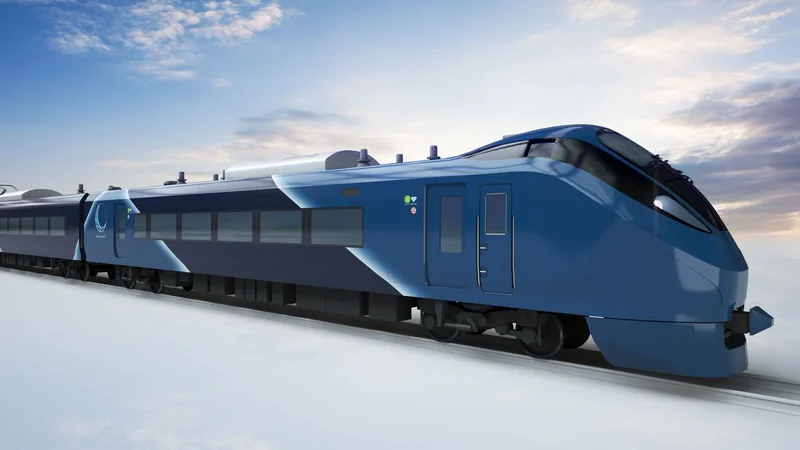
The Luna Azul, which is aiming to debut at the start of fiscal 2027, consists of 10 refurbished limited express cars and features Green Car compartments for one to four passengers each, as well as a lounge. From spring through autumn, it will operate twice weekly between Shinagawa in Tokyo and Aomori, at Honshū’s northern tip, via the Sea of Japan coast using the Jōetsu and Uetsu lines and passing through Akita. The journey will take from 12 and a half to 15 hours. Fares are expected to be slightly higher than a one-way Green Car ticket on the Tōhoku Shinkansen between Tokyo and Shin-Aomori, which costs ¥24,180. During winter, the train is scheduled to operate six round trips per week during the daytime, between Shinagawa and Naganohara-Kusatsuguchi in Gunma Prefecture.
Another overnight train project is the Tōkaidō Lumière Express. Unlike the Luna Azul, this will be a one-time service on the Tōkaidō Shinkansen, departing Tokyo at 10 pm on August 8 and arriving at Shin-Ōsaka at 7 am the following morning. The fare is ¥15,000 for a reserved ordinary-class seat for the whole journey, about the same as the price of a regular Shinkansen ticket for that route. No changes will be made to the Shinkansen cars themselves. From midnight to 6 am, the train will remain at Gifu-Hashima. Because maintenance and inspection work on the Shinkansen lines is carried out during these late-night hours, keeping the train with passengers on it parked at a station during those hours is an interesting approach.
Why Bring Back Overnight Travel?
What strategies are driving the three JR companies’ new overnight rail initiatives?
JR East explained the Luna Azul rationale as follows: “Our aim in launching this service is to create a memorable and exciting train travel experience, tapping into latent demand for long-distance train journeys and meeting the growing preference of international as well as domestic travelers for distinctive experiences while also promoting tourism through collaboration with local communities.”
JR Central describes its aims for the Lumière Express, the first-ever overnight Shinkansen service, as follows: “As demand for transportation between the Tokyo metropolitan area, the Chūkyō area around Nagoya, and Kansai during peak season is increasing and demand for overnight travel is growing with rising hotel prices, our aim is to offer a new travel option while at the same time evaluating how much demand exists for a Tōkaidō Shinkansen service that combines transportation with rest.”
JR West, which launched its overnight train West Express Ginga ahead of the other two, notes: “Our aim is to create new demand in an era of population decline. The West Express Ginga occupies the middle ground between familiar sightseeing trains and luxury cruise trains that are out of reach for many. It offers an affordable way for people to satisfy their desire to travel to more distant destinations while helping increase visitor numbers across West Japan.”
Are these JR operators considering expanding their routes or introducing additional services?
“We have not decided any specific routes or operating areas for expansion at this time, but we will continue examining various possibilities, including broader operating areas,” says JR East. “We currently have no concrete plans for additional services along similar lines, but we will look into these options based on passenger demand.”
JR Central, meanwhile, explains: “The Tōkaidō Lumière Express will be operated only once on a specific date. After evaluating passenger demand, customer feedback, and operational challenges, we will make a comprehensive decision about how similar services might be offered in the future.”
The Analysis Behind Overnight Rail Success
One railway executive has played a notable role in the current revival of overnight train travel. Torizuka Akira, president of Ōigawa Railway in Shizuoka, has served as president of Isumi Rail in Chiba and Echigo Tokimeki Railway in Niigata as well, having been selected through open recruitment processes for both positions. In 2014, as overnight trains were rapidly disappearing across Japan, Isumi Rail introduced a nighttime service that made two and a half round trips along its 26.8-kilometer line. Tickets, which were limited to 40 passengers, sold out in just two hours. Since then, Echigo Tokimeki and Ōigawa have achieved similar successes with nighttime services using former JNR rolling stock, allowing passengers to experience the nostalgic atmosphere of overnight rail travel.
Torizuka’s success with these services is based in providing nostalgia to people who experienced overnight travel during the Shōwa era (1926–89) and offering fresh value to the younger generations who have never traveled overnight by train.
From his perspective as an experienced railway executive, how does he view JR efforts to bring back overnight rail travel?
Torizuka praises the companies’ decision to keep initial investment costs low by refurbishing existing train cars. He also believes developments in Europe have influenced the renewed interest in overnight rail, noting that European regulations on short-haul flights aimed at reducing greenhouse gas emissions have contributed to a resurgence in rail travel, including overnight trains.
“Given the popularity of overnight buses, it’s clear that there is demand for nighttime travel,” said Torizuka. “Japan may eventually introduce environmentally conscious restrictions on short-haul flights similar to those in Europe, which could increase demand for overnight trains. I believe the JR companies may have this possibility in mind. Rather than focusing solely on per passenger spending and improving the turnover rate, I think these companies are taking environmental considerations and contributions to local communities into account as well.”
A Future of New Routes and Services?
Torizuka’s Ōigawa Railway is already popular with visitors from Japan and abroad for its Ikawa Line, which offers views of a massive dam reservoir, as well as its special Thomas the Tank Engine and Percy the Small Engine trains. The company’s next goal in terms of overnight rail is to introduce sleeper cars. To keep building costs down, the company is exploring the possibility of placing shipping-container “hotel rooms” on freight cars and operating them as annexes to the hot spring hotel it runs.
Demand for nighttime travel is already substantial. Railway companies are refurbishing existing rolling stock to keep initial costs down. In this way they can avoid charging high fares while meeting the needs of passengers seeking affordable and accessible overnight travel. The new services being introduced by JR companies suggest that affordable overnight rail travel is ready for a revival—it will be interesting to see how operating routes expand and services become more frequent, and what sorts of new overnight trains will emerge in the years ahead.
(A note for travelers using the Japan Rail Pass, which allows visitors from abroad unlimited usage of most JR trains: The Luna Azul and Tōkaidō Lumière Express introduced above are not covered by the pass. For the Sunrise Seto, Sunrise Izumo, and West Express Ginga services, the Japan Rail Pass covers the base fare, but passengers must still pay the applicable limited express and sleeper surcharges. Because these trains are highly popular, reservations can be difficult to obtain, even for travelers already in Japan. The best way to obtain a reservation may be to contact a travel agency once your travel dates have been finalized.)
(Originally published in Japanese. Banner photo: A rendering of the Luna Azul, scheduled to commence services in 2027. Courtesy JR East.)