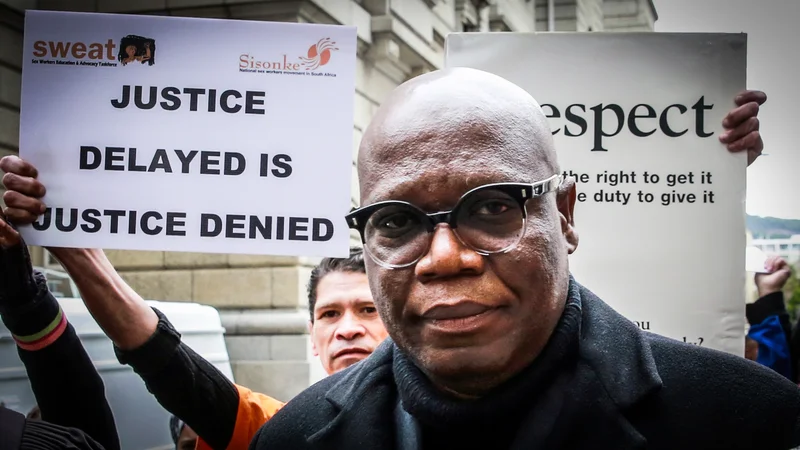
Zwelethu Mthethwa, the internationally exhibited South African artist convicted in 2017 of murdering a Cape Town woman, Nokuphila Kumalo, walked out of Brandvlei Correctional Centre last month, a free man.
His release was not publicly announced at the time.
The Department of Correctional Services (DCS) confirmed it on Thursday only after Daily Maverick submitted questions following a tip-off.
âThe Department of Correctional Services confirms that offender Zwelethu Harold Joseph Mthethwa was placed on parole with effect from 8 July 2026,â said spokesperson Singabakho Nxumalo.
Nxumalo said the 65-year-old had served his minimum detention period and, âfollowing a comprehensive parole consideration processâ, had been found suitable for release by the Correctional Supervision and Parole Board at Brandvlei Management Area.
âAs a first-time offender, Zwelethu completed rehabilitation programmes in line with his Correctional Sentence Plan. His conduct, progress, risk profile and readiness for social reintegration were assessed,â said Nxumalo.
What the DCS has not explained is how those assessments overcame the findings made by the judge who sent Mthethwa to prison.
The unanswered parole questions
Mthethwa was sentenced by Western Cape High Court Judge Patricia Goliath on 7 June 2017 to 18 yearsâ imprisonment.
Under section 73 of the Correctional Services Act, an offender serving a fixed sentence of more than 24 months is ordinarily eligible for parole after serving half of it, unless the sentencing court orders otherwise. For Mthethwa, that point was nine years.
Eligibility for parole, however, does not make release automatic.
Parole boards are required to consider, among other things, the nature of the crime and the courtâs findings, the offenderâs conduct in prison, physical and mental condition, progress towards rehabilitation, risk of reoffending, danger to the community and whether that danger can be managed.
That is where Mthethwaâs release raises difficult questions.
At sentencing, Judge Goliath found that the artist had tried to deceive the court, had refused to explain the source of his rage and lacked appreciation of the seriousness of what he had done.
The DCS has not disclosed what changed during his imprisonment.
It has not said whether Mthethwa eventually accepted responsibility for killing Kumalo, whether he continued to claim total memory loss, what rehabilitation programmes he completed or what assessment led the board to conclude that he could safely be reintegrated.
Nxumalo also did not answer Daily Maverickâs question about how common it is for murder convicts to be released at their first parole consideration, as Mthethwa appears to have been.
The DCS also did not disclose whether any of Kumaloâs relatives were consulted. Immediate relatives of murder victims have the right to make representations to a parole board.
Kicked more than 60 times
The crime the parole board was considering was not an impulsive blow delivered in seconds in the heat of an argument.
Goliath found that Mthethwaâs brutal late-night assault, carried out on 14 April 2013 on a Woodstock road, saw him kick Kumalo more than 60 times, pausing during the attack and then choosing to continue. He stopped only when approaching security guards disturbed him.
Goliath found that 23-year-old Kumalo was defenceless, weighing only 46kg, posed no threat to Mthethwa and lay motionless for much of the assault.
Her liver was âvirtually torn in halfâ. She suffered broken ribs and blunt-force injuries to her face.
The judge found that Kumaloâs work as a sex worker âmultiplied her vulnerabilityâ.
The evidence showed that Mthethwa had left a Gugulethu drinking establishment, returned to his home in Vredehoek for more than an hour, and only then set out for Woodstock, apparently in search of Kumalo.
âHe had ample time to reflect while he was at home, but he was determined to confront the deceased and proceeded to execute this horrific attack,â Goliath noted.
The motive for the murder was never established because Mthethwa refused to testify. He claimed through his defence team that he could remember nothing of the night.
Goliath rejected that account.
âThe accused persisted with his defence of memory loss, or lack of recall, which was introduced belatedly during trial proceedings,â she said.
âThis was clearly an attempt to deceive the court and reduce his blameworthiness.â
The judge also rejected the effort to attribute the claimed memory loss to alcohol, finding that this too was âclearly aimed at deceiving the courtâ.
Her sentencing judgment recorded:
âWhilst a lack of remorse is not an aggravating feature, the contents of the expertsâ reports are indicative that the accused lacks an appreciation of the seriousness of the offence.â
She described the âcallousness, cruelty and brutality of the attackâ and the âcontempt displayed towards the victimâ as aggravating features.
The statutory minimum sentence was 15 years. Goliath added another three, finding the aggravating circumstances âoverwhelmingâ.
Sweat not aware of parole
The Sex Workers Education and Advocacy Taskforce (Sweat) played a key role in bringing Mthethwaâs crime to public attention and demanding justice be done.
On Thursday, Sweat board member Kim Windvogel told Daily Maverick that the organisation was not aware of Mthethwaâs parole and âto the best of our knowledgeâ had not been notified.
Windvogel expressed the concern that Mthethwaâs release demonstrated how little progress had been made regarding sex workersâ rights and dignity.
âA man who brutally murdered a working sex worker and received continued support from the art community even after he was caught and convicted, then gets released early?â Windvogel questioned.
Sweat called on the DCS to disclose the grounds for Mthethwaâs release and reveal who had been consulted in advance.
âWe will always remember the young and vibrant Nokuphila Kumalo who had her life cut short by Zwelethu Mthethwa. She, and so many other sex workers, is the reason we continue the fight,â said Windvogel.
A career that prison did not stop
Mthethwaâs imprisonment may have removed him from public life, but it did not see his work retired from circulation.
When the Javett Art Centre at the University of Pretoria included an Mthethwa pastel drawing in a 2019 exhibition, almost two years into the artistâs prison sentence, artist Candice Breitz withdrew her own work in protest â accusing the centre of offering âa licence for others who are invested in his work to bring it back into circulation and speculationâ.
The available evidence at least partially vindicates Breitzâs concern.
A Daily Maverick review of the period from 2017 to July 2026, when Mthethwa was in prison, identified at least 16 global exhibitions featuring Mthethwaâs work and at least 50 advertised sales of his work over the same period: 46 via auction and four offered by galleries.
Daily Maverick could establish sales prices only for 18 of these sales, which brought in cumulatively around R448,554. This is probably less than half the total money brought in from sales of Mthethwaâs work over this period, although he is unlikely to have personally profited very much: most auction sales involved existing owners reselling works.
The available data do suggest, however, that the market for Mthethwaâs work weakened sharply while he was in prison.
Before his conviction, renowned houses such as Christieâs, Sothebyâs and Phillips regularly valued major Mthethwa works in the mid-four-figure or low-five-figure dollar range.
After 2017, stronger works could still fetch several thousand euros or dollars, but increasingly sold at the bottom of or below their estimated sales price. By 2025 and 2026, some works were selling for the equivalent of just a few thousand rand â at far less prestigious international auction houses than previously. Two large Mthethwa prints auctioned in Italy in May 2026 fetched just â¬30 and â¬20.
What parole means now
Mthethwa remains a sentenced offender until his sentence expires on 6 June 2035.
The DCS says he will be supervised by Community Corrections and that he is subject to âstrict conditionsâ.
The department has not disclosed his individual conditions. Parole conditions commonly include reporting to officials, restrictions on changing residence or employment without approval, home confinement and severe restrictions on travel.
Breaches of these conditions, or committing another offence, could see Mthethwa back behind bars.
The immediate future of his artistic career is more difficult to predict.
The closest modern precedents, in terms of artists serving prison time and going on to resume a career, are not morally comparable in terms of the weight of the committed crime.
The US artist Jesse Krimes, for instance, emerged from prison in 2014 and went on to exhibit at the Metropolitan Museum of Art in New York and the Philadelphia Museum of Art â but Krimes served his time for a non-violent drug offence.
Mthethwa returns after a murder notorious for its duration, its cruelty and the vulnerability of its young victim.
Parole may have restored Mthethwaâs freedom of movement, but its granting does not answer the questions he refused to answer in court: why he sought out Kumalo, why he continued kicking her as she lay motionless, and what evidence now proves that the man who tried to deceive the court has come to understand the gravity of what he did.
The art world will decide whether welcoming Mthethwa back serves its interests. But the public is entitled to ask whether, in doing so, it will once again push Nokuphila Kumalo from the frame. DM