(ATTN: RECASTS headline, lead; UPDATES throughout)
By Song Sang-ho
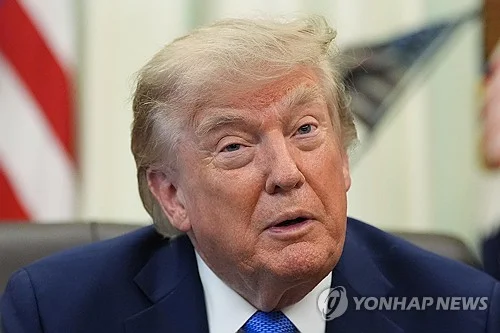
WASHINGTON, Aug. 6 (Yonhap) -- U.S. President Donald Trump on Thursday signed a proclamation to impose a 15 percent tariff on polysilicon derivative products, a move that his aide said is intended to protect America's polysilicon manufacturing, which is crucial for semiconductor production.
The tariff action will take effect 120 days after the signing, the White House said, as South Korea's semiconductor industry has been closely watching the Trump administration's trade policy for a potential impact on its business activities in the United States.
The proclamation came as the U.S. is stepping up efforts to maintain its technological edge amid intensifying competition with China over cutting-edge technologies, including artificial intelligence (AI).
Aside from the tariff, the proclamation includes the imposition of minimum import prices for imported polysilicon and polysilicon derivatives, which will be US$21 per kilogram for polysilicon, $100 per kg for polysilicon ingots and wafers; $0.22 per watt for solar cells; and $0.38 per watt for solar modules.
The minimum price program is meant to "create a level playing field for American producers of these strategic goods," the White House explained.
Trump took the latest tariff action under Section 232 of the Trade Expansion Act of 1962 -- a law that gives the president authority to adjust imports when he determines they threaten to impair national security.
"This is a series of trade and tariff actions under Section 232, intended to ensure that domestic polysilicon manufacturing is properly supported and protected from overseas dumping and offshore threats," White House Staff Secretary William Scharf said of the executive order as Trump was preparing to sign the document.
"Like many of your previous trade actions, this is intended to ensure that we're onshoring manufacturing capacity, that we're onshoring our own supply of critical products, and that we're protecting American industry from malign foreign actors in that space," he added.
Commerce Secretary Howard Lutnick noted that polysilicon is a "foundational" product that is used to make silicon wafers for AI chips.
"We're making the products here, but we need the supply chain here," he said. "So this will bring the supply chain here. We're setting prices so that the Chinese can't dump anymore, and we're setting tariffs to say (you) build it here."
sshluck@yna.co.kr
(END)
- Galaxy Z series logs 1.44 mln preorders in S. Korea, highest on record
- U.S. Marines stage live-fire drills involving FPV drones for 1st time in S. Korea
- Singer-actor Cha Eun-woo files appeal after paying 13 bln won in taxes
- (2nd LD) Temperatures soar to record 42.5 C in southeast
-
Navy's ROKS Daejeon awarded 'top gun' honor at RIMPAC
-
U.S. Marines stage live-fire drills involving FPV drones for 1st time in S. Korea
- (LEAD) Police raid Starbucks Korea over controversial promotional event
- Singer-actor Cha Eun-woo files appeal after paying 13 bln won in taxes
- Navy's ROKS Daejeon awarded 'top gun' honor at RIMPAC
-
(3rd LD) Temperatures soar to record 42.5 C in southeast
-
U.S. Marines stage live-fire drills involving FPV drones for 1st time in S. Korea
- (3rd LD) N. Korea fires short-range ballistic missile toward East Sea: military
- (LEAD) Lee cites coup risk from Army elite, calls for swift integration of military academies
- S. Korea's Danuri orbiter successfully films moon collision of SpaceX rocket
- (LEAD) S. Korea posts record-high current account surplus again in June on strong chip exports