The evolution of life is an incredibly improbable event, and as far as we know, it’s only happened once in our solar system—or so we thought. According to a new paper published in Science Advances life has actually evolved twice, right here on Earth.
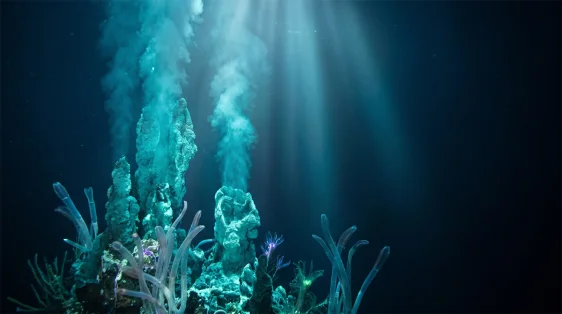
Before life existed on our planet, the areas around hydrothermal vents in the ocean created the kind of primordial soup conducive to its evolution. But how did life emerge from the muck? To find out, an international team of researchers led by scientists from Heinrich-Heine University in Germany investigated the origins of the suite of chemical reactions life uses to, well, exist.
One “non-negotiable property of life,” the authors write, is our metabolism, the more than 400 complex chemical reactions organisms use to convert energy in a usable form. So to trace the origins of life, they traced the evolution of the enzymes responsible for those reactions back in time.
The genes for these enzymes are highly conserved (meaning unchanged) until you get to a certain point: the split between bacteria and archaea. While archaea are single-celled prokaryotes like bacteria, they differ enough from both bacteria and the rest of life to warrant their very own domain. They also inhabit some of the most extreme environments on Earth (including our guts).
Read more: “High on Ayahuasca, Bruce Damer Saw How Life on Earth Began. He May Very Well Be Right”
“The surprise is that the enzymes that catalyse those reactions aren’t conserved across the evolutionary divide that separates bacteria and archaea,” study co-author William Martin of Heinrich-Heine University said in a statement. “We found that the last universal ancestor of all cells, LUCA, possessed enzymes for only about half of the reactions of metabolism.”
How then did the LUCA metabolize energy?
According to the team, the rest of its metabolic enzymes weren’t enzymes at all. Instead, LUCA used transition metals littered around hydrothermal vents to serve the same catalytic process. “The closer we look, the more clearly we can see that early biochemical evolution was a hybrid of enzymatic and metal catalysts,” explained study co-author Joseph Moran from the University of Ottawa.
That means whatever existed before LUCA relied entirely on metals to harness energy.
As they transitioned from leaning on their environments to metabolize energy to become more self-sufficient, bacteria and archaea each evolved their own new enzymes to replace the metals in these reactions. “The new data leave only one conclusion,” Martin said. “The bacteria and archaeal lineages made the transition to the free-living state independently. Only free-living cells are alive. Let’s call it by name: We are looking at one origin of the genetic code, but two origins of life.”
After all, the evolution of life may be an improbable event, but if the conditions are ripe for it to happen once, why not twice?
Lead image: Dilsara / Adobe Stock