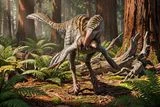
Recent research has helped solve a 73-million-year-old mystery and revealed a new genus of dinosaur found in present-day New Mexico.
The new study, published in Fossil Studies, highlights the diversity of predatory dinosaurs that lived in the Southwest during the Late Cretaceous period. Paleontologists first uncovered a partial skull fragment of what they believed to be the dromaeosaurid Saurornitholestes in 2005. Now, more than two decades later, a reanalysis of the fossil has determined that the species belongs to an entirely new genus.
The study authors have named the dinosaur Dinevenator robustus, and it falls into the newly recognized genus of troodontid dinosaurs. The new findings are helping researchers gain a better understanding of what life was like in prehistoric New Mexico.
Read More: What a Tyrannosaurus Rex Skull Tells Us About Its Intelligence
Who Was *Dinevenator robustus? *
The fossil is a nearly complete left frontal, a bone that forms part of the skull. From what researchers can tell, these dinosaurs were small and bird-like predators that likely had larger brains and sharp senses. Once the reanalysis was complete, the research team noted that the dinosaur had unusually thick and robust skull bones, which determined that D. robustus was distinct from other troodontid dinosaurs and warranted its own genus.
The team also ran a phylogenetic analysis of troodontid relationships and found that D. robustus came from a lineage of thicker and more robust-skulled troodontids. Some of its closest relatives included Albertavenator curriei, which once lived in Canada, and Xenovenator espinosai, which lived in prehistoric Mexico.
According to the study, D. robustus is the most basal member of the subgroup. This offers fresh insights into troodontid evolution and geographical distribution in the North American West.
“This really helps us get a clearer picture of the diversity in this family of dinosaurs during the Late Cretaceous in North America, and it adds to our knowledge of dinosaurs that once roamed New Mexico,” said New Mexico Museum of Natural History & Science (NMMNHS) Paleontology Curator Steven E. Jasinski in a press release.
Evidence of Distinct Populations
The study authors also note that these findings add to a growing body of evidence about dinosaur evolution on the ancient continent of Laramidia — an island continent that covered much of what is now western North America during the Late Cretaceous.
This research states that dinosaur fauna that lived on this continent evolved into distinct species. Identifying D. robustus as part of a separate genus helps increase the known predator diversity in this area and sheds light on the idea that New Mexico was once home to communities of unique dinosaurs.
“This new work illustrates the dynamic nature of dinosaur studies as we continue to test what we think we know,” said NMMNHS Executive Director Anthony Fiorillo in the press release. “Furthermore, it demonstrates that New Mexico clearly has a prominent place in those global conversations.”
Where Does the Name Come From?
In 2005, researchers unearthed the fossil in the De-na-zin Member of the Kirtland Formation in northwestern New Mexico. This area is a well-known fossil hotspot for Late Cretaceous dinosaurs.
After determining that this dinosaur was from a new genus, the research team decided to name it Dinevenator, which combines the Navajo word Diné, which references the Navajo people, and the Latin word meaning hunter.
Article Sources
Our writers at Discovermagazine.com use peer-reviewed studies and high-quality sources for our articles, and our editors review for scientific accuracy and editorial standards. Review the sources used below for this article:
- This article references information from a study published in Fossil Studies: Dinevenator, a New Genus of Troodontid Dinosaur from the Late Cretaceous of New Mexico