A secret sambal recipe and the ex-offender who must win a hawker’s trust as her apprentice
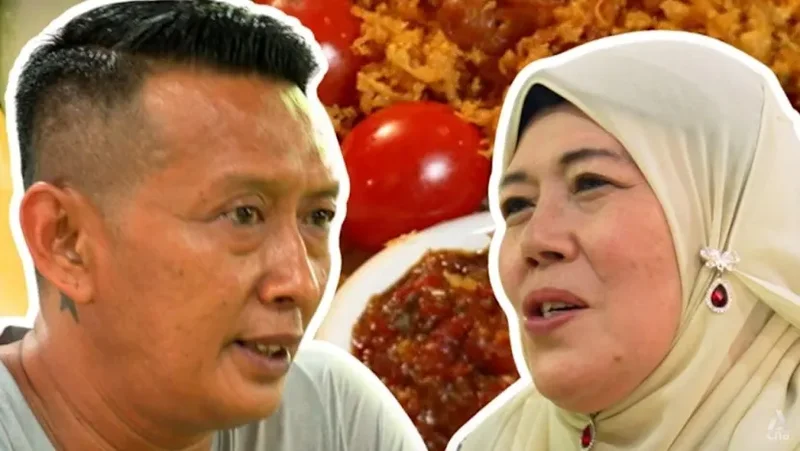
Roziah Adon spent decades honing her craft, including a sambal recipe she had never shared. Then she met Shaly Farid. CNA’s The Hawker Apprentice explores what it takes to carry on a culinary legacy while rebuilding a life after prison.
SINGAPORE: Three weeks into his hawker apprenticeship, Shaly Farid put down his knife and walked out of Bedok Food Centre.
He had been told to fry 150kg of chicken that day. Another staff member at Nur Indah Kitchen was absent, while its stream of customers was not letting up.
In the chaos of cooking and serving, his chronic anxiety problem — heightened by his past incarceration in a single-inmate cell — got to him.
“I came here to train, Hajjah,” he told his mentor, 66-year-old hawker Roziah Adon. “I didn’t come here to work.”
Then he left, and Roziah stood stunned. “This is the first trainee I’ve had … that’s got this problem,” said the hawker, who has mentored more than 10 apprentices over the years.
Shaly eventually returned to training, but the challenges of learning the trade and reintegration into society remained. He was an ex-offender who needed to hold down a job, while Roziah was a veteran hawker who had no successor.
Could she entrust a stranger with recipes and techniques honed over decades, with no guarantee he will take the craft forwards? Would he even appreciate learning the secret of her sambal, which she had never shared with anyone before?
They are one of three pairs in The Hawker Apprentice, a series that looks at what it takes to be a hawker as well as to rebuild a life after prison, with more than just moments of anxiety to navigate.
“EX-CONVICT, HE’S ALSO A HUMAN”
Shaly was 17 the first time he was incarcerated. Now 50, he has spent about half his life in prison. His convictions included rioting, causing grievous hurt with a dangerous weapon and drug consumption.
WATCH PART 1: “I’ve never done anything legitimate” — Ex-convicts face the wok (45:00)
After he was released for the ninth time, in May 2023, he accepted jobs at a hotel and a restaurant. They did not last.
“I couldn’t get along with (others),” he said, putting this down to being housed in a single-inmate cell for more than a year. “I’ve got this anxiety, so I can’t work with people.”
Since he could cook, his partner, Ayu Suparman, suggested he open a food stall instead. In September 2024, Shaly opened Parut, a nasi lemak stall at Amoy Street Food Centre.
“Every month … I’m losing S$1,000 to S$1,500,” he disclosed. “I chose to become a hawker, but I don’t know how to run a business.”
Still, he never considered giving up. “I (already) wasted a lot of my youth (going) in and out … (of) prison,” he said. “I hope I can provide (for) my family. … I’ve never made my family proud before.”
To learn how to run his stall properly, he decided it would be a “good idea” to serve an apprenticeship.
His mentor, Roziah, with 42 years’ experience, sells nasi ayam penyet and roasted chicken rice. As her children were not interested in taking over the business, she started mentoring others.
“Whoever wants to learn, if they’re really interested and they have the passion, I want to mentor (them),” she said. “Regardless (of whether) he’s an ex-convict (or) Yellow Ribbon (beneficiary), I’m okay with that. Ex-convict, he is also a human.”
MORE THAN JUST COOKING
Roziah met Shaly for the first time in June, when she visited his stall to better understand the issues he was facing with his business.
His main difficulty lay in drawing customers. Operating in the central business district meant office crowds that thinned out not only at weekends but during school holidays, festive periods and even when it rained, he said.
“I think I want to close this stall,” he added. “I need a stall that I can (run) from morning till night.”
Roziah’s expert eye could see that a change of location was not enough.
She suggested he sell a wider variety of dishes, offering to teach him her best-selling ayam penyet and help him with marketing, “like buying all the ingredients”, and with suppliers.
She would do so on one condition. “You must do whatever I teach you,” she said, to which he replied: “I’m willing to learn.”
His training did not begin with cooking, though, but with plating. For customers to have an appetite, the dish must be “colourful”, for example with tomatoes and the chicken looking fresh, she said. “That’s the importance of the presentation.”
As his training progressed, the days started earlier: 3am, which was normal for her. She wanted to teach him the preparation from the start, including marinating the chicken and cooking the soup and rice.
The work was demanding. One day, he stood for “almost three hours” straight, frying chicken. But when asked how it went, he said: “My shift was great. I managed to complete my task.”
Initially, Roziah worried that Shaly was “a bit slow”, but he “managed to catch up”. With his food and beverage background, he needed to learn something only once before mastering it. “Everything I teach him, he can memorise,” she said.
So, when he walked out after three weeks, she was “quite disappointed”. But she did not end their apprenticeship. “I hope that he’ll come back," she said. “It’s wasted (effort) if he doesn’t finish (learning).”
WATCH PART 2: Late for training — Can this ex-offender win back mentor’s trust? (46:57)
He returned a few days later and apologised, saying that he had not taken his medicine for his chronic anxiety that day. When “people looked at me (and) smiled or laughed, I thought they (were) talking about me”, he said.
Asked how he copes with his anxiety, he replied: “Actually, I can control myself. … I pray.”
Roziah encouraged him to also take his medication before starting work. And with that, training resumed. According to her, they had completed 70 per cent of the programme and were “just a few steps away” from the end.
“I’m happy he wants to come back,” she said.
SIGNATURE SAMBAL, SPECIAL SHALY
After mastering the basics, Shaly asked for the one recipe Roziah had not shown him. “I’ve almost learnt everything,” he said. “But when (do) you want to teach me your sambal?”
She began creating the recipe in 2003, after going to a “famous ayam penyet stall” in Batam to learn to make its sambal. The recipe she brought back, however, did not really suit Singaporean tastes, she thought.
So she changed the method of preparation: frying instead of boiling. “When you boil, it’s not really fragrant,” she said. She also added her own “secret ingredients”, making it “13 ingredients all in”.
“That’s (how) I ended up with my Nur Indah sambal penyet,” she recounted.
She had never taught anyone her sambal and refused Shaly’s request initially. “This (is) my signature sambal,” she told him. “My husband already told me … I can teach you (everything) except the sambal.”
Undeterred by the rejection, he kept up his hard work in training. And to Roziah’s mind, she saw “something different” in him. “He really wants to start anew,” she said. “So why not?”
She raised the issue for her husband, Sakuwan Jumangin, to consider. “You must think twice because this is our signature chilli,” he cautioned, asking her if teaching Shaly the recipe would be “worth it or not”.
After three days of her persuasion, her husband relented. She could finally reveal her secret ingredients. “Only (you) can know. Special,” she told Shaly.
He was “touched” and grateful. “Teaching some secret recipe is something unbelievable,” he said. “I feel like, alamak, someone trusted me.”
Once he had learnt to cook it, Roziah asked if it was like her sambal. “Yah,” he replied after tasting it. “The (spiciness is) all (on) my lips.”
THE RIGHT TO CARRY HER NAME
His apprenticeship ended with a final taste test, judged by Roziah, food blogger Leslie Tay, food writer Annette Tan and second-generation hawker Melvin Chew.
It was not only a test of skills for Shaly. At stake was also the right to use his mentor’s name, which Chew called a “very sensitive” process.
“You’re not just taking on a recipe,” Tan elaborated. “You’re taking on the reputation of the stall, the reputation of the person who taught you the recipe.”
Shaly’s sambal was the “most important” concern for Roziah. “Let’s say the taste and the quality aren’t there,” she said. “(Then) he can’t use my name on his stall.”
On the day itself, Shaly was up at 3am to get prepared. “He’s putting all his effort (into it),” observed Ayu.
To manage his anxiety, he tried to “relax” and “cook as per normal”. He said: “If I think about (the fact that) I’m cooking for the judges, then everything will be spoiled.”
The verdict? His nasi ayam penyet — consisting of chicken, rice, soup, sambal penyet, tofu, tempeh, vegetables and kremes (spiced fried crumbs) — received mixed reviews.
WATCH PART 3: 6 weeks later — Are these ex-offenders ready to be hawkers? (46:20)
The judges said the chicken was “nice and juicy” but “a little bit under-seasoned inside” and could have been “marinated a bit more”. The star of the meal, however, was the “addictive” and “damn shiok” sambal.
“This sambal is the winner. This is the secret of the whole thing,” Tay said. Chew added: “If you sell this in the hawker centre, I’ll ‘hantam’ (devour) it.”
As for Roziah, she called the sambal “perfect” and said: “The taste is similar (to) what I taught you.”
All four judges passed him, with Tay saying that he was “definitely hawker-ready”.
Then came the words he had been waiting for as Roziah thanked him for doing her proud with his cooking and said: “I’ll (allow) you to carry on my name at your stall.”
When he later collected the new signage for his stall, which included a line crediting his mentor — “Ayam penyet mentored by Hajjah Roziah Adon of Nur Indah Kitchen” — it was quite a moment for him.
“She never taught (other) people about her sambal. Just me,” said a “very touched” Shaly after seeing her name and an image of her sambal on the sign.
Now he will turn his attention to finding a new business location.
“Insya Allah (God willing), I’ll try to find the stalI (that) I dream of,” said Shaly, who sells Roziah’s ayam penyet every Saturday at his Amoy Street stall and hopes to “carry on her legacy”.
Watch the stories of the three ex-offenders and their mentors in The Hawker Apprentice here: Part 1, Part 2 and Part 3.