Commentary: US has crossed an uncomfortable threshold in global opinion
China is now viewed more positively than the US in many countries. Reversing this will be harder than Washington thinks, says Kevin Chen from the S Rajaratnam School of International Studies.
SINGAPORE: For years, the United States was clearly favoured over China in global opinion surveys. That is no longer the case.
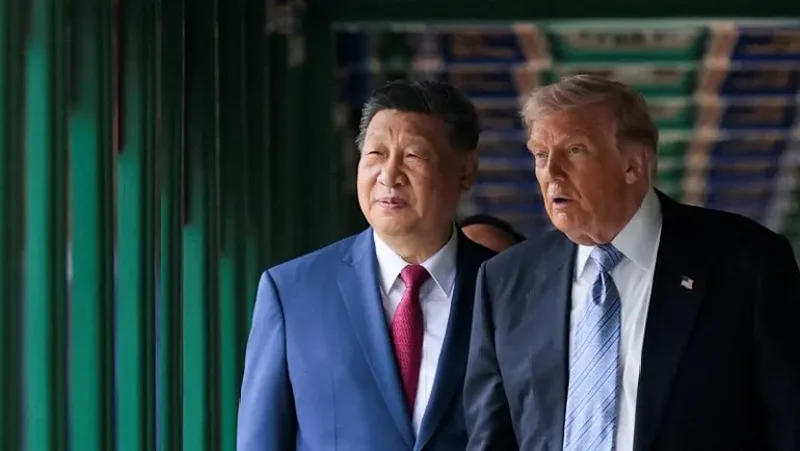
For the first time since the Pew Research Center began its annual Global Attitudes Survey in 2002, it found that China is now seen more positively than the US by the general public across surveyed countries. In the Spring 2026 survey, 46 per cent of respondents had a favourable opinion of China compared to 36 per cent for the US.
Furthermore, fewer respondents had confidence that US President Donald Trump (21 per cent) would “do the right thing regarding world affairs” compared to Chinese President Xi Jinping (31 per cent).
This shift confirms a trend among Southeast Asian policy and business elites. In the 2026 State of Southeast Asia survey by the ISEAS Yusof-Ishak Institute, a slim majority of respondents chose China (52 per cent) over the US (48 per cent) if they were forced to align itself with either of the two strategic rivals.
Both Mr Trump’s disruptive policies and China’s own successes in promoting its soft power and influence likely played a role in this reversal.
But two assumptions deserve closer scrutiny: that those who continue to engage Washington accept its volatility and that America’s standing will recover once a new president assumes office.
DO NOT MISTAKE ENGAGEMENT FOR ACCEPTANCE
Despite declining favourability, Southeast Asian governments continue engaging Washington in pragmatic ways. But the US would be wrong to assume that the region is willing to permanently accept American volatility.
Whether it involves Singapore and the Philippines joining the US-led Pax Silica or Indonesia signing a Major Defence Cooperation Partnership, the region is far from shunning Washington.
One analyst argued that this eagerness stems from the challenges posed by China. Following this realist line of argument, US partners in Asia see the necessity of continuing to engage America as a vital security partner, regardless of the White House’s occupant.
Yet, it is vital to not misinterpret the permanence of this engagement. Southeast Asian governments may be engaging Washington out of a lack of better options, but they are doing so while hedging their bets.
From the Philippines signing defence pacts with Japan and working with Australia to build infrastructure projects in Luzon, to Singapore establishing agreements on supply chain resilience with New Zealand and Australia, countries in the region are busy finding new partners and means of cooperation.
For now, these efforts complement US interests. But at some point, as the region moves away towards a decentralised patchwork of bilateral and multilateral security arrangements, the US may find that it is less central to Asia’s strategic order.
DECLINE WILL NOT BE REVERSED WITH A NEW PRESIDENT
It is tempting to assume too that a change in president might reverse this decline in favourability.
After all, the 2021 Pew survey found that confidence in America sharply rebounded under former President Joe Biden after falling during the first Trump presidency, though this was restricted to a sample of 12 countries that were also polled in the 2020 survey.
Such a rebound appears less likely this time, because the damage extends beyond one president. The economic and diplomatic impacts of Mr Trump’s policies such as the Iran War will be felt over the long term, and traditional tools of American leadership and soft power have also weakened.
Higher education, for example, has long been one of America's greater soft power assets. But stricter immigration enforcement has contributed to a 20 per cent year-on-year drop in foreign student enrolment for the Spring 2026 semester, and this downturn may sharpen as new student visa restrictions come into force. Fewer international students may translate into less affinity and understanding of American cultural norms, presenting a challenge to US cultural influence.
Likewise, the Department of Government Efficiency (DOGE) demolished vital soft power tools such as the US Agency for International Development (USAID) and Voice of America that projected influence through foreign assistance and international broadcasting.
DOGE also cut nearly 400,000 federal jobs, though the US government has since embarked on a hiring drive. Such tools and institutions can be dismantled quickly, but it will take much more time to replace the institutional expertise and rebuild networks that were lost.
CHINA IS ALSO BECOMING MORE ATTRACTIVE
Even as Washington grapples with problems of its own making, Beijing has continued to strengthen its appeal.
China has had not just one technological breakthrough in recent months that stunned American rivals, but several. From landing a reusable rocket to producing AI models like Moonshot’s Kimi K3 that can rival top American alternatives at a fraction of the cost, China has shown an ability to innovate and compete that is not to be underestimated.
China is also doing well in the race for talent. More Chinese researchers and entrepreneurs choosing to return home, in what has been called a reverse brain drain. The story of Moonshot AI’s founder Yang Zhilin, who completed his PhD at Carnegie Mellon University but returned to China instead of accepting offers to work at US tech firms, is a timely example.
This does not mean that America is a spent force. Its economic, scientific and even military strengths continue to make it a partner of choice.
However, the fallout of Washington’s policies makes the US less attractive at a time when China’s clout is growing.
A subsequent US administration will inherit a policy and government environment in need of significant reforms. Simply repairing the damage will not be enough. The challenge for Washington will be to convince partners, companies and talent that it is once again dependable.
Kevin Chen is an Associate Research Fellow with the US Programme at the S Rajaratnam School of International Studies (RSIS), Nanyang Technological University (NTU), Singapore. He writes a monthly column for CNA, published every first Friday.