Charles Darwin finally proven right about bug-eating plant after 150 years
'I hope he'd be really excited and wanted to give us a big high five,' says botanist
LISTEN | Interview with botanist Douglas Soltis:Scientists have finally proven what Charles Darwin suspected more than a century ago — that a small, innocent-looking flowering plant is, in fact, a stone-cold killer.
"I hope he'd be really excited and wanted to give us a big high five or two thumbs up," University of Florida botanist Douglas Soltis told As It Happens guest host Rebecca Zandbergen. "I'm imagining him smiling right now."
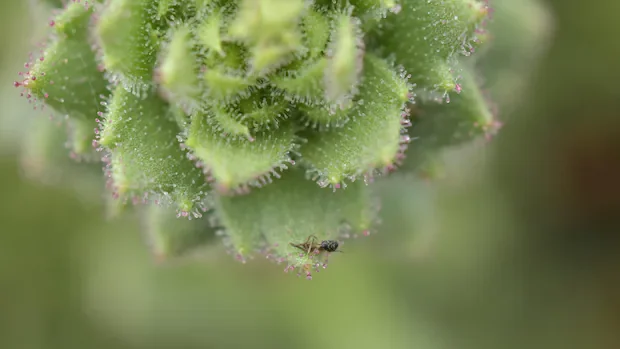
Soltis is one of the authors of a new study that identifies Saxifraga candelabrum, which grows in the rocky mountain crevices of southwestern China, as a carnivorous plant that uses its sticky little hairs to trap and devour unsuspecting insects.
The findings, published Tuesday in the journal Nature Communications, come 151 years after Darwin first theorized that predators lurked among the Saxifraga genus.
Hairy and scary
Many Saxifraga species, including the one researched in this study, are covered in millimetre-long hairs, the tips of which produce a sweet, sticky substance that lures insects in with its scent.
"You'll just see insects plastered to the leaves and stems of these plants. And so it just makes you wonder: What are they doing with all those insects?" Soltis said. "That is what fascinated Darwin."
Darwin, an English naturalist known for his contributions to evolutionary biology, first wrote his musings about Saxifraga plants in 1875 when he observed tiny insects stuck to leaves and stems of two European varieties.
But he had no way to prove the plants were carnivorous. To do that, Soltis says, you have to demonstrate that the plant can digest the insects it traps, absorb their materials, and distribute those materials throughout its body.
Unfortunately for Darwin, it's not the kind of thing you can just see happening in a field in 1875. But fortunately for Soltis and his colleagues, it is something you can observe in a modern laboratory.
"You can have an insect eat a radioactively labelled substance [in] very small, tiny, tiny amounts," Soltis said. "And then you can actually — much as you would do in medicine — trace where those materials are flowing throughout the plant."
An evolutionary advantage
To determine whether it was actually feeding on insects, the researchers used fruit flies raised on food enriched with a stable form of nitrogen.
Nitrogen, says Soltis, is what the nutrient-starved mountain plants are after.
"They're not eating for the same reason that we are. They don't need carbon. They're able to make that," he said. "But they really need nitrogen."
In fact, most carnivorous plants are found in bogs and wetlands, where the watery and acidic soil is nutrient-poor, says Peter Ryser, a plant ecologist at Laurentian University in Sudbury, Ont., who was not involved in the study.
He says it's possible, from an evolutionary standpoint, that Saxifraga candelabrum and other similar plants first developed sticky hairs to keep bugs from eating their seeds, then seized on an unexpected opportunity.
"Eventually they notice, 'Hey, if there are some nice insects which get stuck, and if we exude some enzymes, then we can also get the nutrients out of them,'" he said.
- Common B.C. flower is actually a carnivorous bug eater
- Pitcher plants discovered snacking on baby salamanders in Ontario park
But there is a conundrum. Plants need nutrients, but they also need pollinators. Saxifraga candelabrum has a solution for that.
"They trap a smaller type of insect, and then larger insects that are the pollinator are not really affected by these hairs," Soltis said.
More killers in our midst?
The researchers say this study shows there may be more carnivorous plants out there hiding in plain sight, including among Darwin's beloved Saxifraga genus.
Five years ago, researchers at the University of British Columbia discovered that a plant in B.C.'s Cypress Provincial Park uses a similar method of trapping and eating insects as Saxifraga candelabrum.
"At the time, we predicted that additional examples of carnivory would be discovered, and so it was really gratifying to read this paper and see our predictions coming true," UBC botanist Sean Graham told CBC in an email.
"I'm sure there are other examples of plant carnivory out there, waiting for discovery."
According to the U.K.'s Natural History museum, there are more than 630 known carnivorous plants in the world.
Some, like Venus flytraps, snap their jaw-like leaves shut to imprison insects. Others, like pitcher plants, lure prey with a sweet nectar, only to drown them in a digestive fluid.
Their taste for flesh can even extend beyond the bug world. One pitcher plant in Ontario has been known to snack on salamanders.
It's no wonder Darwin had a well-documented obsession with carnivorous plants, Soltis said.
"Plants have invented incredible ways to trap insects for nitrates," he said. "It's amazing to think of, you know, plants kind of turning the tables"
Interview with Douglas Soltis produced by Livia Dyring. With files from Reuters