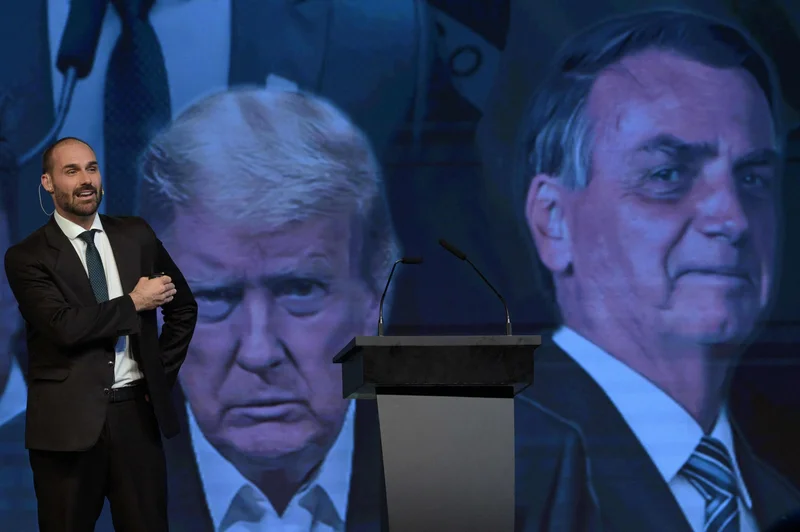
Eduardo Bolsonaro Urges Trump to ‘Attack’ Brazil
Politics & Society: Brasília
Eduardo Bolsonaro used an English-language video posted to X on Thursday to call on Donald Trump to ‘attack’ Brazil and to see Lula arrested. The appeal lands in a dispute that now runs through tariffs, a divided Supreme Court and an election two months away.
What Eduardo Bolsonaro Said, and Where
The video was published on Eduardo Bolsonaro’s own X account late on Thursday morning, 6 August 2026, and was recorded in English as what he called an alert to the international community. He said that ‘Lula is following the steps of Maduro,’ a reference to the former Venezuelan leader Nicolás Maduro, who has been held in United States custody since January.
He closed with a line pointing at the Brazilian president: the last time someone tried to follow those steps, he said, ‘he ended up arrested in New York.’ The remarks were made by a Brazilian politician, in English, addressed to a foreign head of state, about his own country’s sitting president.
Because the video comes from his own account, its authenticity is not in question. That sets it apart from the AI-generated video of his father that Brazil’s electoral court opened an inquiry into in July.
The claims in the video vary in how far they can be checked, and are set out one by one below. Some rest on documented events, others are contested, and at least one rests on a description that the public record does not support.
The Two Diplomats and the Denied Visas
Eduardo Bolsonaro devoted part of the video to Riley M. Barnes and Samuel Samson of the State Department’s Bureau of Democracy, Human Rights and Labor. Barnes is the assistant secretary who heads the bureau.
The two requested Brazilian visas on 20 July and were refused on 24 July. Eduardo Bolsonaro described them in the video as ‘second-tier’ officials on a routine trip.
‘All countries send their authorities to other democracies as observers, to see how elections are going and certify that everything is running well,’ he said. He argued that Lula’s government had blocked them without cause.
Brazil’s foreign ministry gave a different account. It said a visit on the eve of a presidential election risked being used to cast doubt on the electronic voting system, and the Washington Post reported the mission had been pushed by Trump and Secretary of State Marco Rubio.
Refusing entry to foreign officials is a recognised, if uncommon, diplomatic instrument. It is generally read as a signal rather than an administrative detail.
The Russia Claim, and What the Record Shows
The video also linked Brazil to Russia, and here the underlying event is documented. Eduardo Bolsonaro said ‘Putin’s right-hand man, the number two of Russia,’ was in Brazil discussing military cooperation.
A senior Russian visit did take place that week. Nikolai Patrushev, a presidential aide to Vladimir Putin and chairman of Russia’s Maritime Board, was in Brasília from 3 August for talks that included naval and defence cooperation, meeting Lula, Defence Minister José Múcio and the navy commander.
The description is where his account departs from the record. Patrushev is a presidential aide and Maritime Board chairman, not Russia’s number two, and Revista Fórum itself reported the visit two days before the video appeared.
He went on to place Brazil alongside Iran, Maduro’s Venezuela and Daniel Ortega’s Nicaragua, and questioned why any government would sign a defence agreement with an administration he called finished. Fórum described that wider framing as a conspiracy theory; the alignment claim is his characterisation rather than a documented position.
The Ballot-Integrity Claim
Brazil’s electronic voting system has been repeatedly audited and defended by the country’s electoral authorities. The machines are subject to public testing and to scrutiny from parties, prosecutors and other institutions, and no fraud capable of changing a national result has been demonstrated in any formal proceeding.
Bolsonaro allies continue to dispute that record. In July, Flávio Bolsonaro linked the machines to Venezuela and to the vendor Smartmatic, a claim the electoral court publicly rebutted.
Electoral administration in Brazil is the responsibility of the electoral courts, which run their own audits and publish the results. The government’s stated reason for refusing the two US visas was that outside scrutiny on the eve of the vote would cut across that framework.
What He Said About the October Election
Eduardo Bolsonaro said what was really at risk was that ‘the international community, for the first time, might not recognise a Brazilian election.’ He tied that to the prospect of his brother Flávio being defeated in October.
Fórum read the passage as signalling that he would support US-backed action if the polls were confirmed. He did not use those words in the section quoted, and the reading is the outlet’s.
The polling gives the exchange its charge. Our July reference guide to the race put Lula on 39% and Flávio Bolsonaro on 33%, and more recent surveys suggest a tighter contest.
The family context is part of why the remarks carry weight in Brasília. His father was convicted over a plot to overturn the 2022 election and remains under court-ordered house arrest, while a second son discusses the terms on which an October result might be rejected abroad.
Why Eduardo Bolsonaro Is in the United States
Eduardo Bolsonaro has lived in the United States since early 2025, when he took leave and left Brazil to seek Donald Trump’s support against the criminal case then being prepared against his father. He has said he fears arrest if he returns.
His status there is now settled. Washington granted him permanent residency on 20 July 2026 under the EB-1A ‘extraordinary ability’ category, a decision he confirmed to Reuters and one that set off a diplomatic row with Brasília.
He lost his seat in the Chamber of Deputies on separate grounds. The Chamber’s directing board declared the mandate forfeit in December 2025 because he had missed more than a third of deliberative sessions, under Article 55 of the Constitution, a measure that did not by itself suspend his political rights.
He describes his lobbying as a defence of his family against political persecution. The Supreme Court, in convicting him, treated the same conduct as an attempt to coerce a court.
The Tariffs and the Claim of Credit
Eduardo Bolsonaro has claimed credit for pushing Washington to impose tariffs on Brazil. The current picture is more layered than that claim suggests, and it has changed over the past year.
Two measures are in force. A 25% tariff took effect on 22 July under Section 301 of the US Trade Act, and a separate 12.5% duty tied to forced-labour allegations applies alongside it, as our reporting on the day it took effect and Brazil’s WTO complaint against both layers set out.
Goods caught by both now face up to 37.5%. Brazil’s development ministry calculates that band covers about 16.5% of exports to the United States, worth some US$6.6 billion, with a further slice touched by one measure but not the other.
The reach is significant but far from total. Washington excluded more than 2,100 Brazilian products after public hearings, among them coffee, beef, oranges, orange juice and aircraft parts.
The 40% duty imposed in 2025 under emergency powers was not revived when Trump renewed the national emergency in July. That distinction matters for the credit claim, because the 2025 measures were expressly linked to his father’s trial while the 2026 tariffs rest on trade grounds, including Pix, digital commerce, ethanol market access and deforestation.
Economists differ on who ultimately pays. Brazilian exporters lose competitiveness in a major market, US importers and consumers absorb part of the increase, and it is the exporter side that Lula has put at the centre of his argument.
The Supreme Court Conviction, and Its Critics
The First Panel of the Supreme Court convicted Eduardo Bolsonaro on 16 June 2026 of coercion in the course of proceedings, sentencing him to four years and two months in an initial semi-open regime. The decision was unanimous among the panel’s justices.
Prosecutors built the case on his public statements and social media posts claiming credit for efforts to have the United States sanction Brazilian authorities and impose economic measures on the country. The conviction also carries a period of ineligibility for public office.
His defence and his allies reject the ruling. He has said he was not properly notified through international channels, has described the case as political persecution, and argues that punishing speech made abroad is itself an abuse.
That objection sits inside a wider and genuinely contested record. Our archive has documented the strain the court’s approach has placed on Brazilian institutions, alongside censorship concerns raised by moves against conservative broadcasters.
The Contested Case Against His Father
The Supreme Court found on 11 September 2025 that Jair Bolsonaro had led a plot to overturn the 2022 election, sentencing him to 27 years and three months. He began serving in late November 2025 after the court rejected his appeal, was moved to a military police battalion in January 2026, and has been under humanitarian house arrest since March 2026 following treatment for bacterial pneumonia.
Moraes extended that house arrest on 3 July 2026 without setting an end date, calling it reasonable and proportionate, and maintained it later in the month. The conviction itself is documented and is not seriously disputed as a matter of record.
The objections concern how it was reached, and they were raised inside the court itself. The case was decided by a five-justice panel rather than the full court, and Justice Alexandre de Moraes served as rapporteur while himself an alleged target of the plot.
Justice Luiz Fux dissented. He argued the Supreme Court lacked competence to try the case at all and rejected the finding that the events amounted to an attempted coup, a position he has since defended publicly against criticism from foreign legal scholars.
The dispute also drew foreign sanctions. Washington designated Moraes in July 2025 and extended the measures to his family’s business interests that September, then lifted them in December as relations briefly thawed.
Separately, our reporting has covered allegations touching Moraes directly, including the Banco Master affair. Nothing there has been resolved against him, and none of it displaces the conviction; both belong in the record.
Congress Voted to Cut the Sentence. One Justice Suspended It.
The sharpest institutional fight has been over the sentence itself. Congress passed a law recalculating penalties for crimes against the democratic order, which our reporting at the time put at around 22 years for Bolsonaro, with the bill’s rapporteur estimating time in closed regime would fall from nearly seven years to two years and four months.
Lula vetoed the bill in full in January 2026. Congress overrode the veto on 30 April, and the law was promulgated on 8 May.
The next day Moraes suspended it, pending a ruling by the full court. It remains suspended, so an act of the elected legislature is being held in abeyance by the same court that handed down the sentence.
Supporters of the court point to public opinion. Polling we reported in October 2025 found most Brazilians opposed amnesty or reduced sentences for those convicted over 8 January.
Moraes has also restricted access to Bolsonaro, barring all visits for 30 days in July, blocking Flávio from seeing his father and, in March 2026, refusing a Trump envoy access to him in custody.
The two readings run in parallel. His supporters call the restrictions punitive and say the courts are managing a political opponent; the court has framed them as necessary to stop the case being worked politically from inside custody.
Lula’s Position and the Stakes for Brazil-US Relations
Lula has already answered this line of attack, though not this video. Speaking to Reuters in August 2025, when the first tariffs took effect, he said Eduardo Bolsonaro should ‘face more legal proceedings because of what he is doing, inciting the United States against Brazil, causing harm to the Brazilian economy, causing harm to Brazilian workers.’
He said then that there was ‘no precedent in history’ for a president’s son and sitting congressman to go to the United States to incite its president against Brazil, and called the Bolsonaros ‘traitors to the homeland.’ The words moved the dispute from policy to allegiance, and the government has not softened that position since.
By framing tariffs as harm to Brazilian workers, Lula ties a diplomatic quarrel to jobs and incomes. That is the terrain on which an election is fought.
What follows will be shaped by two things: the court-ordered house arrest of Jair Bolsonaro and the October election in which Flávio Bolsonaro is a candidate. Relations between Brasília and Washington now carry tariffs of up to 37.5% and a public argument over the legitimacy of Brazil’s voting system.
For voters, the open question is whether a campaign conducted partly from abroad, and partly through the trade policy of another government, helps or harms the family running it.
Frequently Asked Questions
What exactly did Eduardo Bolsonaro say?
In an English-language video posted to his X account on the morning of 6 August 2026, he urged US President Donald Trump to ‘attack’ Brazil and said Lula is ‘following the steps of Maduro,’ closing with a reference to the Venezuelan leader ending up ‘arrested in New York.’ He also said a senior Russian official was in Brazil discussing military cooperation, and that the international community might not recognise the October election. The Russian visit did take place, though the official concerned is a presidential aide rather than Russia’s number two.
Who are Riley M. Barnes and Samuel Samson?
They are officials of the US State Department’s Bureau of Democracy, Human Rights and Labor, which Barnes heads as assistant secretary. They requested Brazilian visas on 20 July 2026 and were refused on 24 July. Eduardo Bolsonaro described the planned trip as routine election observation, while Brazil’s foreign ministry said it feared a visit on the eve of the election would be used to cast doubt on the voting system.
What tariffs does the United States currently apply to Brazil?
Two measures are in force. A 25% tariff under Section 301 took effect on 22 July 2026, and a separate 12.5% duty tied to forced-labour allegations applies alongside it, so goods caught by both face up to 37.5%. More than 2,100 products were excluded, including coffee, beef, oranges, orange juice and aircraft parts, and Brazil’s development ministry estimates about 16.5% of exports to the United States fall in the band hit by both. The 40% emergency duty imposed in 2025 was not revived when the national emergency was renewed in July 2026.
Has Eduardo Bolsonaro been convicted of anything?
Yes. The First Panel of Brazil’s Supreme Court convicted him on 16 June 2026 of coercion in the course of proceedings, sentencing him to four years and two months in an initial semi-open regime, over statements claiming credit for efforts to have Washington sanction Brazilian authorities. He rejects the ruling as political persecution and says he was not properly notified. He has lived in the United States since early 2025 and was granted US permanent residency in July 2026.
Where is Jair Bolsonaro now?
He was convicted on 11 September 2025 and sentenced to 27 years and three months. He began serving in late November 2025, was moved to a military police battalion in January 2026, and has been under humanitarian house arrest since March 2026 after treatment for bacterial pneumonia. Justice Alexandre de Moraes extended that arrangement on 3 July 2026 without setting an end date.
What happened to the law that would have cut his sentence?
Congress passed a law recalculating sentences for crimes against the democratic order, which would have reduced Bolsonaro’s term to about 22 years and sharply shortened his time in closed regime. Lula vetoed it in January 2026, Congress overrode the veto on 30 April and the law was promulgated on 8 May. Justice Moraes suspended it the following day, pending a ruling by the full court, so the original sentence still stands.
This article was drafted with automated assistance and reviewed before publication. How we use AI · Report an error