Women's Day is often marked by flowers, speeches and commemorations but for many women who have shaped the country's political, business and academic landscape, the day carries a far deeper significance.
It is a reminder of those who fought before them, an acknowledgement of the progress that has been made and a challenge to ensure that future generations inherit a society where equality is not aspirational but lived.
From boardrooms and universities to government and art galleries, these women reflect on leadership, resilience, justice and the respon sibility to continue creating spaces where women can thrive. Their perspectives reveal that while much has changed since the historic 1956 Women's March, the work of achieving true gender equality is far from complete.
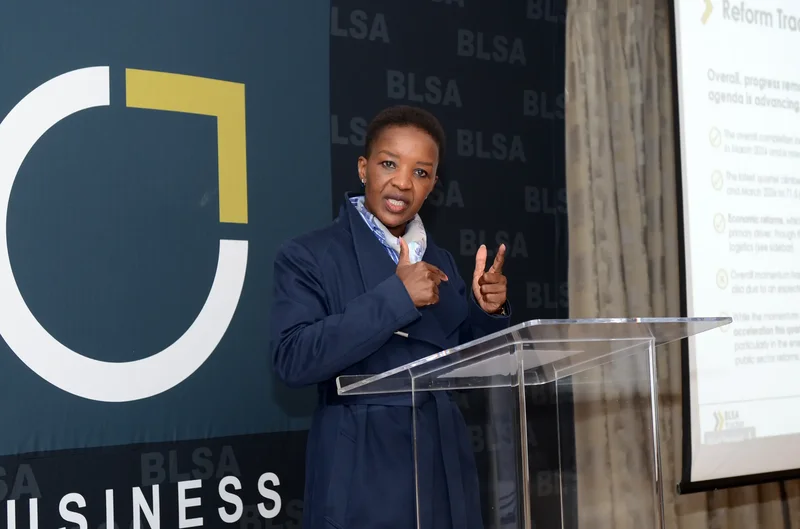
Busi Mavuso: CEO of Business Leadership South Africa
Mavuso said many women have had to navigate structures where they were underrepresented, underestimated or expected to adapt to leadership models that did not reflect who they were.
In her experience, she said, "women lead differently and it is precisely that difference that makes leadership teams stronger".
According to the Women in Business 2026 report, South Africa has 47.3% women in senior management, above the global average of 32.9%. The report notes that the country is approaching leadership parity as one of the few countries globally reporting no businesses with all-male senior management teams.
"Women often bring a more collaborative style of leadership, greater emotional intelligence, deeper listening, long-term relationship building and an ability to navigate complexity by connecting seemingly unrelated issues. These are often described as soft skills, yet in today's world of geopolitical uncertainty, organisational complexity and social division, soft is the new hard," said Mavuso.
At the same time, she added, the business sector should not underestimate the resilience women have developed by succeeding in environments that were never designed with us as top of mind.
"That journey builds resilience, adaptability and perspective. But it also comes at a cost. Women are judged more harshly, continue to earn less than men for comparable work and the World Economic Forum estimates that closing the gender pay gap will take well over a century if current trends continue. That should concern all of us," she said.
Mavuso said the modern challenge for women is not simply to increase the number of women around the table but subsequently create environments where women do not feel compelled to fit into moulds that were never designed to accommodate them.
Mavuso highlighted that leadership should not require women to suppress what makes them different: "In fact, it is often those differences that create the greatest value".
"As we celebrate Women's Month, I hope we move beyond seeing inclusion as a compliance exercise. It is an economic imperative.
"The future competitiveness of South African business will depend on whether we are prepared to draw on the full breadth of our country's talent.
"Women's leadership is not important despite being different. It is important because it is different," she said.
Lindiwe Zulu: former minister of social development
"When I compare my life to that of my grandmother, the differences are unbelievable. I always think of her as a domestic worker in Johannesburg during apartheid, working for white families without constitutional rights or the freedoms that would allow a woman to truly feel she belonged in society or in her community. Women were often seen only as people who gave birth to children and cared for them.
"I compare myself with my grandmother because, although her circumstances were very different, she understood that something was deeply wrong. She recognised the oppression, the racism and the injustice that shaped her life. While she may not have participated in political activism in the way that my generation did, she resisted in her own way. Her form of resistance was education. She made sure her children, including my father and his siblings, received an education. When my father died, I was only 11 years old and I did not have my mother to raise me. My grandmother stepped in and ensured that I, too, had the opportunity to be educated.
"She understood the importance of freedom. She understood the importance of education. And she understood that women should be empowered to be more than people who simply give birth and raise children. When I look at my grandmother's generation, then my father's generation, my own life, my children and now my grandchildren, I see an enormous difference.
"It is a difference that should be celebrated. It is a difference that we must protect and build on. Most importantly, it should become a strong and beautiful foundation for future generations."
Mary Metcalfe: professor of Practice at the University of Johannesburg's School of Public Management, Governance and Public Policy and a National Planning Commissioner
"The courage, leadership and organisation of the women who led and participated in the march to the Union Building in 1956 was remarkable given the repression of the time, the status of woman in urban areas and the discriminatory legislation that defined women as 'minors'.
"The march showed exceptional organisational capacity and political voice and demonstrated the 'unbreakable' strength of women. For this we must continue to honour all women who have acted for change. I resent the narrative the marketing and the floral memes that cast women's day in the language and imagery of softness that neglects the rock-like strength and ongoing struggle for gender justice."
Dr Nonkululeko Dladla: Developmental lecturer in Geological Sciences at UKZN
"We also need workplaces and universities that actively support women throughout their studies and careers, with opportunities for leadership, research funding and career progression," said Dr Nonkululeko Dladla, a developmental lecturer in geological sciences at the University of KwaZulu-Natal and the first black female South African to be awarded a PhD in marine geology.
"Inclusion isn't just about increasing numbers; it's about ensuring women have the support, recognition and opportunities they need to thrive."
Dr Same Mdluli: curator and manager of the Standard Bank Gallery
"While African societies have made great strides in recognising and acknowledging the role women play in all aspects of political, social and especially economic life, there is still work to be done in celebrating women's cultural, creative and intellectual contribution to advancing Africa's place in global conversations."