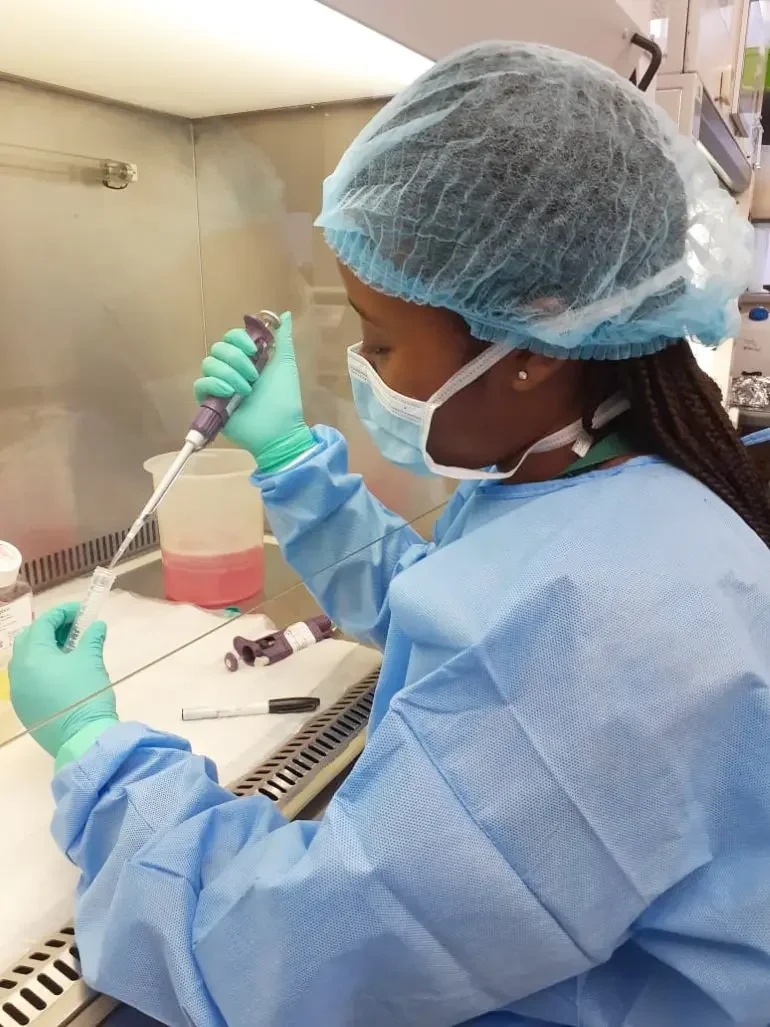
When South Africans think of scientists, many imagine white coats, laboratories and people far removed from everyday life.
Few picture a young black woman from Durban speaking about HIV, vaccine science and careers in Stem on TikTok, YouTube and beyond, while helping to shape the future of scientific knowledge in the country. Yet this is where Dr Zakithi Mkhize has found her power. A virologist specialising in HIV research, science communicator and founder of Black Girl Scientist Media, Mkhize belongs to a generation of women who are transforming South Africa not through loud declarations or public spectacle but through knowledge, mentorship and access.
Her work lives in laboratories and lecture rooms but equally in social media videos, school halls and conversations with young women who need someone to tell them: you belong here too.
For this year's Women's Day edition, which celebrates women whose work often unfolds away from headlines, Mkhize represents a different kind of leadership, one built on translating complex science into language people can understand and opening doors for those who might never have imagined a place for themselves in science.
"I always say that being a scientist is a calling," she says. "The people I have reached and the people who reach out to me I can only explain it by saying this is what God called me to do."
Born and raised in Durban, Mkhize grew up in Newlands East alongside her elder sister, in a family where education and sport were equally important. Tennis was central to their childhood. Both sisters represented South Africa in the sport, while their parents encouraged curiosity and learning without placing rigid expectations on what success should look like.
"We were privileged in the sense that there was never pressure to finish a degree and immediately start working," she says. "My parents encouraged us to pursue what interested us."
Science fascinated her from a young age, though she is quick to challenge the idea that only top-performing pupils belong in Stem fields. "I was not an A student in science. But I loved it. People need to know that you do not have to be the smartest person in the room to become a scientist. Passion and a willingness to learn matter just as much."
The curiosity eventually led her to the University of KwaZulu-Natal and later into virology, with a particular focus on HIV research.
For many South Africans, HIV is not an abstract scientific subject but a personal reality. Mkhize remembers hearing stories of communities devastated during the height of the epidemic in the 1990s, when funerals became a near-weekly occurrence. "I wanted to understand HIV and contribute to finding a cure," she says. Her master's and doctoral research focused on HIV cure research, exploring one of medicine's most persistent challenges: a virus that mutates rapidly and hides in the body in ways scientists cannot completely eliminate.
"HIV is a very clever virus. Even when treatment suppresses it, the virus remains hidden in certain parts of the body. That is why curing HIV remains so difficult."
Mkhize's work extends beyond the laboratory. During the Covid-19 pandemic, she became one of the many scientists helping the public understand vaccines, viral outbreaks and misinformation.
At a time when conspiracy theories spread almost as quickly as the virus, she used radio interviews and digital platforms to explain the science in ways that felt accessible.
"A lot of vaccine hesitancy came from people not understanding how viruses work and not understanding that research into coronaviruses existed before Covid-19."
The pandemic also gave birth to another important part of her work. In 2020, while pursuing her PhD, Mkhize launched Black Girl Scientist, first as a YouTube channel and later as a broader platform spanning TikTok, Instagram and a science communication company. Its purpose was to become the guide she wished more young women had.
"I wanted to be someone's big sister while they walked the journey," she says.
Through practical advice on postgraduate studies, scholarships, funding opportunities, choosing supervisors and navigating scientific careers, Mkhize began sharing the knowledge often hidden behind institutional walls.
Many young people, she says, abandon scientific careers not because they lack talent but because they lack information.
"People do not know that postgraduate studies are often funded. They do not know there are careers beyond academia. There are so many opportunities."
Today, the message has expanded further. Mkhize works remotely for an international company, illustrating how scientific skills developed in South Africa are increasingly sought after across the world.
'People need to know that you do not have to be the smartest person in the room to become a scientist'
Her story is also about visibility. Representation in science, she says, is not symbolic. It is essential. Recently serving as a judge at the Eskom Expo for Young Scientists, she found her self looking into the faces of children who reminded her of her younger self.
"People cannot dream things they cannot see," she says. "If a child has never seen a scientist who looks like them, it becomes harder to imagine that future for themselves."
That is why her presence online matters. It is why Black Girl Scientist matters. In a country where women, especially black women, remain underrepresented in scientific fields, Mkhize is redrawing the image of who gets to belong in the spaces.
Yet her message to young women entering Stem is not only about qualifications. It is also about confidence. "I want the next generation of women scientists to be confident, audacious and to take up space. Do not only understand your job. Understand your industry. Understand where you fit into the bigger picture."
Leadership, for Mkhize, is not about standing above people. It is about walking beside them. It means understanding the journey because you have lived it yourself. It means sharing knowledge freely. It means remaining close enough to people to hear their struggles and help them navigate possibilities.
Too often, Women's Day celebrates women who occupy visible positions of power. But there is another kind of leadership taking shape across South Africa quieter, less celebrated, yet deeply transformative.
It looks like a scientist explaining viruses to the public during a pandemic. It looks like a mentor helping a young student apply for postgraduate funding. It looks like a black woman in a laboratory, on TikTok, in classrooms and conference rooms, expanding what is possible for those who come after her.
That is the real power of Dr Zakithi Mkhize: not only that she studies viruses but that she is helping cure something else too the belief that science belongs only to a few.
For every young girl who sees her and thinks: "Maybe I can do that too", a different future begins.