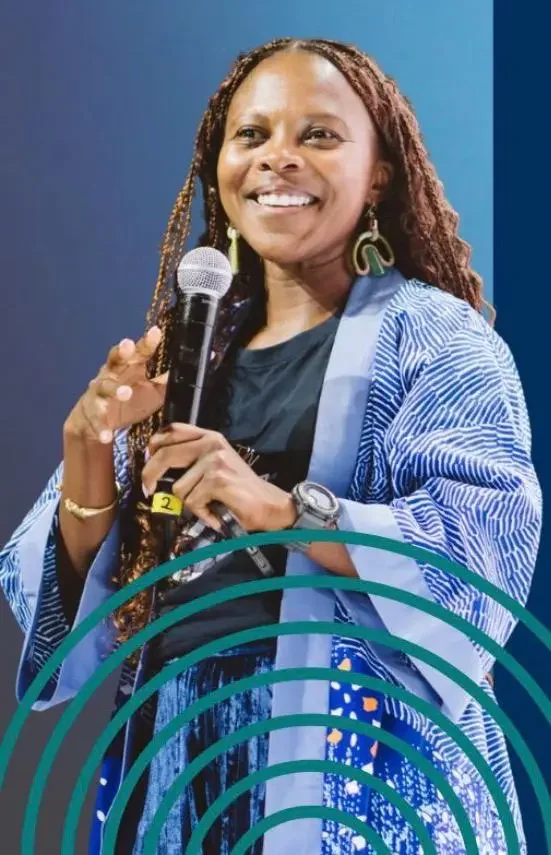
"We're all connected to the ocean by breath."
It isn't the answer many people would expect when asked why someone living hundreds of kilometres from South Africa's coastline should care about the sea.
But for Thando Mazomba, that simple truth lies at the heart of her work.
A trained marine biologist and oceanographer, Mazomba is now the venture development manager at Ocean Hub Africa, where she works with blue-tech entrepreneurs harnessing science and innovation to solve marine challenges and build a more sustainable ocean economy. For Mazomba, the future of the ocean depends as much on people, policy and opportunity as it does on science.
A key part of that is ensuring women, young people and other historically marginalised communities are actively included in, and benefit from, that economy.
It is about the women who clean fish while men head out to sea, communities displaced from the coastline by apartheid-era policies and building an ocean economy in which people and nature thrive together. Above all, she is talking about what she calls becoming "a custodian of the ocean".
"I consider myself a custodian of the ocean and, because of that, I believe it's important to understand that conservation alone isn't going to get us where the ocean needs us to be. We're living in a world where profit is often the bottom line.
"We're fighting against a system that exploits nature and people without considering the cost to future generations.
"What are we leaving for our loved ones? How do we regenerate our oceans while allowing them - and us - to thrive together?
"What excites me is looking at the ocean holistically. What does it look like to build a career in science while understanding the policies that govern how people use the ocean?"
For Mazomba, science matters most when it shapes the real world. It cannot exist in isolation; it must be connected to policy, innovation and the people whose lives depend on healthy oceans.
"The science is exciting but we can't do science without understanding how people are governed or how it will be implemented in the real world."
While there are deep ties between South Africans and the ocean, she is pragmatic about the complexities of that relationship.
"South Africa has nearly 3 000km of beautiful coastline and a rich, diverse history. Whether people live on the coast, along rivers or around lakes, we're all connected to the ocean by breath.
"That should inspire us to understand our different relationships with it, whether they're spiritual, cultural or rooted in fear because we've never had the opportunity to step into the water."
Mazomba says women remain underrepresented in many parts of the marine sector. "I've often been the only woman offshore, the only woman leading a project, the only female diver or one of the few qualified female skippers.
"Women don't automatically have a place in physical work around the ocean. Yet they're often the ones processing and selling the fish, or creating seaweed farms and other small businesses. We need to recognise the value of those roles so people feel a greater sense of ownership of the ocean."
She points out that there are deep structural barriers, including the policies that determine who gets to work in the ocean and the cultural beliefs about whether women belong in these spaces. There are also financial barriers.
Historically, men were seen as the breadwinners and decision-makers, creating power dynamics that women have had to overcome, she says.
Yet there's another lens that people don't often consider: the psychological one. "It's not enough to put women into decision-making roles or promote them into leadership positions without giving them genuine support to succeed.
"You can't set women up for failure and then say you've ticked the box because you have a black woman in management. You have to understand the nuances of inherited fear, of inherited culture and the nuances of inherited history that a woman who steps into a decision-making position then has to overcome, often alongside men who have never had to deal with daily imposter syndrome or with daily doubt."
Mazomba believes the conversation must ultimately be about people, not just science.
"Every person brings valuable lived experience into the lab, onto a vessel or into the boardroom. We're real people and we need to understand how people move through everyday life if we want to build a more inclusive world. If we continue to ignore that, we'll never get it right."
Asked what message she has for girls considering a career connected to the ocean, she is reluctant to offer false hope. "The reality is we're not handing the next generation a healthy world and we have to acknowledge that. Real, tangible changes are needed if we're going to leave behind the world we want for those who come after us.
"I'd encourage every girl to be rebelliously honest about the world she wants to create. The ocean offers an incredible opportunity because it touches almost every aspect of our lives from tackling poverty and advancing gender and racial equity to addressing climate change.
"Be true to yourself and how you want to use the ocean to make the world better. It takes hard work, honesty and a willingness to challenge the status quo but that's exactly what we need today.
"I've had to create my own blueprint. There have been failures and successes along the way but it's given me a fulfilling life. I want every girl to know that I believe she can do the same."