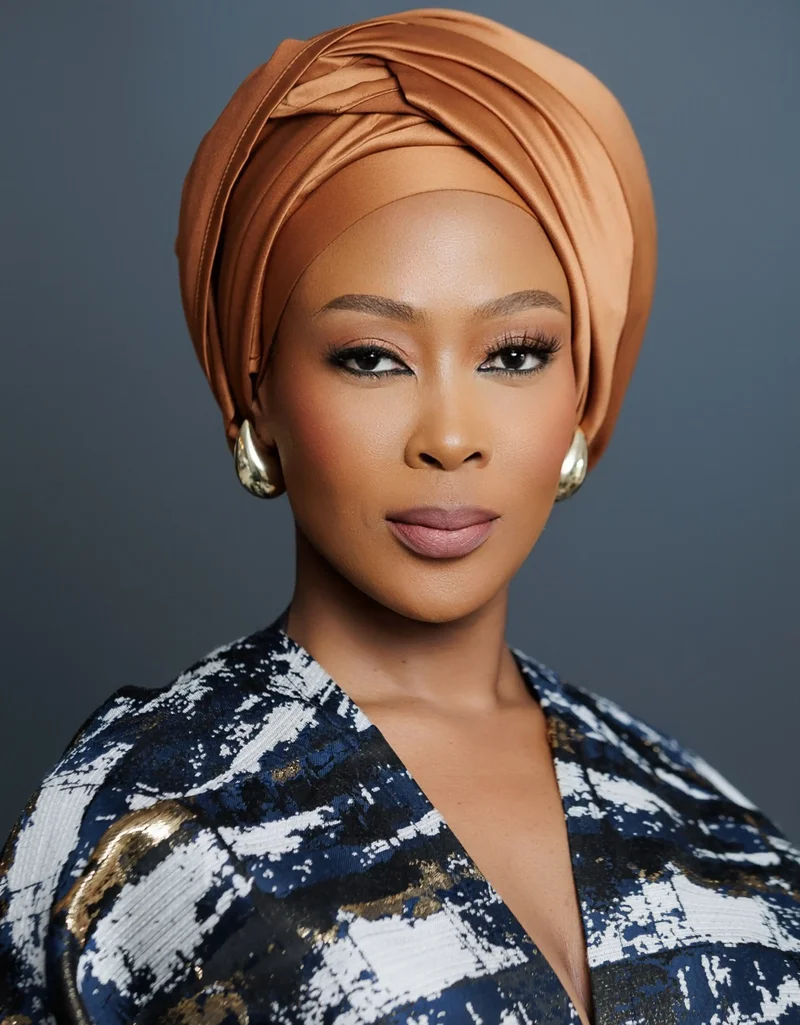
Buhle Phiwe Hlatshwayo's career reads like a study in relentless reinvention. Unafraid to pivot, she embodies the principle that women can continuously redefine themselves and excel at every stage.
Her professional career spans roles as a former political journalist, a former diplomat at Auda-Nepad within the African Union, the recently appointed president of the Chevening Alumni Association of South Africa (CAASA) and a PhD candidate specialising in AI governance, digital sovereignty and security.
Hlatshwayo's trajectory began in rural Bergville, KwaZulu-Natal. Growing up as a farmer's daughter, her days were spent milking cows and herding sheep in a community where educational opportunities for girls were limited.
"Bergville is a tiny town nestled in the Drakensberg. It's beautiful, beautiful scenery but it's impoverished. It is rural. I would look around and I would see young women getting pregnant, not finishing school. A lot of women, especially young women, are disenfranchised here. You find that a lot of women don't finish school. You find that a lot of them don't have many prospects. They don't have much of a voice. That's the environment I grew up in.
"I'm also very proud to have grown up in Bergville but it taught me that many people live with the consequences of decisions they have no voice in making. My environment showed me this and shaped every step of my career. So my commitment has always been to champion inclusion and strengthen representation."
Starting out in political journalism gave Hlatshwayo an early lesson in challenging authority and elevating unheard voices.
Focus on Africa in London, she noticed that young black women in diplomatic circles were few. The realisation prompted a pivotal shift: she moved from reporting on policy decisions to helping shape them from within.
"I was reporting on politics and economic development across the continent and engaging with ministers, technocrats and policymakers. It was during this time that I became very aware that I didn't see diplomats who looked like me. I didn't see young people. I didn't see black people. I didn't see women.> His energy was so calm but commanding. He sat down and I was fidgeting. I was sweating bullets
"I was young. I was curious. I was ambitious. At university, I was determined to understand how public policy shaped people's lives. Journalism really placed me very close to political processes and gave me a front-row seat to how governments make decisions, how institutions function and how those decisions ultimately affect our communities."
While reporting for the BBC's "Young people and women were not being advocated for in these spaces. That was the first lightbulb moment. That was the reason why I chose to transition into diplomacy."
The precise catalyst for her transition from journalism to diplomacy was an unexpected encounter with the former UN secretary-general, Kofi Annan.
"I know exactly the turning point, when I wanted to be a diplomat and it was when I got to interview Kofi Annan. I had no business interviewing this man. I was a junior journalist. There were way more seasoned journalists who were supposed to interview him but he was in town and I was the only one available."
Despite having interviewed high-profile figures like Julius Malema, Oprah Winfrey and Bill Clinton, Hlatshwayo felt intimidated about meeting Annan. Yet his presence instantly put her at ease.
"I remember him coming into the room and he had that Morgan Freeman-like energy, when you feel like God just walked in. It was literally like that... His energy was so calm but commanding. He sat down and I was fidgeting. I was sweating bullets. I remember he leaned over, held my hand and said AICalmly: 'Why are you a journalist?'
"I said: 'Because I want to be the voice of the voiceless.'
"He leaned back and said 'Hmm, that is such a noble thing.'
"Then I said: 'Sir, with all due respect, I think you have the most noble job in the world.'
"And he said: 'What do you think I do?'
"I said: 'Your job is to literally maintain peace and security in the world.'
"He asked: 'Why do you think that?'
"He had a way of calming me down. I didn't realise it at the time but as I started talking, I started calming down. He looked at me, nodded and said: 'You're going to do great things.' "I left that interview and went to my editor and said: 'How do I become a diplomat? What do I need to do? Because I want to do that.' So I was inspired by Kofi Annan, the first black secretary-general of the United Nations."
Reflecting on her time at the African Union, Hlatshwayo highlights her work on continental development while revealing her next big academic step.
"Over the years at Auda-Nepad, I had the privilege of contributing to initiatives that supported regional trade, regional integration, trade innovation and Africa's digital transformation.
"My time within the African Union system provided an extraordinary opportunity for me to contribute to Africa's development agenda, Agenda 2063 and to engage with some of the continent's most important policy conversations. Currently,> My journey has taught me that leadership is ultimately about ensuring that the table is big enough for everybody
and this is the first time I'm announcing it, I am pursuing a PhD in politics and international relations."
As a past recipient of Chevening, the prestigious UK government scholarship programme active across 160 countries for six decades, Hlatshwayo leads CAASA as its president.
In this role, she is focused on expanding access across all nine South African provinces, targeting overlooked regions to dismantle geographic and systemic barriers to global opportunities.
"I became a Chevening Scholar in 2013 and it completely transformed my life. I got to pursue a master's in international relations at the School of Oriental and African Studies in the UK. It completely expanded my worldview. It connected me to an extraordinary global network and reinforced my belief in the value of international cooperation.
"As the current president of the Chevening Alumni Association of South Africa, my priority is to ensure that those opportunities become more accessible to talented South Africans from every part of the country, especially the parts where people are most disadvantaged, because I come from those spaces. I come from a place where people are disenfranchised. It is my mission to ensure that I reach those corners. I really implore young people and not just young people, actually, people of all ages, especially women to please apply.
"My vision for CAASA is simple. It's to make it inclusive, dynamic and impactful, while celebrating the achievements of our alumni. But it's also about looking at how we are contributing meaningfully to South Africa and inspiring the next generation of leaders."
Hlatshwayo is also adding "author" to her credentials with a forthcoming children's book, Buhle the Brave Diplomat (uBuhle uSomaqhuzu Omncane), which will be released at the end of August. The project introduces young readers to global governance and will be published in English and isiZulu.
"I always say you cannot become something you don't see. A young person cannot dream of becoming a diplomat when they don't know what a diplomat is or even that diplomats exist. And so, I'm in the process of publishing my book.
"So, this book ... it's my little baby. I wrote it last year... It's about inclusion, strengthening representation and really helping, especially women and young Africans, to have a meaningful seat at the table. I think that is so important.
"The book is about my journey. My journey has taught me that representation matters, inclusion matters and when more people have a seat at the table, we can make better decisions. My journey has taught me that leadership is ultimately about ensuring that the table is big enough for everybody. If it's not, build a new table."