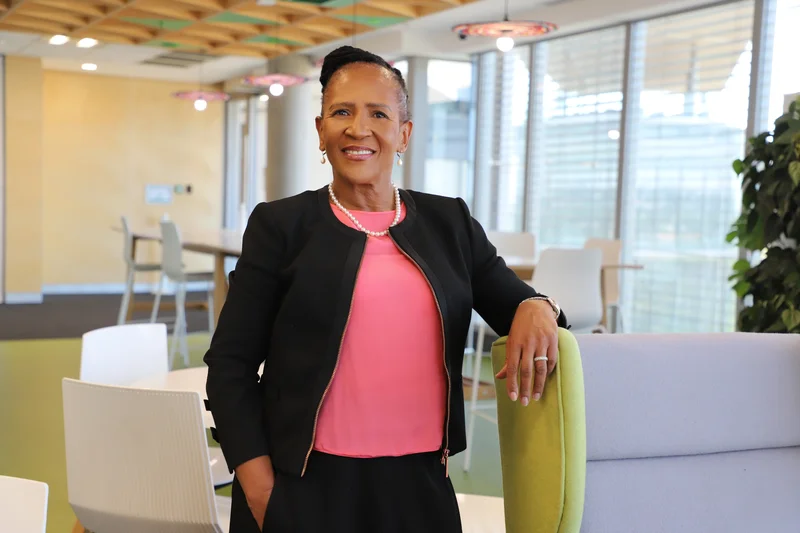
With the kind of support available to her, the young woman of 2026 is in a much better position to succeed in her chosen career than her counterpart was half a decade ago.
Thandi Orleyn, for example, was a University of Fort Hare student in 1976 when opportunities were closed to her – by law.
“Using young Thandi is a good analogy because in 1976 the young Thandi was a student at Fort Hare,” Orleyn, who is now an advocate, responds to the question, before adding: “The Constitution didn’t protect her. We didn’t have any rights.”
Fast-forward to this day, the businesswoman trained in law, who also chairs Impala Platinum, is at the coalface of opening doors to those who came after her.
She is president of the IWFSA, the South African Chapter of the International Women’s Forum.
The IWFSA was founded by Zanele Mbeki in 2002 at the time her husband, Thabo, was president of South Africa.
Orleyn has no doubt that through the work they do at the IWFSA “that is what Mrs Mbeki wanted and it has come to fruition”.
The IWF is a global organisation of pre-eminent women with significant achievements across a wide range of fields. It brings women leaders together across national and international boundaries to share knowledge, exchange ideas and inspire one another to promote better leadership for a changing world.
Founded in the United States in 1974, IWF facilitates connections among accomplished women and promotes opportunities for women in leadership.
Its global network comprises more than 8 400 members across 77 forums in 35 countries, with representation throughout North America, South America, Africa, Asia, Europe and the Middle East.
Through international programmes, conferences, galas, symposia, publications and other engagements, members connect, share experiences and exchange ideas that can influence industries, economies and public policy across the world, those asked about it say.
The IWFSA offers mentorship programmes to aid young women to reach for the stars in their careers.
“We’ve just concluded a three-year programme with Fasset, the financial services seta, specifically for women in the financial services sector. It didn’t matter where their area of work was, whether in the public or private sector or entrepreneur.
“I personally took on three people to mentor; one of them was a DG in the department of finance in the Western Cape; the other one had just started her auditing and accounting firm. I had them throughout the year to help them navigate this new leadership space.”
It was a three-way partnership where the IWFSA provided the mentors, Orleyn says.
She cites the example of Young Leaders Connect, which looks at the corporate fortunes of women at mid-career level and the IWFSA “supporting them to move through the next level of their careers”.
Young Leaders Connect will host its gala dinner, where Orleyn will be guest speaker, during Women’s Month.
YLC was relaunched in August 2020 by IWFSA patron, Mrs Mbeki. “It is dedicated to cultivating the next generation of ethical young women leaders.”
One cannot shake the feeling that women are in good hands with Orleyn at the helm of championing their cause.
How important is mentorship?
“When we grew up, we didn’t have any mentors. You had someone in the family who could sponsor you,” she says. “But mentorship is very important. We didn’t know what was happening.
“When I became director of the CCMA, it was a new entity and experience for me. I had to find my way,” says the legal hawk who became the inaugural director of the Council for Conciliation, Mediation and Arbitration when it was founded in November 1996.
As she takes one along the memories of her career path which included, among others, a stint at the Legal Resources Centre, one gets the sense that those she mentors will benefit from a wealth of knowledge forged through resilience, built through the years.
She avers that the new cohort of young women have examples, within reach, to emulate and their load is lighter:
“They don’t have to do everything.” They have the loadsters of IWFSA to call on.
Through all her board positions, Orleyn says, she found white men and women and “you had to navigate your own way through”.
“But now, there are more of us to mentor the young women, to say: ‘This is what to expect. This is how to deal with it.’ I’m able to tell them: ‘This is how I managed to get skin in the game and succeed’.”
Orleyn says that without mentorship, a lot of people become frustrated and give up.
The 110 member-strong organisation is a who’s who, really. It is like a roll-call of big-hitters: Naledi Pandor, Wendy Lucas-Bull, Bridget Motsepe-Radebe, Wendy Applebaum, Mary Vilakazi …
Orleyn says she took over the organisation’s corner office from Nolitha Fakude. She believes Dr Judy Dlamini will succeed her.
We get back to the summation: Young women in South Africa today are in good hands with the calibre of the IWFSA’s membership to look out for them.
Orleyn concurs. “We are mindful of what it means to give opportunity to people who are less privileged. That is why we are involved. We are even looking at legislation to help young women to have opportunities everywhere.”
Juxtapose this with the chances open to the young Fort Hare student of 1976 and one gets a better understanding of what it means to stand on the shoulders of giants.
The IWFSA is not an open organisation. It is constituted of “women who have made a success of their careers in different areas” and who should “continue to give back by helping young women”.
It’s a 365-day operation.
Would it worry the IWFSA that girls often miss school for whatever reason?
“Not only the girls, even the boys.”
Case closed. As they lift up the female, the male is not kicked to the curb
The IWFSA is non-partisan.
“Insofar as the issue of women in leadership is concerned. It is important to us; be it the president, minister of finance, vice chancellor of a university … any position that women would aspire to, we will support them.
“When Nkosazana Dlamini Zuma wanted to be president, we applauded that but we did not participate in [the campaign] though she is a member of the IWFSA.
“Lets assume Pandor or Helen Zille decided to stand for president; we would applaud that we have two women competing for the top position.”
Do young women sign up to become members? Say if an impressionable 17-year-old saw the good in the IWFSA, would they be eligible to join?
The answer remains the same: “The IWFSA itself is not an open organisation. It is meant for people who achieved; the top leaders. So the young ones come to the programmes we provide.”
So, the law might have prohibited the generation of 1976 to be a mining engineer and go underground, “I wouldn’t be allowed” but it is open season for the dreamers of 2026.
“The new Constitution and the legislation have allowed you to reach for your dream. If you have the capability and the drive, we provide you with support and coaching … then you can achieve anything.”
As a parting shot, Orleyn says: “The sky is no longer the limit.”
There’s hope for everybody.
IWFSA Mentorship Circle
Mentorship is the cornerstone of the YLC IDEAL Programme. Mentees between the ages of 23 and 40 are professionals from diverse industries who are actively contributing to their organisations and communities.
Young women are paired with IWFSA members and other experienced mentors who support them as they navigate their professional development, leadership aspirations and personal growth. The mentorship relationship assists mentees in developing their leadership and soft skills and provides guidance throughout their leadership journeys.
The YLC mentorship model has developed into an intergenerational and pay-it-forward programme. In addition to mentorship by IWFSA members and seasoned leaders, former mentees who have gained experience can return to support current and future participants.
Upon completing the programme, mentees join the IDEAL Circle of Influence, YLC’s alumni network. This enables past participants to remain connected and contribute to the development of women who follow them.
In November 2025, IWFSA piloted a Mentorship Circle in collaboration with Women at Microsoft South Africa, with support from Women in Tech.
The session followed a rotating mentorship format, which gave participants an opportunity to engage with several experienced IWFSA leaders through a series of focused conversations.
Participants exchanged insights, reflected on leadership challenges and gained guidance from different mentors during one engagement.
As of January 2026, YLC had supported more than 540 mentees through its mentorship and leadership development initiatives.
IWFSA members mentorwomen in the global programme IWFSA members also contribute directly to the IWF Leadership Fellows Programme as mentors.
The global programme matches Fellows with experienced IWF members whose backgrounds align with their professional development goals.
Two IWFSA Board members, Ms Busisiwe “Totsie” Memela-Khambula and Ms Audrey Mothupi-Palmstierna, were appointed as mentors for the 2025–2026 programme.
Ms Memela-Khambula is herself an IWF Fellow from the 2000–2002 class. The appointment of IWFSA members as mentors reflects the depth of leadership within the South African Forum. It also strengthens South Africa’s contribution to the global IWF learning and mentorship community. – Source: IWFSA website