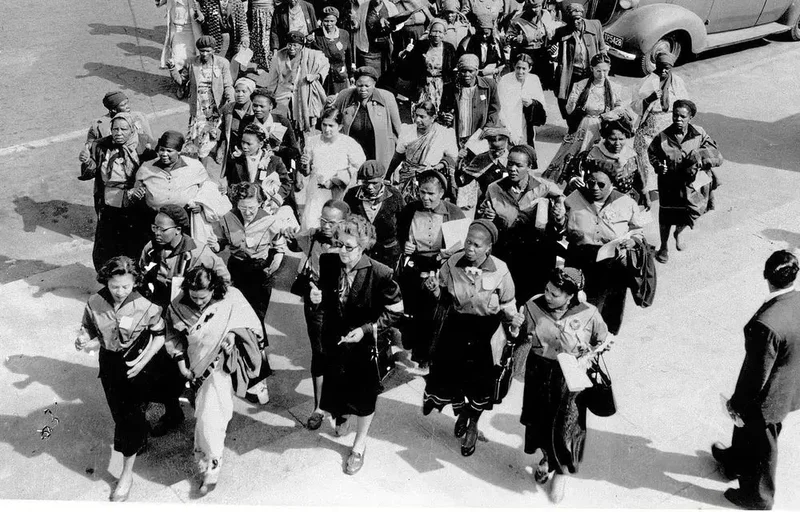
Every August, South Africa turns its attention to the women of 1956. The pho- tographs of some 20 000 women converging on the Union Buildings in Pretoria are familiar: women bearing the peti- tion that became one of the most celebrated documents of the libera- tion struggle.
The names of the leaders, Lilian Ngoyi, Helen Joseph, Rahima Moosa and Sophie de Bruyn, have been inscribed on streets, hospitals and biographies, the latest being UCT professor Martha Evans's biography of Ngoyi.
The Ahmed Kathrada Foundation has even launched a campaign to recover the names of the thousands who marched in the background and made it possible for the capital to come to a standstill on 9 August 1956. It is a generous and necessary act of historical retrieval.
But I want to pose a challenge and a question: What about the women of 1913?
Silence about them is a form of historical violence. Exactly 43 years before the Union Buildings march, in the cold and dust of the Orange Free State, black women decided they had had enough. They tore up their passes, marched on magistrate's courts, went to prison in winter and walked on cold cement floors with out shoes rather than submit to a law they regarded as an abomination.
Their leaders included Mrs Molisapoli, whose first name is not recorded and Mrs Katie Louw. Their names survive in the pages of the early black press, among them Tsala ea Batho, the bilingual Setswana and English newspaper edited by Sol T Plaatje. We owe them a reckoning.
The war that started in Winburg
The story of the women of 1913 is inseparable from Plaatje. A co-founder of what became the ANC and one of the most signifi- cant black South African journal- ists of the early 20th century, he clearly understood the situation in Bloemfontein, Winburg, Senekal and Jaggersfontein and called it the War of Degradation.
The weapon in the war was the pass. Under old Orange Free State laws, black women were forced to carry documents that regulated their movement, residence and right to exist in towns. Issued by white municipal authorities, the pass made women administratively depend- ent on the state in the most intimate details of daily life. It was the instru- ment through which black women's oppression was made legal.
In June 1913, the same month the Natives Land Act came into force, women in Waaihoek, Bloemfontein, marched to the Native police station, tore up their passes and threw them down before officers.
At some point things escalated as women fought back and "sjamboked, threw stones at, bit and subjected the police to assaults and injuries. Only a strong batch of policemen succeeded to place prisoners behind bars at Douglas Street lock up, then drove the women away to the location", to quote from Tsala ea Batho of 21 June 1913.
Yet Pankhurst would enter the global story of women's rights, while Mrs Molisapoli would not.
Prison, barefoot in the Free State winter
The consequences were severe. Tsala ea Batho of 16 August 1913 records Plaatje visiting 34 Batswana women from Bloemfontein imprisoned in Kroonstad after being moved from Edenburg.
The food was terrible. They were not permitted to wear shoes, alleg- edly on doctor's orders, a cruelty that, in a Free State winter, reads as deliberate humiliation. The women had developed callouses from walk- ing on cold cement floors.
Yet they refused to be broken. They told the newspaper they were not on holiday in Kroonstad. They were there to fight for women's rights and were prepared to die for the madness to end.
Mrs Molisapoli and the suffragette she never met
Tsala ea Batho of 14 June 1913 car- ried a vivid account of what followed. About 600 women, led by Mrs Molisapoli, marched up Maitland Street in Bloemfontein toward the magistrate's court. Plaatje described the procession as "weirdly pictur- esque": some women jumping as if possessed, others carrying emblems on walking sticks, knobkerries and broom handles.
Mrs Molisapoli led them with a flag draped around her. The news- paper compared her to Emmeline Pankhurst, the British suffragette leader then conducting her own campaign of militant civil disobedi- ence including burning of post boxes, imprisonment, hunger strikes and release under the notorious Cat and Mouse Act.
The comparison was a polit- cal argument. Plaatje was saying Bloemfontein was not witnessing a disturbance but a principled act of civil resistance equivalent to what Europe was beginning to celebrate.
Only three pounds had been raised through the newspaper for the imprisoned women. Tsala ea Batho opened a public subscription, publishing names and amounts: 10 shillings from EL Plaatje (Sol's wife), 10 from N Motshumi, 10 from Grace Mbelle, 5 from Olive S Plaatje (Sol's daugh- ter), 5 from E Diniso, 5 from JP Ntin- gana. The newspaper itself gave 10 shillings. The sums were small but the gesture was noble. It was a com- munity keeping faith with women who had walked into prison on its behalf.
The spreading fire
The resistance spread. In September 1913, Tsala ea Batho reported that women in Makeleketla, Winburg, had refused to buy passes since June, causing a "considerable shortfall of municipal receipts". Trouble was brewing in Jaggersfontein. Senekal's municipality was confronting women organising around passes.
This was more than a single march. It was a sustained campaign across towns, in which women chose fines and imprisonment over obedience. Katie Louw, the honorary secre- tary of the Women's Association of Bloemfontein, wrote to the newspa- per acknowledging donations. The women had a committee and were organised.
Plaatje urged them on. After report- ing further arrests in Bloemfontein, he wrote: "Let no woman pay a fine... Let them build new gaols. It is no disgrace to occupy them for your lib- erty." Decades before 1956, Free State women were being told that impris- onment for freedom was an honour.
Why 1956 and not 1913?
Why do we remember 1956 so read- ily and 1913 so poorly? The answer is uncomfortable.
The women of 1913 were largely Setswana- and Sesotho-speaking women from small Free State towns. Their story was preserved mainly in a bilingual newspaper whose archive was not easily accessible.
The women of 1956 marched in the age of photography, film and interna- tional anti-apartheid attention and within a movement with a growing communications infrastructure.
Their courage was equal. But the apparatus of memory-making was not. The 1956 march became part of a liberation movement that ulti- mately had the incentive and capac- ity to honour its heroes. The 1913 women won only a partial, tempo- rary victory.
The passes eventually returned. The war of degradation paused; it did not end. Without institutions to memorialise them, they slipped through the record.
A debt that must be paid
This Women's Month, while we rightly honour the women of 1956, we must also speak the names of 1913: Mrs Molisapoli, Mrs Louw; Mrs Pitso, who accompanied Plaatje to visit the 34 women imprisoned in Kroonstad; the unnamed women of Makeleketla who refused to buy passes for months; and the women of Jaggersfontein and Senekal who car- ried the struggle onward.
A correspondent from the Transvaal, writing in Tsala ea Batho on 11 October 1913, said that although his community appeared silent, they had heard the women's cries.
Their women, he wrote, were going around in circles but that they were shaking them into action. Plaatje's reply was characteristically dry: "Keep shaking them up. They might end up shaken."
The women of 1913 shook the Free State. They paid in cold cement floors, calloused feet, state humili- ation and separation from their children.
A century later, we owe them more than admiration. We owe them their names in our mouths and their story in our textbooks.
We owe them the recognition that 1956 was not the beginning but the continuation of something that began when Mrs Molisapoli and 600 women marched on a magistrate's court and declared that prison was preferable to carrying passes.
That is where Women's Month begins. In 1913.
Dr Lesley Mofokeng is a journal- ist, author and lecturer at the Wits Centre for Journalism. He holds a doctorate from Wits University on Sol T Plaatje's journalism.