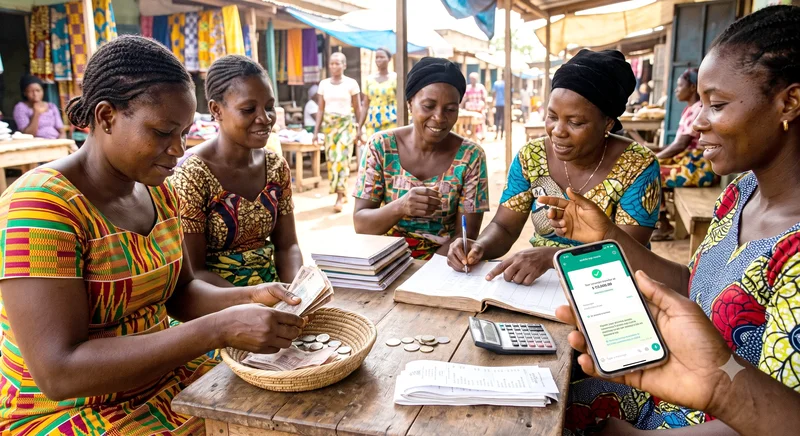
What if one of Afri- ca's most impor- tant financial innovations is not an app, an algo- rithm or a digital bank but a group of women sitting together around a table?
Across the continent, women gather in stokvels, savings clubs, rotating credit associations and other community finance groups. They pool money, provide loans, finance businesses, pay school fees and help one another through illness, unemployment and bereavement.
The groups are often described as "informal". The word sounds harmless but it carries a damaging assumption: these are temporary arrangements used by people who have not yet entered the modern financial system. Women's Month is an appropriate time to challenge the assumption.
Women-led savings groups are not imperfect versions of banks. They are sophisticated institutions in their own right with important lessons for banks, fintech companies and policy- makers about the future of finance.
More than money
A bank knows a customer through transactions, documents and a credit score. A community finance group knows its members as people.
It knows who has lost a job, whose child is ill, who is caring for an elderly parent and whose business has suffered an unexpected setback. When necessary, the group may adjust a repayment arrangement not because an algorithm has detected a permissible exception but because its members understand the circumstances and decide together.
This is sometimes portrayed as sentiment standing in the way of financial discipline. We believe it is better understood as contextual intelligence: the ability to make sound decisions using knowledge that cannot easily be captured in a database.
The groups establish rules, moni- tor contributions, keep records and impose consequences. But they com- bine accountability with care. Trust is not an optional addition to the financial mechanism; it is part of the infrastructure that makes it work.
Women have sustained and refined this institutional knowledge over generations. Yet financial inclusion policies frequently recognise only what these women supposedly lack: a bank account, a credit history, col- lateral or access to a formal loan. We measure the absence of formal finance while overlooking the pres- presence of functioning, women-led financial institutions.
Women are not waiting to be modernised
Digital technology has not caused the groups to disappear. Instead, their members have incorporated it selectively.
Contributions can be transferred using mobile money. Funds can be held in bank accounts rather than cash boxes. Receipts can be posted in WhatsApp groups, creat- ing an immediate and visible record. Meetings can take place online.
But many groups retain face-to- face gatherings because their mem- bers understand something technol- ogy designers are only beginning to appreciate: financial transactions can be digitised but social account- ability cannot always be automated. The combination of digital tools and human relationships is described in the financial sector as "phygital" banking. African commu- nities were practising it before the consultants gave it a name.
Their experience challenges the idea that innovation begins in a technology company and is later delivered to communities. Here, communities are the innovators. They decide which technologies are useful, adapt them to their purposes and reject the elements that weaken their institutions.
We describe this capacity as rooted innovation: adopting new technolo- gies and practices without abandon- ing the relationships, values and purposes that give an institution its legitimacy. Rooted innovation is not resistance to progress. It is a demand for a more intelligent form of progress.
Formalisation is not the only destination
This confuses mimicry with mod- ernisation. Women's savings groups show that people do not necessar- ily replace community institutions when they gain access to mobile money or banks. They often use the services alongside their groups. The relationship is complementary, not transitional.
This matters because the groups provide something that individual bank accounts cannot: shared dis- cipline, practical financial educa- tion, mutual support, collective investment and a platform through which women exercise leadership. That leadership is economically significant.
In South Africa, the scale of this largely women-driven economy is difficult to dismiss. Industry esti- mates suggest that more than 11 mil- lion people belong to more than 800 000 stokvels, collectively associated with about R50 billion. Their impor- tance extends beyond household saving. Statistics South Africa found that, among informal business own- ers who used their own money to start a business in 2023, women were almost 10 times as likely as men to draw on a stokvel payout (8.9% com- pared with 0.9%).
Stokvels are therefore not merely helping women cope with economic exclusion; they are supplying capital, supporting enterprise and creating forms of economic agency that the formal financial system frequently fails to provide.
But the significance of the insti- tutions cannot be reduced to the amount of money accumulated. They also create confidence, solidarity and decision-making power forms of capital that conventional financial statistics rarely capture.
A different Women's Month agenda
Celebrating women's resilience is not enough. Resilience is too often praised when institutions should instead be providing recognition, resources and power. Governments should recognise indigenous and community-led finance groups as development partners. Financial reg- ulators should create space for tech- nologies designed with the groups in mind, including robust protections for community data and appropriate regulatory testing environments.
Banks and fintech companies should approach women's groups as co-designers rather than distribution channels. The question should not be: "How do we move these women onto our platform?" It should be: "What have these institutions learnt about trust, accountability and finan- cial resilience and how can technol- ogy strengthen what works?"
Universities also have a role to play. We should direct more research towards understanding what com- munity institutions produce, how their governance works and how they innovate. Too much research begins by cataloguing what African communities lack. We need to become equally rigorous about rec- ognising what they have built.
This Women's Month, we should look beyond familiar accounts of women as beneficiaries of develop- ment. Across Africa, women are governing institutions, mobilising capital and designing hybrid forms of finance that combine technology with human judgment. They are not waiting to be modernised. They are showing us what a more inclusive modernity could look like.
Professor Ulrike Rivett is the deputy dean of undergraduate affairs at the University of Cape Town's Faculty of Commerce.
Dr Rebecca Njuguna is a postdoc- toral fellow in Information for Com- munity Services, a transdisciplinary research group housed in the Uni- versity of Cape Town's Department of Information Systems.