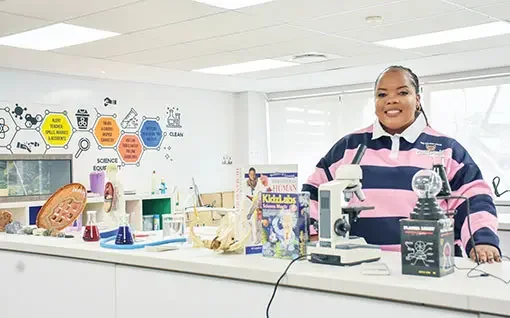
I remember standing in front of a grade 4 class at a school in Gaut- eng, asking a question I thought was almost too easy: What is half of two?
Silence. I tried again, asking for double two instead. Still nothing.
It was 2017, and I, a Wits-trained science and maths teacher, was four years into a job I had not fully under- stood. The school where I had been working since 2014 was a full-service school, a category of public school set up to support learners identified as having "barriers to learning", from dyslexia and dysgraphia to attention difficulties and processing delays. Nobody had told me this when I was hired. And nothing in my four-year bachelor of education degree at the university had prepared me to teach in one.
That gap between what teacher training covers and what happens in the classrooms became the subject of my 2019 master's research, learn- ing to teach in a full-service school through a self-study, completed at the Wits School of Education. I am now doing a PhD.
Rather than studying other teach- ers, I studied myself. Over three months, I kept a journal of "trigger incidents" classroom moments that unsettled me, surprised me or forced me to change tack mid-lesson. I discussed each incident with two experienced remedial teachers at my school and my supervisor, recorded the conversations and wrote down my reflections. It's a method known in educational research as self-study: turning a critical eye on one's own practice to learn from and improve it. The halving-and-doubling lesson was one of eight incidents I recorded. Faced with a room of silent grade 4 learners, I pulled four children to the front of the class - two boys and two girls and used their bodies to physically demonstrate the concept, adding and removing learners to show doubling and halving in action. It worked immediately. Learners who could not answer a spoken question suddenly understood.
A separate lesson on fermentation told a similar story. I had planned to explain the concept and show pic- tures of dough rising, using umqom- bothi (traditional beer) as a familiar example. Instead, most learners dis- engaged umqombothi, it turned out, meant little to them, unlike fat cakes and dumplings. Discussing the lesson afterwards with a colleague, I realised that familiarity with a topic in theory is not the same as a learner having a personal connection to it.
Out of the recorded incidents, My research distilled two main findings. The first is that many learners in full- service schools learn best through movement and physical involvement rather than through being told or shown what education research- ers, drawing on Howard Gardner's theory of multiple intelligences, call bodily-kinesthetic learning. The sec- ond is that learners in the schools tend to grasp new concepts much more slowly than the national cur- riculum's pacing assumes, creating a mismatch between what the curricu- lum expects and what happens in the classroom.
Neither finding is something South African teacher training equips new educators to expect or manage.
My research situates my experience within a longer, unresolved story in South African education policy. Full-service schools were introduced under the government's 2001 White Paper 6, which set out inclusive edu- cation as a right for all learners after apartheid-era segregation. But my thesis argues that, nearly two decades on, teacher training institutions offer substantial dedicated preparation for the realities of the schools - leaving qualified teachers to learn the specif- ics on the job, often through trial and error, while managing class sizes far beyond what policy envisages and severe shortages of trained remedial staff.
My recommendation is direct: teacher training programmes need to build in specific modules on teach- ing in full-service schools, rather than assuming that mainstream teaching strategies will simply transfer.
Beyond the specific findings, my thesis makes a case for self-study as a research tool, arguing that turning a teacher's struggles and reflections into structured evidence can sur- face knowledge about a classroom that outside observation might miss. It's a small-scale, personal piece of research, built from one teacher's journal entries and conversations rather than large datasets. But it offers something official policy docu- ments haven't: a first-hand account, from inside the classroom, of what happens when good intentions on paper meet 60 learners, an inflexible curriculum and a teacher improvis- ing her way through a lesson in real time.
Cebolakhe Zondo is a teacher, head of department, researcher, keynote speaker and PhD candidate at Wits.