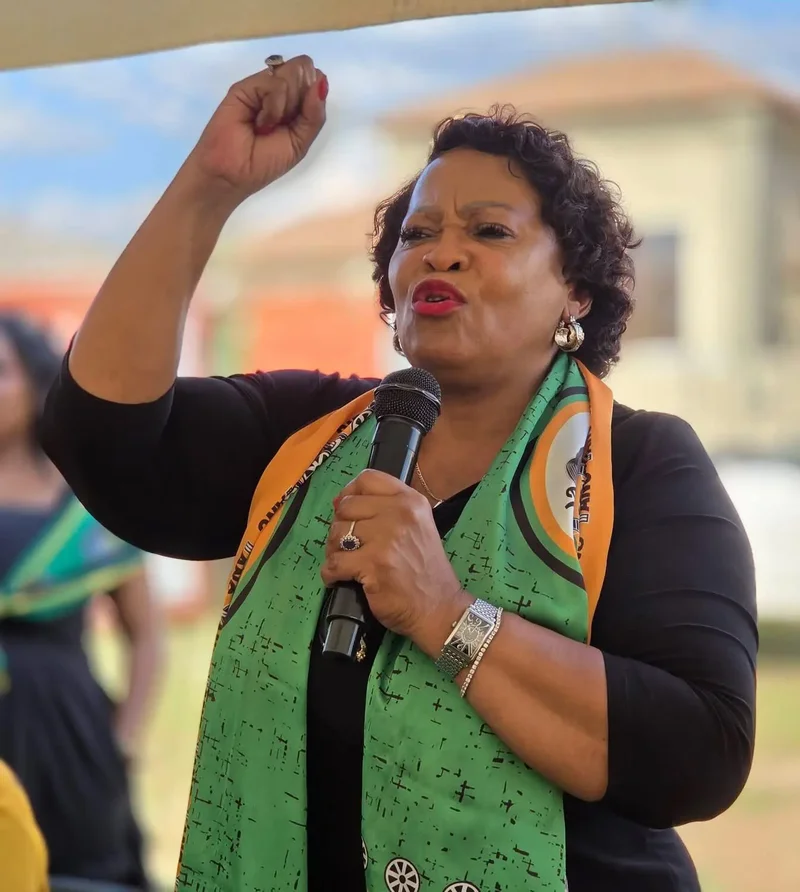
ANC second deputy secretary-general Nomvula Mokonyane has described being a female leader in politics as "a struggle within a struggle". Speaking to Mail & Guardian this week, Mokonyane said women had to fight many battles, build many relationships and bring everyone along in understanding why they also had a right to exist and be part of an organisation.
"Once you are in it, you also must know that your role must always be one that makes people feel that you matter, irrespective of the position you occupy and irrespective of the collective you belong to.
"You have a role to make yourself relevant," she said, adding that women can sometimes be isolated for doing so, not only by men but also by other women, who can be very destructive.
Seen as one of the ANC's strong women, Mokonyane took part in the struggle against apartheid from the age of 15. She was also involved in the Young Christian Students movement and was a member of the Congress of South African Students. From 2009 to 2013, Mokonyane served as the first female premier of Gauteng and subsequently held three ministerial positions. At the ANC's 2022 national conference, Mokonyane was elected second deputy secretary-general.
She said that since 1994, a great deal has been done to empower women but it is unfortunate that the gains were often overshadowed by issues such as gender-based violence and sexual harassment. Mokonyane said until the country addressed the economic independence of women, progress would remain limited.
"You have seen eminent judges being accussed of sexual harassment and abuse of power against women, like the Selby Mbenenge case and the Jacob Zuma rape case but a lot has been done."
She said despite the girl child being empowered in areas where society often placed greater emphasis than on the boy child, girls were viewed as the lesser sex because of societal norms.
"Investment in empowering women has, in some instances, left the boy child behind. But what is good is that the country has been conscious of it, has been able to deal with it and it has never been ignored. "What is needed is a consistent mechanism, from the home to society, to help the boy child because they end up becoming bullies at school, perpetrators of gang rape because of peer pressure or becoming heavily involved in drugs because they have been told they can't complain or cry."
Mokonyane said one of the country's major risks was that many children were raised by single parents who were, in most instances, women. That required greater societal attention.
Earlier this month, during a house handover in Limpopo, ANC provincial chairperson Phophi Ramathuba said the downfall of women in leadership positions, especially those in politics, was dating younger men.
"Look at all the women who were removed, some of us very old. It is because of Ben 10s (younger men). You are given power, you are given a municipality and then some boy you saw growing up comes and makes you change," she said, add ing that the reason she had managed to remain in power for so long was because she had been cautious of such attempts by men.
Speaking last week after a two-day national executive committee meeting of the ANC Women's League, the league's secretary-general, Nokuthula Ngaba, said the remarks were inappropriate and risked undermining the organisation's unity and the image of women in leadership.
"The remarks by Comrade Phophi Ramathuba are deemed inappropriate and the NEC will reach out to her and have an engagement, as these comments might be detrimental to the unity of the organisation and drive a narrative about women in leadership," Ngaba said.
Responding to Ramathuba's remarks, Mokonyane said for her, the issue was about the exploitation of a relationship, irrespective of age or gender.
"There are men who marry or are in relationships with people who are the age of their own grandchildren. And they get celebrated."
"I've been consistent in condemning what we call slay queens and the sugar daddy phenomenon. Any relationship, irrespective of age, that takes advantage of the other person is not the right one."
Mokonyane urged women to define themselves on the basis of what they had to do, what was at stake and how they could make a meaningful contribution to society.
"Never be subjected to being characterised or defined by someone else."