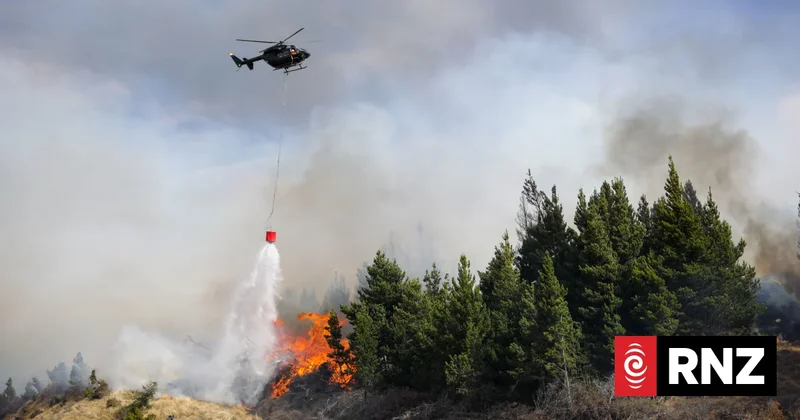
With super El Niño conditions forecast for New Zealand this summer, people in Canterbury, Marlborough, Central Otago, Wairarapa, Hawke's Bay and Tai Rāwhiti are being warned to prepare for increased wildfire risk.
What is the plan to manage wildfires this summer?
While every El Niño weather pattern was different, Fire and Emergency (FENZ) said analysis of five previous El Niño seasons showed the country's east, central North Island and Northland were most likely to see periods of very high fire danger.
Wildfire manager Tim Mitchell told Nine to Noon it was a challenge identifying the areas most likely to be affected and when, early in the season.
"We can actually live with quite high risk without necessarily seeing fires but it's very dependent on the public in terms of heeding those warnings, doing the preparation and doing the activities that then avoids those fires starting," he said.
Kiwi firefighters lending a hand in Oregon
Mitchell said causes of New Zealand wildfires differed to blazes in Europe, the United States and Canada.
"They'll get a couple of hundred fires start in a day based on a dry lightning storm...where 98 percent of our fires in New Zealand are caused by people," he said.
He said the dry conditions and strong winds that were a feature of El Niño contributed to the wildfire risk.
The Foehn effect, which happened when wind swept across mountain ranges and brought warm dry air, could push fires along quickly, he said.
"It doesn't always need to be super dry for that to occur. We can get what we call wind-driven fires, where it actually looks pretty green but what the fire's doing is pushing those hot embers some considerable distance ahead of the fire and it will find those receptive fuels, whether it's a shelter belt, whether it's a hay barn or something else, which will ignite and then spread," he said.
Mitchell said fires could grow quickly, fuelled by dry vegetation.
Earth Sciences NZ indicated that El Niño patterns would start around September with westerly winds but it was harder to tell when dry conditions might set in, he said.
"The risk of these winds coming in a little bit earlier than we might typically see them during spring and a little bit stronger than perhaps what they might otherwise be is those can catch people out and that's what can then cause a fire to start and spread," he said.
"Certainly at the moment it's preparations and caution around use of fire, just to avoid those ignition sources."
FENZ said people could prepare by clearing vegetation, including storm damage, that could dry out and become a fire risk later in the year. People should also keep on top of grass growth to avoid it becoming fuel later in the season.
Access should be clear, rapid numbers visible and water supplies for firefighting available.
Anyone lighting a fire should use the Check it's Alright website to check on the local fire danger level and fire season status.
Mitchell said it was important that anyone who started a fire made sure it was fully extinguished with water.
"We have been well caught out. It's actually our most common cause of wildfires in New Zealand at the moment, people not extinguishing fires and then those fires being flared up by winds afterwards," he said.
Fires were often detected and reported quickly, which enabled a quick response, Mitchell said.
"A lot of our preparation work does consider looking at where some of those risks are and what is going to be the plan for deploying. Additional to sending ground resources and ground crews in, we can also send aviation resources that can help hold or start some initial work on the fire until we can get that access," he said.
Mitchell was confident there was sufficient local expertise managing wildfires, which was boosted by the number of firefighters deployed overseas who came back with more knowledge about complex firefighting.
He said five firefighters had been sent to the US, with another 60 in the process of being deployed and more likely to be sent in the coming weeks.