New Zealand’s first three-party coalition Government has required significant co-operation, but it also contains three competitors, none of whom can bear to be outshone by their partners.
Going into Government, NZ First and Act were determined not to face the fate of other smaller parties. Peters’ party was overwhelmed by the red wave that followed Covid-19 and failed to return to Parliament. Historically, minor parties that enter a term of government have tended to finish smaller because the compromises involved hurt their brand, because they hold less visible portfolios, and are often invisible for the wins.
The most visible manifestation of NZ First’s attempts to avoid this has been pushing back on government policies like the India free trade agreement (FTA) and gene tech legislation.
NZ First’s last-minute criticism of the Government’s health and safety changes is a recent example. NZ First Ministers have known about those changes for more than a year. Either they weren’t paying attention to what was being proposed, or they saw an opportunity to win the support of the bill’s opponents at the expense of the commitments it had made to its coalition partners. Either way, you can see why the Act minister responsible for the legislation thought it was bad faith.
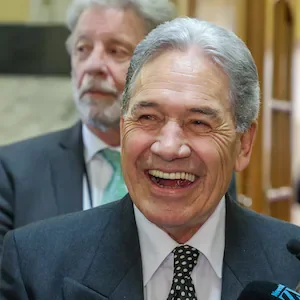
The coalition's three leaders have governed together while continuing to compete for many of the same centre-right voters. Photo / Jason Dorday
Peters and co have also kept themselves at arms’ length from the coalition’s economic plan, criticising tax cuts, plans to reduce the size of the public service, and allowing businesses in the regions to fail. Given the economy has failed to fire, and the cost-of-living crisis rumbles on, that appears to have been a winning approach in the short term. It contrasts with Act, which has itself more tightly to National’s economic approach.
NZ First is also carving out a loud, abrasive identity aimed at voters who are fed up. Rather than using the member’s bill process available to backbench MPs to promote small law changes that might find cross-party support, NZ First has used it to loudly signal its unique values. It has put up controversial legislation unlikely to pass into law, banked the headlines, and then quietly withdrawn the bills only to restart the process. It’s a deeply cynical ploy, but you cannot help but admire it.
NZ First’s “war on woke” speaks to voters who are exasperated that the public service excesses of the Ardern Government have not been excised. But don’t for a moment believe NZ First can or will take on the Wellington bureaucracy. Indeed, it’s responsible for some of it. For example, the diversity, equity and inclusion provisions of the Public Service Act Peters and co now disavow were passed on their watch.
NZ First is now competing with Act on climate policy, but no one remembers that Peters once championed the Paris Agreement’s implementation as “the 21st Century’s existential challenge” and jointly took credit for the Zero Carbon Act with the Greens.
NZ First’s rejuvenation since 2020 has relied on the forgiveness of voters for what happened in 2017. If you’ve ever engaged a NZ First voter on social media, they’ll shrug and tell you the other parties are worse.
National’s Christopher Luxon faces constant questions about why he allows his coalition partners to behave in ways that he would not tolerate from his own team. But the Prime Minister has limited options in dealing with NZ First’s behaviour. He can’t formally sanction the party’s ministers, and strong public criticism has the downside of dragging an unwanted story into another day.
National’s response to NZ First’s growth at its expense has been a burst of initiatives aimed at the voters who’ve left National. Scrapping the Broadcasting Standards Authority. Allowing only elected councillors to vote on council committees.
Changing climate change law to stop iwi leader Mike Smith’s case against major emitters. It’s possible these initiatives were already underway, but one suspects Luxon has instructed National Party ministers to find policies that will persuade voters to come home.
The fundamentals also favour NZ First. Inflation is no longer rampant, but prices remain high. Inflation-adjusted wages have been flat for five years, meaning the average worker is no better off than they were in 2021. There is much economic anxiety in the electorate, which is why concerns over immigration and the India FTA have been able to fester.
NZ First strategists will be amazed at the success of their campaign to characterise the migration provisions of the FTA as mass migration, when it might increase temporary migration by only a few per cent. The smiles in Peters’ seventh-floor office grow wider every time a columnist suggests its approach is racist.
The major parties have not given voters a sense they can tackle the deep structural problems facing New Zealand. Can NZ First get us back on track? It’s difficult to see how. Peters is unlikely to go into the election, and out the other side of negotiations, with the kind of ambitious policy agenda New Zealand needs.
Shrinking government spending so the private sector can grow, selling assets the Government doesn’t need to own, cutting red tape, and allowing greater overseas investment are all essential and all viewed with scepticism or outright hostility by NZ First. In fact, a stronger NZ First in the next Government might make dealing with New Zealand’s long-term problems even more difficult.
Catch up on the debates that dominated the week by signing up to our Opinion newsletter – a weekly round-up of our best commentary.