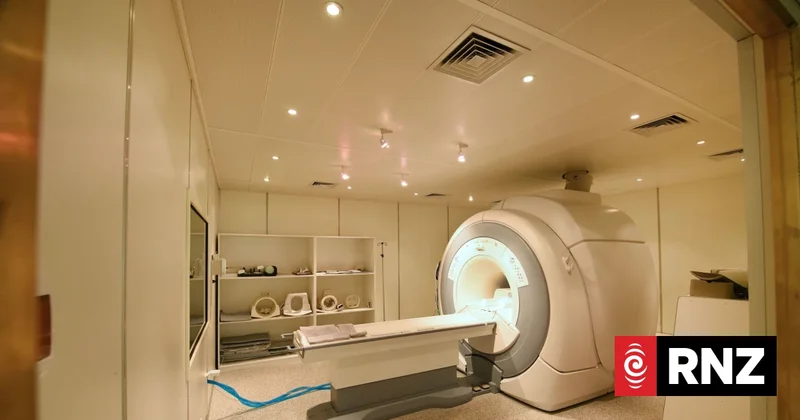
Whakatāne has waited years for a medical MRI scanner, but it has somehow ended up in Masterton.
Residents from the eastern end of Bay of Plenty must still travel to Tauranga for a scan in one of its seven MRI machines, all privately owned.
Health NZ says it is working on a plan for Whakatāne - but its last one failed.
June Goodhew says it has dragged on long enough.
In May, the 85-year-old retired tutor was given a packed lunch at Whakatāne Hospital and sat in an ambulance headed for Tauranga and an MRI.
A second woman sat up front.
"I really felt sorry for her because, you know, she was in pain," said Goodhew.
"From 11 o'clock till 5pm, it was quite a long day for people that are unwell. I imagine the cost of our travel, plus nurse and driver, would have been large, plus, well, not good for those in pain."
If Whakatāne had an MRI they could have just gone down the hall.
"This is the futility of all this nonsense of us getting it, promising and then we don't get it."
Whakatāne Hospital.
Screenshot / Google
'Something went pear-shaped'
In 2014 Whakatāne Hospital got a $67 million upgrade, the government trumpeting about its "modern radiology department".
"This new building will ensure the 50,000 people living in the region continue to receive high quality health care for many years to come," said then health minister Tony Ryall.
Modern - but with no magnetic resonance imaging machine for advanced body scanning.
So locals tired of the 180km-round trip to Tauranga began pushing for one.
Several years later, Health New Zealand began talks with Bay Radiology, part of a big nationwide private provider RCHNZ Medical Imaging Group, majority owned by Infratil, to put its MRI in a yet-to-be built, specially designed unit at Whakatāne Hospital.
Dr Victor Luca, mayor at the time, anticipated it would be installed by the end of 2024.
"The territory had been defined, the building had been designed, site works were about to start."
"The end of 2024 came and went, 2025 came and went.
"We were all trying to uncover what had actually gone on ... obviously something went pear-shaped," said Luca.
Grey Power health campaigner Dr Victor Luca
Supplied
'Relocated to Masterton'
Three months ago Health NZ Te Whatu Ora spelled it out to Whakatāne Action Group, which had emailed asking why the machine sat in a crate at Port Tauranga for a year.
"An agreement for a lease wasn't reached and the MRI has been relocated to Masterton. The MRI was owned by the private provider," the agency said.
HNZ told RNZ it terminated the deal with Bay Radiology over site constraints due to an earthquake faultline under parts of the hospital.
Authorities have known the fault was near the hospital since at least 2016.
More recently, they pinned down exactly where, and that area - where the MRI unit was to be - has now become an exclusion zone for new construction.
Health NZ said the existing hospital buildings were fine.
The Whakatāne Action Group said the agency had been helpful lately, but questioned why it did not find a suitable site in the first place.
Bay Radiology declined to comment about Masterton getting the machine or what it said were "'recollections, or assumptions".
"We appreciate the community's interest in this issue and understand the frustration many people feel," the company said in a statement.
"For some time, Bay Radiology has been seeking to work with Health New Zealand on an MRI service for Whakatāne.
"While we haven't reached an agreement on getting the MRI established yet, we hope we can progress this partnership opportunity to expand diagnostic imaging for the people of the Eastern Bays."
Wairarapa Hospital in Masterton.
Supplied / Google Maps
New business case - but staffing hurdles
Asked if the Masterton machine was available for scans it funded in Wairarapa, HNZ said it did not know.
"The machine is privately-owned, as such we aren't privy to its current location or if it's being used in public or private care."
Luca has written twice in the local Beacon about what he calls "an absurd situation".
"My question is how the **** you get to the point of putting spades in the ground to be derailed by an earthquake fault that was known about in 2015?"
Health New Zealand said a new business case for MRI options for the eastern Bay community would be completed within the next three months.
It declined to be interviewed.
'Wage and workforce competition'
Staffing may still get in the way of the plans.
While HNZ had a new strategy to create a single, nationwide public radiology service, it had fewer than 350 radiologists to work with and increasingly they were spending more time in private clinics, according to workforce surveys. Technicians - MITs - were also in hot demand.
"We now have significant wage and workforce competition from private radiology for MITs that specialise in CT and MRI," said Health NZ on its website.
"This has led to some centres not operating public MRI machines due to workforce shortages."
The government this month passed a law making it explicit for Health New Zealand to work with private healthcare providers.
On the public front, Hawke's Bay hospital got a $35m-plus radiology upgrade last year.
On the private, RHCNZ has been targeting growth in "under-served regions, with plans to expand imaging services into Wānaka, Masterton, Palmerston North and Rangiora", according to Infratil's annual report. It did 10,000 more scans in 2025-26 than the previous financial year.
'We ... apologise for the inconvenience'
Last year Whakatāne protested over a downgrade of the hospital's obstetrics and gynaecology department due to lack of staff that forced hundreds of women from the Eastern Bay to travel to Tauranga Hospital to give birth. It staged a hikoi and secondary services were resumed in April 2026. However, a general manager appointed just last year had now resigned.
Five years back Tauranga had four MRI machines, now it had seven, all private.
Luca takes a bigger warning from the experience, a warning he and others of the town's Grey Power advocates made to health minister Simeon Brown in a face-to-face last year.
"All I can say is the present debacle indicates how difficult it is to do public-private partnership and it should be no mystery to anybody in New Zealand," said Luca.
He used the Official Information Act to find out $300,000 was spent a year on ambulances for Whakatāne MRI patients to go to Tauranga, at just under $500 dollars per trip.
People who were not admitted as patients had to find their own way.
The scans themselves cost the taxpayer $1100 each which was relatively cheap for an MRI.
"We acknowledge Dr Victor Luca's article and his concerns and apologise for the inconvenience caused to patients needing to travel," HNZ's group director of BOP operations Sarah Fenwick said in a statement.
It currently prioritised patients clinically to ensure those in greatest need were seen as quickly as possible, she said.
"We always work with patients to ensure they can access the services they need."
The action group said it continued to be involved in the push for an MRI.
June Goodhew would believe it when she saw it - she's even doubtful the faultline was really the problem HNZ made it out to be.
"That was the final excuse, I think, but then they didn't want to give up any of the parking area for the building.
"It's such a disappointment, and I think some of us suffer from a bit of anger, because why didn't we get it?
"Is it profit and loss or what? Why? I don't know."