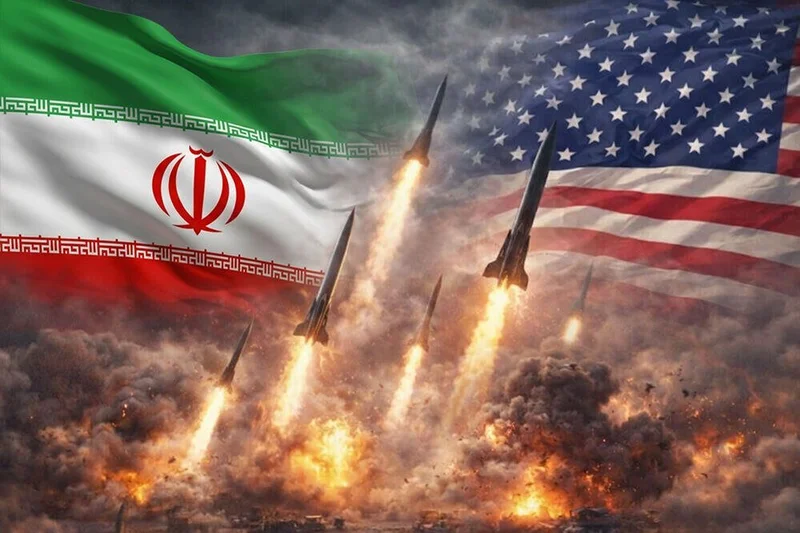
TEHRAN – Iran has significantly expanded its retaliatory military campaign against US forces across West Asia, announcing a series of missile and drone strikes against American military facilities in Bahrain, Jordan and Kuwait while senior military officials added the country has recovered from the initial US offensive launched on Feb. 28 and rebuilt its operational capabilities.
The latest operations, carried out under Operation Nasr-2, mark one of Iran's broadest waves of attacks since the conflict began and underscore 'a transition from strategic defense to sustained offensive operations.'
Among the most significant targets announced by Tehran was Amazon Web Services' (AWS) cloud infrastructure in Bahrain, which Iranian Armed Forces described as the "digital eye" of the US Central Command (CENTCOM).
According to an official military statement, the strike targeted Amazon's me-south-1 cloud region, launched in Bahrain in 2019 as the company's first West Asia data center. Iranian officials alleged that the facility functions as a major information-processing and intelligence hub supporting US military operations throughout the Persian Gulf.
The statement also highlighted Amazon's participation in the Pentagon's Joint Warfighting Cloud Capability (JWCC) program, under which leading technology companies provide cloud computing, artificial intelligence and data-processing services to the US Department of Defense.
Iran presented the strike as retaliation for ten consecutive days of US air attacks on Iranian territory that targeted both military and civilian infrastructure.
In parallel operations, the Iranian Army announced drone strikes on Al-Azraq Air Base in Jordan, saying accommodation facilities, logistics buildings and military equipment belonging to US forces had been targeted.
Military officials also said Iranian Arash drones struck maintenance facilities, aircraft shelters and equipment warehouses at Sheikh Isa Air Base in Bahrain.
In Kuwait, Iran's Army said it launched a large wave of attack drones against Camp Al-Doha, one of the principal US logistical hubs in the region, stating to have targeted ammunition depots and logistics centers supporting American ground forces.
Meanwhile, the Islamic Revolution Guard Corps (IRGC) announced another phase of Operation Nasr-2, saying missile and drone strikes targeted US positions at King Faisal and Prince Hassan military bases in Jordan.
According to the IRGC, the attacks damaged hangars used for F-15 fighter aircraft, drone maintenance facilities and heavy-lift helicopter infrastructure. The force also stated that eight MQ-9 drones were destroyed before entering operational service, while additional aircraft and US personnel suffered casualties.
The latest operations illustrate 'the country's recovery following the opening phase of the war.'
When the United States launched its initial large-scale strikes on Feb. 28, military analysts widely assessed that Washington sought to overwhelm Iran's command structure, degrade its missile forces and limit its ability to sustain prolonged combat operations.
However, defense analysts now note that Iran appears to have restored much of its operational tempo, resuming coordinated missile and drone attacks while maintaining production of military hardware despite continued combat.
"Iran has demonstrated a notable capacity to regenerate combat power under sustained pressure," said several regional defense analysts in recent assessments, pointing to the country's dispersed military infrastructure, decentralized command networks and large inventory of domestically produced drones and missiles.
Independent military experts have also argued that Iran's extensive use of underground facilities, mobile launch platforms and distributed production lines has complicated US efforts to permanently degrade its military capabilities.
Acting Defense Minister Brig. Gen. Majid Ebn al-Reza said the conflict has accelerated the development of indigenous military technologies.
"The more sophisticated the enemy's technology became, the more our domestic capabilities advanced," he said, arguing that battlefield conditions had become a catalyst for innovation across Iran's defense industry.
Armed Forces spokesman Maj. Gen. Abolfazl Shekarchi echoed that assessment, saying missile and drone production has continued uninterrupted throughout the conflict.
"Strategic missile production never stopped," Shekarchi said. "Equipment produced during the war entered operational service immediately and replaced expended inventories."
He added that despite extensive US intelligence capabilities, Iranian missile production facilities remain undiscovered.
Iranian officials also responded sharply to recent warnings from US President Donald Trump, who threatened additional strikes against Iranian infrastructure should shipping in the Strait of Hormuz come under attack.
A senior Iranian military source said any US attack on bridges, power plants or energy facilities inside Iran would trigger reciprocal strikes against regional infrastructure and energy installations linked to American interests.
The source reiterated Tehran's position that Iran will continue exercising 'sovereign control' over the Strait of Hormuz and warned that any escalation against Iranian infrastructure would be met with proportional retaliation across the region.
Military observers say the latest developments suggest the conflict has entered a new phase. While the opening US offensive sought to rapidly neutralize Iran's military capabilities, analysts increasingly believe Tehran has adapted its operational doctrine, rebuilt portions of its command and logistics network and shifted toward sustained regional retaliation designed to impose rising costs on US forces and their regional partners.
Some defense specialists also argue that Iran's ability to continue launching coordinated long-range missile and drone operations months after the initial US assault indicates that Washington has not achieved its original objective of decisively degrading Iran's military capabilities. Instead, they say, the battlefield has evolved into a prolonged war of attrition in which Tehran has sought to demonstrate resilience, replenish its arsenal and gradually regain the operational initiative.