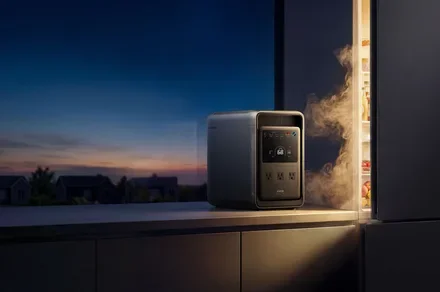
When you’re shopping for a portable power station, there’s one number that’s almost impossible to ignore: battery capacity. A 2 kWh battery should give you roughly 2 kWh of usable power, right? Unfortunately, things aren’t quite that simple. Anker SOLIX has published new efficiency data for its S Series portable power stations, and it’s putting the spotlight on something that doesn’t get nearly as much attention as capacity: how much of the energy stored inside the battery actually makes it to your devices.
According to Anker, portable power stations are commonly advertised with efficiency figures measured under relatively heavy loads, where they can reach roughly 89% to 92% efficiency. But that’s not necessarily how most people use one during an outage. Think about what you’d actually plug in. A Wi-Fi router might sip power continuously, a refrigerator switches its compressor on and off throughout the day, and a CPAP machine could run overnight. Together, those devices may draw just a fraction of what a large power station is capable of supplying. And that’s where efficiency can start slipping.
Your 2 kWh battery isn’t necessarily giving you 2 kWh
Anker says discharge efficiency on typical portable power stations can drop to around 70% to 80% under lighter loads. So, a noticeable chunk of the energy you’ve paid to store could disappear through conversion losses and the power station’s own consumption before it ever reaches your fridge or router. The company says its OptiSave 2.0 technology is designed to reduce those losses by changing how the power station operates depending on what’s connected.
Instead of running the inverter the same way all the time, the system monitors demand and adjusts accordingly. A power-hungry appliance such as a microwave can get full output when it needs it. With something much less demanding, such as a router or CPAP machine, the inverter can reduce its operating frequency and its own energy consumption. There’s also a Smart Standby Mode designed for appliances that don’t continuously draw power. When your refrigerator’s compressor switches off, for example, the power station can dramatically reduce its own standby consumption. Once the fridge needs power again, Anker says the system can wake within milliseconds. Those small savings could become surprisingly significant when you’re trying to stretch a battery through a lengthy blackout.
Anker is putting some unusually specific numbers behind it
More interestingly, Anker isn’t only providing a best-case efficiency figure. The company says its S Series reaches 88% discharge efficiency at a relatively light 100W load and 96% at 400W. It claims comparable portable power stations typically fall below 80% at 100W and hover around 89% at 400W. It has cut idle power consumption by as much as 50% compared with competing products. Its S2000, for instance, consumes about 6W while idle, compared with the 15W to 20W Anker says is typical for other 2 kWh power stations.
Put everything together, and the company claims OptiSave 2.0 can give its S Series up to 20% longer runtime than competing power stations with the same advertised battery capacity. The S2000 has also received TÜV SÜD’s A+ energy-efficiency certification under its relevant 2026 portable-power standard, lending some independent weight to the efficiency conversation. Of course, actual runtime will always depend on what you plug in, how frequently those devices run, and environmental conditions. The bigger takeaway here isn’t simply that one battery lasts longer than another. It’s that comparing portable power stations purely by capacity may be leaving out one of the most important numbers. If other manufacturers follow Anker’s lead and start publishing efficiency across different loads, shopping for a power station could become a lot less about whose box has the biggest battery number printed on it.