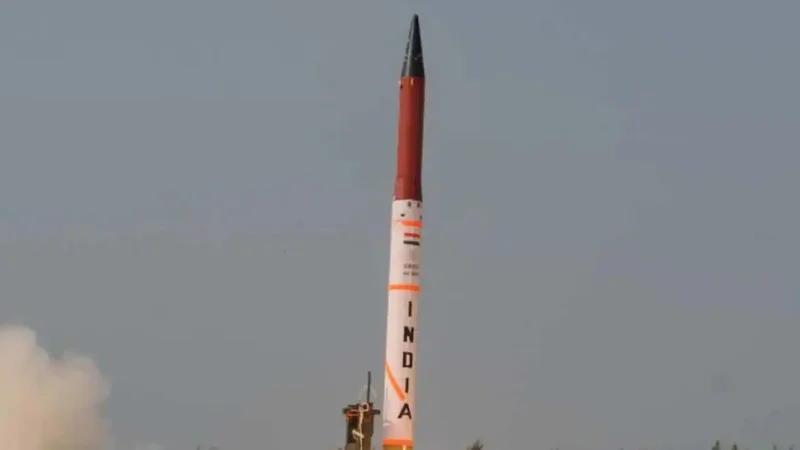
The test of the Agni-IV ballistic missile by the Strategic Forces Command (SFC) has demonstrated the country's readiness to respond to any contingency. The test demonstrated the successful firing of the Agni-IV intermediateârange ballistic missile, which is a roadâmobile and nuclearâcapable weapon. The road mobility means that the missile can travel freely across the country and would therefore be difficult to target. This is in contrast to ballistic weapons that are fired from missile silos, which can be easily monitored or targeted by an adversary during a conflict. This is the tenth test of this missile and the sixth by the SFC.
The Strategic Forces Command, commanded by a lieutenant general-ranked officer, or an air force or navy equivalent, is the operational part of Indiaâs Nuclear Command Authority (NCA). It is tasked with managing the countryâs nuclear arsenal. The SFC holds sole responsibility for initiating nuclear delivery after explicit approval is granted. Exercising complete command and control over nuclear assets, the SFC has established robust communication and contingency systems since inception.
The Agni-IV ballistic missile with a range of 4,000 km, provides strategic deterrence to New Delhi against regional rivals.
Designed by the
Defence Research and Development Organisation (DRDO), AgniâIV incorporates several firstâtime technologies, including composite rocket motors, ring laser gyroscopeâbased inertial navigation, microânavigation systems, digital controllers and a powerful onboard computer.
These innovations have significantly enhanced accuracy, reduced radar signatures and improved survivability against countermeasures. These technologies have also been incorporated in later variants of the Agni-series of missiles.
The AgniâIV can carry a oneâtonne warhead to a range of 4,000 kilometers. This warhead can either be nuclear or conventional. The missile is powered to these distances by a twoâstage solidâpropellant engine. The missile's lighter weight, due to the use of composites and compact design, allows deployment from roadâmobile launchers, providing flexibility and operational readiness. The missileâs avionics architecture, featuring redundancy and distributed systems, ensures high reliability. Trials conducted off the Odisha coast demonstrated precision strike capability, with radars, electroâoptical systems and naval ships tracking the missileâs trajectory and confirming its accuracy.
AgniâIV represents a leap in Indiaâs missile technology, the introduction of a composite rocket motor that delivered excellent performance and advanced avionics that improved kill efficiency. Its reduced radar crossâsection makes detection difficult, strengthening Indiaâs deterrence posture. The indigenous ring laser gyroscope and micro-inertial navigation system complement each other to provide redundancy, while the digital control system and high-speed communication bus ensure seamless guidance to the target.
The AgniâIV is a technological milestone, as it is a strategic asset that enhances Indiaâs layered deterrence capability. Positioned between mediumârange and intercontinental systems, it provides decision makers in the country with a versatile option against regional threats while demonstrating Indiaâs growing selfâreliance in missile development, reinforcing its longâterm commitment to credible nuclear deterrence and strategic autonomy.