I was 27 when I met the man who would completely redefine my understanding of love.
David Robinson was 23, a former soldier with piercing blue eyes and the most wicked sense of humour.
He was also profoundly disabled, having been paralysed from the chest down in a terrible accident while serving in the Army, left unable to move his arms or legs.
I, meanwhile, was a trainee nurse on secondment to the Younger Disabled Unit in Leicester General Hospital, where he was having rehabilitation treatment.
Despite our differences, the moment we spoke there was electricity between us, the kind of rare, deep connection that sends a tingle straight down your spine.
From the start it was obvious to us: we were soulmates. For the eight weeks I was on the unit, we saw each other every day. We laughed, talked for hours – and secretly fell in love.
I discovered that three years earlier, in 1988, David’s neck had been broken when the tank he was in rolled over during a training operation in Cyprus.
For a man of just 20, with his life ahead of him, it must have been devastating. Yet despite everything, his personality was vibrant and magnetic. And even though he faced serious challenges because of his disability – he was unable to live an independent life – ours should have been a happy ending.
But while we could overcome physical obstacles together, what we could not ignore was the fact I was married – to my first husband.
Louise Robinson as a newly qualified nurse. When she was 27 she was seconded to the Younger Disabled Unit at Leicester General Hospital and fell in love with David
David in uniform, before the accident that would leave him paralysed from the chest down
I was just 17 when I met Nigel, a carpet-fitter three years older than me. He was never very romantic – he wasn’t one for compliments – but we got on well enough and I was too young to know things could be different. We married when I was 23.
It wasn’t until I met David, three years later in September 1991, that I realised what love should feel like – and that it was unlike anything I had ever experienced.
I found myself waking up every morning next to Nigel filled with intense excitement at the prospect of seeing David.
We would secretly go to his room, shut the door – of course, physical contact was very much frowned upon with me being a nurse – and kiss, both of us overwhelmed with love for each other.
It felt completely right, like it was truly meant to be.
In our blissful bubble, we talked about having children together – despite David’s injury it was possible for him to father children – and I even told my parents about him.
My dad was practical and warned me: ‘You’ll end up being his carer.’ But that didn’t matter to me. I was too swept up in the moment to think about what the practicalities of a life with David would look like, or even how I would end things with Nigel.
But the reality of my life outside the hospital walls quickly caught up with us.
A few weeks after I’d moved on to my next placement, on Valentine’s Day 1992, Nigel found the card I’d written for David in my bag.
He was absolutely furious and told me in no uncertain terms that the relationship had to stop.
I felt the crushing weight of guilt and duty.
I didn’t want to break David’s heart, but I’d made a promise when I got married and I felt I had to stick to that.
My heart was telling me to be with David, but my head said otherwise and I wanted to do the ‘right’ thing.
In the end, I told David our love affair had to end.
It was one of the worst days of my life. He was completely devastated and told me years later that after I left his room that day, he broke down and cried.
He said my walking away completely ripped him apart in a way that even his injuries hadn’t.
Afterwards, I tried my best to work at my marriage so that something positive could come out of such heartache, and a year later I had Daniel, followed by Joseph three years after that.
I threw myself into being a mother, which I loved, and building my career in nursing.
Yet no matter how busy life became, David remained in my heart. Every time I saw a soldier in uniform, my mind would immediately drift back to his blue eyes.
I did try to find David in the early days of Facebook but had no success because – as I discovered later – he’d registered his first name as Davey. I assumed I’d never see him again.
What I didn’t realise was that we were just a mile apart.
Incredibly, we lived at opposite ends of Whetstone, a village a few miles south of Leicester.
A year after we’d ended our love affair, David had left the hospital and moved into a specially adapted bungalow not far from my marital home, with a team of nine regular staff providing 24-hour care.
While he’d tried dating after I’d ended things back in 1992, nothing had ever worked out for him beyond the short term.
David with a friend in hospital in 1988 after his accident. He had broken his neck when the tank he was in rolled over during a training operation in Cyprus
24 years later, they reconnected through one of David's carers and began to message on Facebook. Louise went to visit him and it was like nothing had changed
He used a modified van to get around and had actually spotted me multiple times. Seeing me with children, however, he’d assumed I was happy and didn’t want to disrupt my life.
He even confessed to me years later that he used to have his carer drive past my house regularly just to catch a glimpse of me.
But the truth was that my marriage to Nigel was slowly fracturing. Increasingly, we were living separate lives. And, deep down, I knew I was unhappy because I’d experienced true love with David.
Then in November 2016, aged 51, nearly a quarter of a century after I’d last seen David, I was working as a nurse in the local GP surgery when a lady called Debbie walked into my room for a routine test.
As we chatted, she mentioned she was a senior carer for a disabled gentleman living in Whetstone.
As she described him, my heart stopped. I looked at her and asked: ‘Is it David?’
Surprised, she nodded and I admitted that we had fallen in love 24 years before. I told her to give him my fondest regards.
Debbie went straight back to David’s bungalow and told him she had just met me. He searched for me on Facebook that night and sent me a private message.
Having no idea that I was unhappily married, he simply asked how I was, what I was up to and said how nice it was to hear from me.
But as we began messaging back and forth, the decades melted away.
A week or so later he suggested I come over for a cup of tea – as long as I brought biscuits. He had never lost his sense of humour.
I was so excited to see David, by then 48, again, though I realised I had no idea what his physical situation might now be.
But I was more worried about visiting him behind Nigel’s back than by any health concerns.
At the front door, I was met by one of his carers, who led me into the living room. David looked completely different.
The last time I’d seen him he still had the physique of the slim, athletic military man he had been not so long before.
But after decades of immobility, he had put on a lot of weight.
It didn’t matter though, as the moment our eyes met and he flashed his cheeky smile, my knees went completely weak.
For two hours we talked non-stop, and the connection was just the same as it had been all those years ago. I felt dizzy and breathless, knowing our love had never died.
Two weeks later, I went to David’s house for what was supposed to be another quick cup of tea, but ended up staying for seven hours, both of us pouring our hearts out about the lost years.
While, during our first visit, David had assumed his feelings for me were not reciprocated and that we’d just be friends, this time I told the truth about how my marriage had not been a happy one – and admitted that my feelings for him had never gone away. By the time I left that day, I knew I couldn’t go back to my old life. Having let David go once, I didn’t want to leave him ever again.
By then my oldest son Daniel, 23, had moved out, and only Joseph, 20, was still living with us.
Three days later, I told Nigel we needed to talk.
I looked him straight in the eyes and said: ‘There’s someone else. I’m leaving you.’
Nigel didn’t take the news well. I think it was a blow to his ego, particularly the fact I was leaving him for a man who was severely disabled. His reaction only reinforced the feeling that I was doing the right thing.
The next day, I moved into my mum’s house. She’d been living alone since my dad had died two years earlier and fully supported my decision to leave Nigel to try to make a go of things with David.
When I went into work on the following Monday, I was glowing.
My manager smiled and asked: ‘Did you have a good weekend, Louise?’ I replied: ‘Yes, thank you. I’ve left my husband!’
It wasn’t the answer he’d expected and everyone was shocked, but my colleagues gave me the most wonderful, supportive hugs.
Naturally, it was harder for my sons to accept the sudden news, as they had largely been shielded from my unhappiness.
Both were very upset, though a few years later Daniel admitted he was surprised I hadn’t ended the marriage sooner, as he was aware of the friction between us. Every single night after work, I would drive over to see David, and his carers made sure to give us privacy. Kissing David again was truly amazing. There were butterflies but also a deep sense that it was right.
While we’d never attempted to have sex in the hospital unit – that would truly have been overstepping the mark – we found a way to enjoy an intimate relationship together.
In June 2017, seven months after we’d reconnected, I officially moved into David’s bungalow.
He had lived alone with care staff his entire adult life and had never cohabited with a partner before, so I had wanted to make sure he was entirely comfortable with me invading his space, especially as he relied on so much complex equipment.
My mother thoughtfully bought us two single beds that slotted perfectly side by side to look like a standard double bed.
David’s side had to be a specialised medical bed, fitted with an electric alternating pressure mattress to protect his skin.
Due to his severe injuries, David also carried a lot of deep-seated insecurity. He was convinced everyone in public would stare at him but, gradually, I managed to coax him out with me.
Soon, we were regular fixtures at local cafes and theatres – experiences he hadn’t enjoyed in over 30 years.
Initially people did stare, but because I didn’t care and fully supported him, over time neither did he. We were on cloud nine, saying every day how lucky we were to have found our way back to each other.
In 2018 he proposed.
The rings we chose were deeply meaningful. My band was engraved with the words Nulli secundus (‘Second to none’), the motto of his former regiment the Coldstream Guards, which I thought described him perfectly.
David’s ring was engraved with a heart and the inscription ‘Like never before’, words taken from Eva Cassidy’s Songbird, a song he’d shared with me when I was staying at my mum’s house after leaving Nigel. Our wedding was delayed until May 2022 due to Covid restrictions. By then, sadly, my mother wasn’t there to see it; she had died the year before after a cruel battle with Alzheimer’s disease.
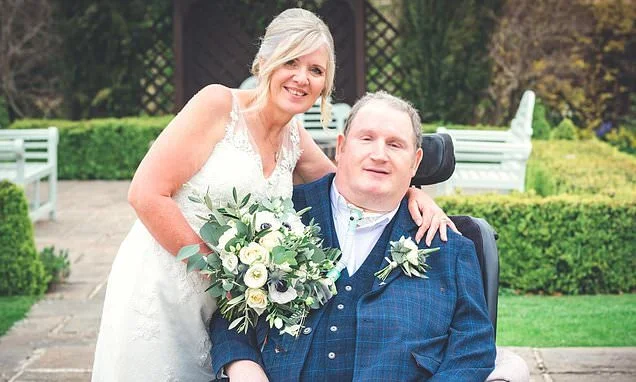
The ceremony was held in a gorgeous, sunlit orangerie, and Daniel and Joseph proudly walked me down the aisle.
They married in 2022, and both Louise's sons, Daniel and Joseph, proudly walked her down the aisle
In 2025, David was diagnosed with bowel cancer and Louise knew that he was ready to go. 'Our story remains a beautiful fairy tale – just one with a very human ending,' she writes
Despite their initial upset they had come to love David dearly; they could see how much I had blossomed after being unhappy for so many years.
Sadly, though, our happiness was short-lived.
In late 2023, David developed severe sepsis due to an infected ulcer at the base of his spine.
He was rushed to the Sheffield spinal injuries unit, where surgeons had to completely remove his hip joint in a desperate bid to halt the infection.
By November 2024, his medical needs had become so intense that I officially joined his professional care team, managing his complex clinical care at home.
Our dog Logi also provided a precious kind of comfort for David during this time. We’d bought him three years before after winning £1,000 on the weekly lottery run by Rainbows Hospice for Children and Young People, a respite care charity I’ve supported since I looked after a young girl I’d worked with who had a fatal brain tumour.
As David’s health declined, Logi never left his side. He would sit quietly on David’s lap for hours and every night without fail he would lean up to kiss David goodnight while simultaneously ‘washing’ his glasses.
Then, in February 2025, severe sepsis struck David’s fragile body yet again. This time the news was shattering: the overall toll on his body meant it was now a matter of palliative care. We were told we had months, perhaps only weeks.
But we tried not to dwell on what was to come. Instead, we spoke about the good times we’d had, about how we were truly soulmates, and enjoyed small outings to the cinema, cafes or the theatre, as much as David could cope with.
Then in April 2025, aged 57, David was diagnosed with bowel cancer. The very moment the doctors uttered the word cancer, something shifted in my brave husband. He looked at me, completely exhausted, and I knew he had simply had enough.
He had fought daily for 37 years against the confinement of his own body, but he had no fight left for this new enemy.
I had been blessed with eight-and-a-half wonderful years with David, three of them as his wife, and I’d have gladly given up my own life to have had longer with him. But as a nurse, and as his wife, I could see he was ready to go.
We kept him at home and on the evening of September 15, 2025, with my hands cradling his face, the bravest, kindest soul I have ever known quietly slipped away.
I was heartbroken. I knew he was at peace but that didn’t give me any comfort initially. I just wanted more days, weeks and years together.
Our love story didn’t end the way David and I would have planned when we were young and full of hope.
Today, aged 61, part of me will always wish I had fought harder for him the first time, that I hadn’t walked away so easily and missed out on almost 25 more years together.
But the time we did share was pure, unfiltered joy.
David was the love of my life. Our story remains a beautiful fairy tale – just one with a very human ending.
To learn more about Rainbows Hospice for Children and Young People, visit rainbows.co.uk
As told to MATTHEW BARBOUR