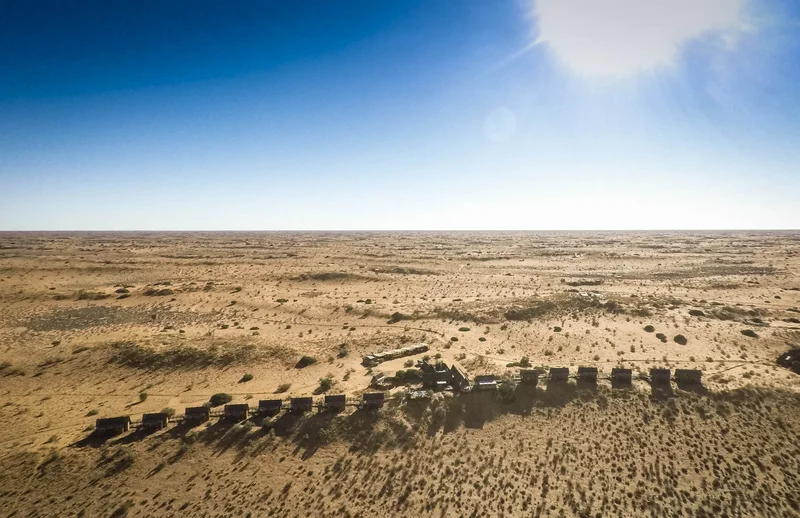
There is a question every guest of !Xaus Lodge answers before they arrive, somewhere between âwhat vehicle will you be driving?â and âany medical conditions we should know about?â It reads, innocently enough: any dietary requirements?
We have been asking it for the best part of two decades. Our address is Dune 91, off the Auob River Road. The tar ends at the Park gate, and the last stretch is 91 dune crossings. So we read the answers very, very carefully. There is no popping out for an ingredient here. If a guest needs gluten-free, the gluten-free travelled 300km from Upington to meet them.
Recently we sat down with the whole archive, nearly 6,000 bookingsâ worth of pre-arrival notes, and asked what it all adds up to. It turns out our kitchen has been quietly keeping a diary of how South Africans (and our overseas visitors) eat. Here is what it says.
One party in four
First, the headline: among guests who tell us anything about food at all, roughly one booking in four arrives with at least one dietary requirement. On a full night at the lodge, the kitchen is essentially always cooking around someone. This is simply the modern condition of hospitality, and any lodge that still treats the dietary question as an afterthought is planning to disappoint somebody at dinner.
(A booking is usually a couple or a family, so per person the figure is more like one in eight. The other seven eat most anything. Dessert is served every night. It is rarely declined.)
The great constant: the vegetarian
If you had asked us to guess which requirement had grown the most over the years, we might have said vegetarianism. We would have been wrong. Vegetarians are our great constant: steadily 7% to 9% of bookings with requirements, year in, year out, for as long as weâve been counting. Not rising, not falling. The vegetarian share of Kalahari travellers today is the same as it was back when everyone still had a Blackberry.
And the vegans? Whatever the food magazines proclaimed, the plant-based revolution never quite crossed the dunes. Vegan requests have stayed under 1% throughout, peaking at five bookings in a single year. We were ready. They mostly didnât come.
The rise and fall of Banting, as witnessed from a dune
Here is our favourite finding, because you can date a national food craze from our kitchen records with almost archaeological precision.
Low-carb requests are essentially absent from our notes until about 2014, the year The Real Meal Revolution hit the bestseller lists and half of South Africa started weighing their cauliflower. Through the Banting years the requests tick along steadily, guests arriving with polite notes about avoiding starch. And then, from 2023, they vanish: down to a third of their peak, heading for zero.
Somewhere out there is a cultural historian who would like our reservations system. The Banting era: born 2014, quietly buried by 2023, survived by its cookbooks.
The one true riser
The genuine long-term trend in the data is gluten-free, which has climbed from about 2% of requirement-stating bookings in the early years to roughly double that today. Alongside it, guests have become steadily more forthcoming about allergies generally: nut, shellfish, and the rest. Whether there is more gluten intolerance in the world or simply more willingness to mention it over dinner, we cannot say. Either way, the gluten-free supplies now make the 300km journey from Upington as a matter of routine, and they are never lonely on the truck.
The quiet fixture: âno pork, no lamb, no gameâ
Running underneath everything, steady at 3% to 5% throughout, is the guest who eats meat, just not that meat. No pork. No lamb. And, delivered with some regularity to a lodge in springbok country: no game, please. We accommodate cheerfully, though we admit the springbok take it as a compliment.
Which brings us to the finest single entry in two decades of dietary correspondence, reproduced here exactly as received:
âI have no dietary requirements (but I do hate pap).â
We have framed this sentence in our hearts. It is the most South African dietary requirement ever written.
The Covid chapter: when the international holiday came home
And then there is the anomaly, the two-year spike that puzzled us until we remembered what the world was doing at the time.
In 2020 to 2022, our dietary-requirement rate jumped to its highest level yet recorded: at the peak, more than a third of bookings arrived with a requirement. Stated allergies peaked. Fish and shellfish notes peaked. We fielded more halaal requests in those two years than in the five before. The pre-arrival forms suddenly read differently: longer, more detailed, more cosmopolitan.
The explanation, we now believe, was parked at Kamqua Picnic Site in a very capable, very well-appointed 4x4. With international borders shut, South Africans who would ordinarily have been sunning themselves on a Greek island or visiting the grandchildren in Sydney suddenly found South Africa. They came to the Kalahari, many for the first time, and they brought their travel habits with them, dietary paperwork included. They were wonderful guests. They gasped at the right sunsets.
And we owe them more than they know. The lodge had just endured 164 days without a single paying guest, from late March to early September 2020. It was these explorers of their own country who allowed us to turn the lights back on, fill the kitchen with noise again, and keep the team together. If any of them are reading this: the rusk tin is still bottomless, and you are always welcome back.
Then the borders reopened, and you can watch them leave in the kitchen records: by 2023 the requirement rate had settled neatly back to its long-term line, as though the whole episode were a tide that came in and went out again. The Greek Isles reclaimed their own. We like to think a few of them still dream of dunes.
What two decades of forms taught us
Three things, in the end.
The question matters more than the kitchen. Almost any requirement can be met 300km from the nearest deli, if we know in advance. Every disappointment weâve ever served was really a communication failure.
Silence means âI eat everythingâ, and it usually does. Two decades of experience confirm it: the guest who writes nothing on the form is the guest who asks for seconds of the slow-cooked lamb shank.
And food data is people data. We set out to count vegetarians and unexpectedly recorded a small social history of South African travel: the fads that came and went, the crisis that rearranged us, and the one immortal soul who took the trouble to tell a lodge in the middle of the Kgalagadi that they would eat absolutely anything, except pap.
We kept a seat for them. No pap was served. DM
Eleanor Muller works in tourism across southern Africa, much of it with remote, community-owned lodges. She is interested in the small, often funny details that reveal how people travel, eat and make themselves at home.