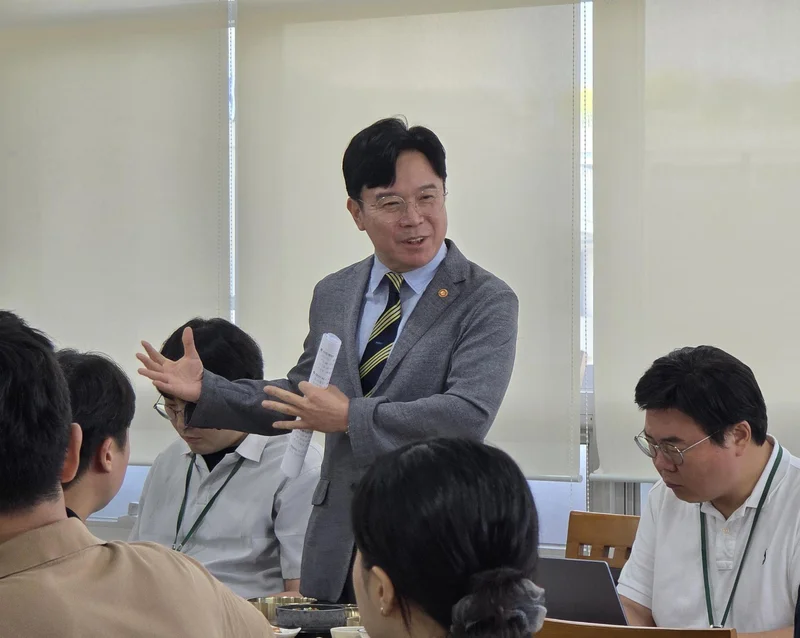
The reported plan to allow an exception to the 52-hour workweek for research and development (R&D) and other high-income personnel at the megaprojects announced by the government in late June has the Trade Minister Kim Jung-kwan and Labor Minister Kim Young-hoon at odds.
Speaking Thursday at Kwanhun Club, a journalists' association based in Seoul, the trade minister said that while the 52-hour workweek should be upheld, there is a need for flexibility in the implementation of the system in the proposed megaproject zones.
"The system should not stand in the way of young people's willingness to work," he noted.
The labor minister has been less inclined to support an exemption, noting that the country's major companies have made profits even with the 52-hour workweek in place.
In June, President Lee Jae Myung unveiled his flagship megaprojects in a bid to elevate Korea as a leader in artificial intelligence (AI) by spreading AI-related sectors throughout the nation. The initiative includes semiconductor fabrication plants in the southwestern city of Gwangju and the surrounding Jeolla provinces, high-bandwidth memory (HBM) and data packing factories in the central Chungcheong provinces, physical AI and robotics hubs in the southeastern Gyeonsgang provinces and AI data centers in Gangwon Province in the northeast.
It is an essential initiative for Korea as it looks to catapult its economy to become an AI powerhouse, with expected investments of around 4,755 trillion won ($3.35 trillion) in total. With AI investment already accelerating, speed is just as vital to success as the scale of the projects. There are already expectations of exemptions being carved out in the laws to govern the megaprojects to allow more flexible operations beyond the 52-hour workweek to facilitate the initiatives. Labor groups are already protesting.
Notably, the two ministers who should be mediating these differences are on opposing sides. Both agree that on principle, workweeks are limited to 52 hours. However, their stances differ on the bonus packages that were agreed on between companies like Samsung and SK hynix this year over operating profits and how they should be distributed to workers.
The labor minister, a former official at the Korean Confederation of Trade Unions, views excess profits as fruit produced by all. However, the trade chief, a bureaucrat with private sector experience, has expressed skepticism over bonus payments taking precedence over investments in R&D.
The booming global semiconductor landscape, where rival companies are catching up fast, is placing pressure on the top players to stay ahead.
There is a rising challenge from Chinese firms, such as memory chips producer CXMT, being posed to Korean chip companies. Following its successful debut on the Shanghai Index, CXMT is reportedly building a second semiconductor plant in Beijing. In addition, the "996 system" embedded in Chinese tech sector often sees workers reporting for work at 9 a.m. and leaving at 9 p.m. six days a week. As companies in other countries continue to catch up rapidly amid the growing global demand for chips, Korea should and must be aware of its competitors. That would mean flexible implementation of the 52-hour workweek for select R&D employees, known as the "white-collar exemption" in Korea.
The two ministers should pursue efforts to get on the same page. The government's megaprojects are critically necessary for Korea to continue as an export powerhouse as it takes its economy to the next level in the AI era. It is imperative that an exemption be considered for the proposed megaproject zones around the country.