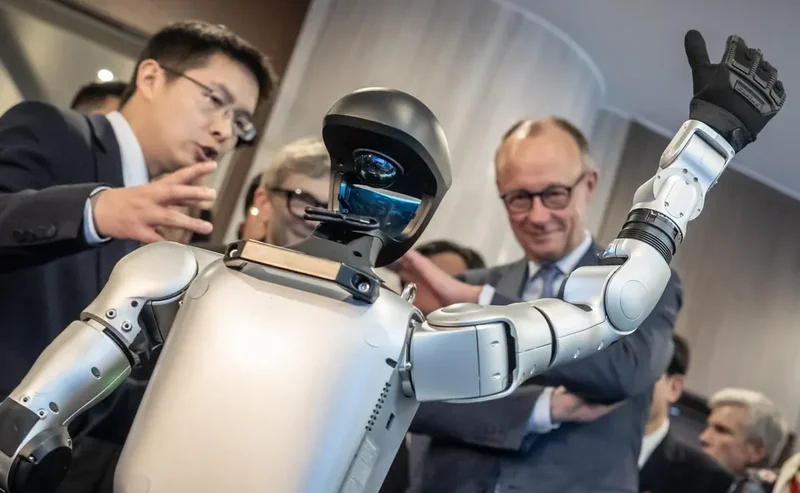
Wang Xingxing, the chairman and CEO of Chinese humanoid robot maker Unitree Robotics, has become a billionaire as the company gears up for a listing in Shanghai, testing investor enthusiasm for a firm that has largely become synonymous with the country’s humanoid robot boom.
The 36-year-old mogul, who is also the chief technology officer of the Hangzhou-based company, has amassed a fortune of $2.4 billion based on his ownership, according to Forbes estimates. Unitree Robotics is seeking to raise 6.1 billion yuan ($904 million) by selling 40.4 million shares at 150.8 yuan apiece in its initial public offering, according to a Friday stock exchange filing. The company plans to use the proceeds for developing new products and refining its software algorithms, according to the prospectus. Unitree Robotics didn’t respond to a request for comment.
Wang founded the firm in 2016 after briefly working for Chinese drone giant DJI. Over the years it has developed more than a dozen models including four-legged robot dogs and humanoid robots, while also selling components including lidar sensors and dexterous robotic hands. This year, the company lit Chinese social media on fire by launching__ GD01__, an over 3-meter tall, transformable robot that can carry a human pilot in its cockpit—priced from $650,000. In its filing, the company positions the product as a tool capable of adapting to complex environments.
The company’s real mainstream breakthrough came in early 2025. Back then, Wang was invited to meet Chinese leader Xi Jinping, along with tycoons including Alibaba cofounder__ Jack Ma__ and DeepSeek founder__ Liang Wenfeng__, as Beijing encouraged them to innovate amid a fierce technology rivalry with the U.S. The company’s robots made their high-profile debut during China’s 2025 Spring Festival gala, captivating audiences with humanoids capable of walking, running, and performing martial arts.
Growth followed rapidly. Last year, Unitree shipped 5,511 humanoid units globally, marking an over 10-fold surge from 2024, according to its prospectus. The company, which says it leads the global humanoid market in terms of shipment, has also sold over 33,000 units of robot dogs since its founding, the prospectus shows. Revenues surged over 300% year-on-year to 1.7 billion yuan in 2025, while net profit jumped almost 200% to 278.2 million yuan from a year ago, according to its prospectus. The average selling price for its humanoids is 166,400 yuan, its prospectus shows.
The stock is likely to see a strong market debut, says Shen Meng, managing director of Beijing-based boutique investment bank Chanson & Co, citing reasons including Chinese retail investors’ enthusiasm for new stocks and the firm’s market-leading position. But Unitree Robotics also faces mounting obstacles, including geopolitical headwinds and intensifying competition, it warned in the prospectus.
Last year, the firm generated over 10% of sales from the U.S., according to its prospectus. Citing reasons including national security concerns, the Trump administration__ announced in July__ a ban on imports of new Chinese humanoids and quadruped robot dogs. In its prospectus, Unitree Robotics says the ban doesn’t apply to products it already sells in America, but it needs U.S. government approval for newer models.
Meanwhile, market competition is fierce. As China seeks to nurture advanced industries and surpass the U.S. in tech leadership, the number of humanoid robot makers has reached over 200 by mid-2026, according to data provided by Shenzhen-based Gaogong Industry Research (GGII). Many harbor IPO ambitions, with competitors including AgiBot and AI² Robotics reportedly eyeing share sales in Hong Kong as soon as this year.
Unitree Robotics pointed to the intensifying rivalry as one reason for slower growth in the first three months of 2026. During the period, revenues grew 68.5% year-on-year to 422.8 million yuan, while net profit was down 52.6% to 40.3 million yuan. The company said in its prospectus that rising R&D and marketing costs forced down margins, warning it may cut prices the selling price of its humanoids to cope with rising competition down the road.