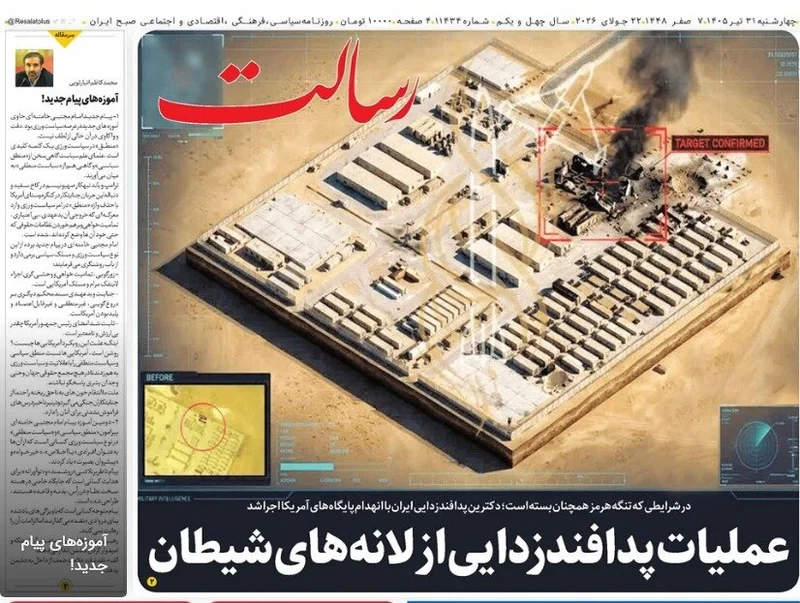
Resalat shifted its focus to the failure of the US and Israel to achieve their goals before the start of the war. It wrote: The reality of the battlefield shows that the hegemonic war machine has not achieved any of its strategic objectives.
Neither Iran’s missile and nuclear capabilities have been disabled, nor its strategic depth in the region severed, nor its political structure collapsed. On the contrary, this military adventure has not only produced no strategic achievement for Washington and Tel Aviv but has added a severe geopolitical nightmare to their list of crises: the closure of the Strait of Hormuz—an artery whose blockage directly paralyzes global energy security and targets the Achilles’ heel of the Western economy. This battlefield deadlock clearly proves how, when a hegemon tries to block the organic path of an independent power through aggression and physical elimination, it becomes trapped by its own hand in a swamp of unforeseen consequences, from which exiting is far more costly than entering.
Siasat-e-Rooz: No change will occur in Iran’s position
Trump, under various pretexts and within the Zionist game, seeks to intensify attacks against Iran. But in an environment where the power of Iran’s armed forces dominates all US bases and interests in the region, The Washington Post, quoting intelligence officials, reported that based on a new assessment, new attacks against Iran are unlikely to change Tehran’s position toward Washington. Washington is trying to intensify economic pressure—especially through blocking Iran’s oil exports—to achieve its previous goal of changing the system in Iran. War with Iran is currently the biggest international crisis facing the US government but may create an even bigger crisis in the coming years. Meanwhile, the US Secretary of Defense attended a Senate Appropriations Committee session to defend the Trump administration’s request for tens of billions of dollars in supplemental war funding.
Donya-e-Eqtesad: The outlook for reviving the Islamabad understanding
Donya-e-Eqtesad, in an analysis, addressed the 10‑day ceasefire proposal raised by mediators and the prospects for reviving the Islamabad understanding. It wrote that what is visible today is not the formation of a new agreement but the reactivation of overt and covert diplomacy in the region. The ceasefire proposal, Qatar’s new initiative, the Iranian interior minister’s trip to Pakistan, the conditional stance of the foreign ministry spokesperson, and Marco Rubio’s renewed emphasis on diplomacy all form pieces of a shared puzzle. Under such conditions, reviving the Islamabad understanding is not a definite scenario but a noteworthy possibility. If the 10‑day ceasefire moves beyond the proposal stage, it could be the first step toward reviving an understanding whose main goal is managing disputes through diplomacy and preventing escalation. However, the scenario of deception—based on the patterns of the 12‑day and 40‑day wars—should not be overlooked.
Ettelaat: The future of the crisis in the region
Ettelaat assessed the future of the crisis and war through three scenarios. It wrote that the outcome of developments shows the future of the crisis can be analyzed through three main scenarios: first, gradual escalation of war; second, formation of a new ceasefire; third, continuation of the current situation—neither full-scale war nor lasting peace. In this state, limited attacks, political pressure, and competition over regional leverage continue, and any incident can once again push the region to the brink of a larger crisis. Considering military analysts’ assessments of the high costs of a ground invasion, the most likely short-term option is continued air and naval battles and proxy warfare, along with occasional efforts to establish ceasefires. As a result, the future of Iran–US relations will continue oscillating between escalation and crisis management, and achieving a lasting agreement will face many obstacles.