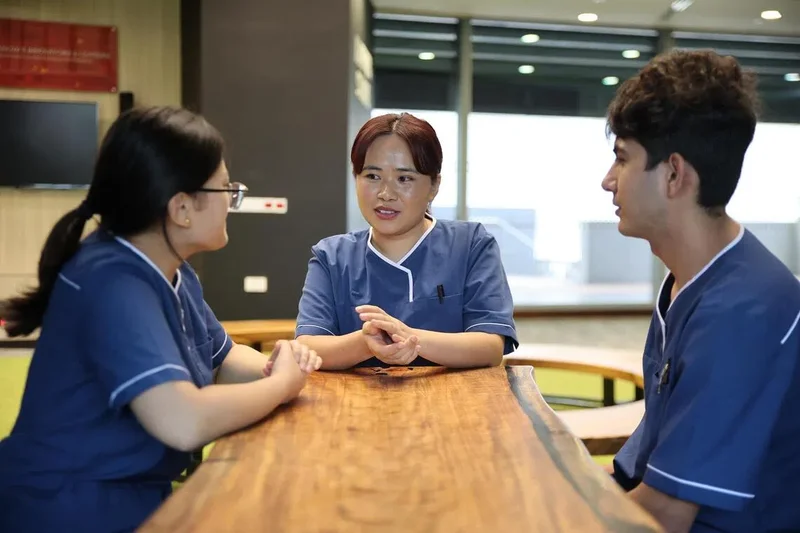
S’pore diversifies nursing talent pool with new nurses from Bhutan
AI generated
SINGAPORE - In early 2023, Darmita Rai was a nursing student at the Khesar Gyalpo University of Medical Sciences of Bhutan’s Faculty of Nursing and Public Health, a key training hub for healthcare workers in Bhutan.
After learning about Singapore’s Asian Nursing Scholarship (ANS) from the first batch of Bhutanese scholars who graduated in 2024, she withdrew from the university in her home country in the second year of her studies to apply to come to Singapore.
After completing her diploma in May, she became a staff nurse at the National Centre for Infectious Diseases, joining a growing pool of Bhutanese nurses being integrated into the public healthcare institutions here.
“Singapore is very advanced, especially its healthcare system. It is a huge opportunity to be able to come here to study and gain quality work experiences,” said Darmita Rai. “Coming here will help us grow professionally and also personally.”
According to MOH Holdings (MOHH), the holding company of Singapore’s public healthcare institutions, around 40 Bhutanese ANS scholars are now serving in the public healthcare sector.
The fully-funded scholarship, which has produced 8,000 nurses since 1994, requires a six-year bond after the scholars from Asian countries complete a three-year diploma in nursing at Ngee Ann or Nanyang Polytechnic.
They are deployed across the three public healthcare clusters in acute and community hospitals, based on operational and manpower requirements, MOHH said.
MOHH had also said in 2023 that Singapore conducted recruitment drives in the untapped markets of Sri Lanka and Thailand.
Today, foreign nurses make up about one-third of the nursing workforce in Singapore. They are a vital component of its healthcare capabilities as the country navigates a super-aged society.
A spokesperson from the Ministry of Health (MOH) said the annual attrition rate for foreign nurses leaving the public sector has stabilised at around 8 to 9 per cent on average from 2023 to 2025. This is down from 14.5 per cent in 2022 and 14.9 per cent in 2021.
“We lost many during COVID-19, and worked extra hard to bring in about 2,000 newly hired nurses a year in the last two years, including those from the Philippines, Malaysia, India and China, and more recently from Bhutan,” he said.
According to a Bhutanese news report, the inaugural cohort of Bhutanese nursing students graduated in 2024, and the third intake of Bhutanese students this year totaled 66 students.
With a projected need for 82,000 nurses, allied health professionals and support care staff by 2030, Singapore has been growing this pool.
The large majority of the nursing workforce continues to comprise locals from nursing school intakes and mid-career training programmes.
Singapore’s Institutes of Higher Learning (IHLs) recorded an intake of nearly 2,300 nursing students in 2025, and over the past years, about 8 in 10 nursing graduates from local IHLs entered the nursing profession or further nursing studies, MOH said.
In 2024, the total number of registered nurses rose to slightly over 42,000, up from 38,834 in 2023 and 36,995 in 2022. The data for 2025 isn’t publicly available yet.
Still, challenges remain. NTUC and Healthcare Services Employees Union president K Thanaletchimi said Singapore’s nursing manpower shortage situation is not just driven by the outflow of nurses attracted to opportunities in countries such as Australia and the United Kingdom.
It is also fueled by those who leave the workforce temporarily to care for family members or raise children. Furthermore, some nursing graduates choose to pursue careers outside the profession, she said.
K Thanaletchimi also highlighted the pervasive issue of stress and burnout, citing that nursing is demanding work.
“Many nurses face challenges balancing shift work, patient care responsibilities and family commitments,” she said.
To attract and retain nurses, public healthcare institutions have progressively introduced flexible work arrangements as part of their manpower strategies, with one notable example being TTSH’s “liquid workforce” model, she said.
This model segments the nursing role into clinical and non-clinical itemised tasks and allows manpower gaps to be filled through a gig workforce.
While flexible work arrangements exist, they must become more “practical and accessible” to enourage uptake, she said.
To retain foreign nurses, Singapore’s strategy includes backing the permanent residency applications of nurses who uphold exemplary clinical practices, make outstanding contributions, and show a strong commitment to the country.
However, there is no available data on the number of nurses who obtained PR status from 2023 to 2025, according to MOH.
Meanwhile, as the nursing workforce diversifies, the very nature of nursing is shifting as healthcare evolves and patient needs become increasingly complex.
K. Thanaletchimi said there will be a growing need for nurses to be generalists with broader, cross-functional skills. They will also need to leverage technology in caring for patients.
“Nurses will also play a greater role in shaping and coordinating care, rather than simply delivering it,” she said.