28,000 bottle caps, no cap! A giant map reimagines Singapore using recycled materials
AI generated
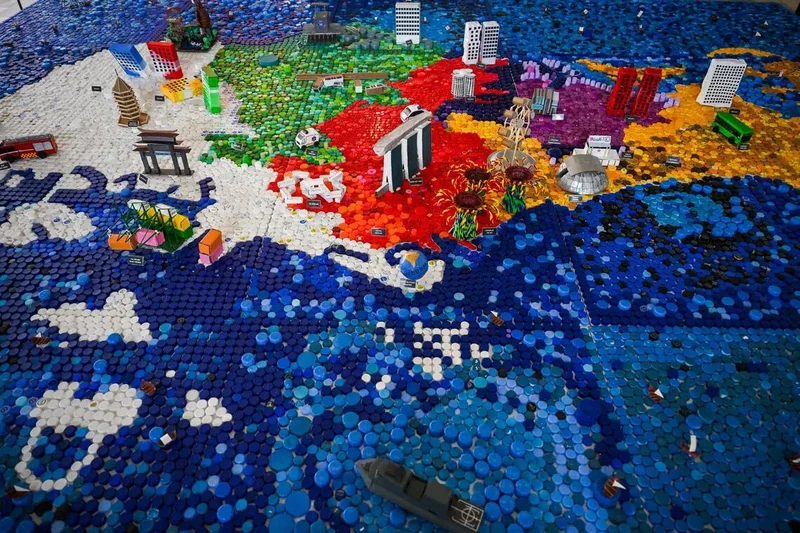
SINGAPORE – Woodlands Checkpoint, Jewel Changi Airport, Gardens by the Bay, Sungei Buloh Wetland Reserve, and the National Stadium are among iconic Singapore places and structures that have been re-created using recycled materials in a community-driven artwork.
Around 80 volunteers used some 28,000 bottle caps and other recycled materials such as cardboard and satay sticks to create a giant map of the Republic, titled Woven Harmony – A Singapore Story, to celebrate its 61st birthday.
Look closely at the 6m by 4.8m artwork displayed in the foyer of Rivervale Community Club: Not only are there replicas of landmarks across the island, you can also see handcrafted boats that represent the journeys taken by Singapore’s early migrants, as well as miniature military assets like the Republic of Singapore Navy’s multi-role combat vessel and CH-47 Chinook helicopter, in tribute to everyone who has contributed to the defence of Singapore.
Accompanying the artwork is a 22m-long quilt that line the map, sewn from donated pieces of fabric contributed by residents in Sengkang East.
The project was spearheaded by the Sengkang East Constituency Office and Rivervale Shores Residents’ Network in collaboration with the Sengkang East Community Arts and Culture Club.
It includes contributions from Temasek Polytechnic international students, and Sengkang East residents and volunteers.
Leading the project is 25-year-old Xavier Ang, a volunteer with the Sengkang East Constituency Office, who conceptualised the artwork.
“As Singapore celebrates its 61st birthday, we wanted to create an artwork that reflects our shared journey as a nation. Our greatest achievements are made possible when people come together,” said Ang, who has been creating upcycled artworks since he was 17.
Landmarks he worked on for the map include Jewel and the National Stadium, which holds the most meaning for him.
“It’s more than just a landmark, it’s where Singapore comes together for many of our biggest moments, from world-class concerts and major sporting events to our National Day Parade. This year, Singapore’s 61st National Day Parade will also be held there, making it an even more special place,” he said of the National Stadium.
Planning began in April, with residents taking several months to collect the bottle caps and fabrics.
Most of the bottle caps and fabrics were donated by residents, schools, friends and family members, while cardboard and other recycled materials were sourced from nearby businesses.
The team then took four weekends starting in July – and as much as 12 to 16 hours a day – to assemble the artwork, sew the quilt, and craft the miniature landmarks.
Final touch-ups were completed on Aug 2, the day of Sengkang East PassionArts Festival, which the installation is a part of.
The 2026 edition of the festival carries the theme “Woven Harmony”, bringing together National Day, racial harmony and environmental sustainability through recycled materials.
Among the project’s participants was Rivervale Shores Residents’ Network vice-chairperson Melissa Tan, 32, who is also one of the organisers of the Sengkang East PassionArts Festival.
She balanced her involvement in the project with caring for her almost two-year-old young son, relying on her parents and in-laws to look after him over several weekends while both she and her husband toiled over the artwork.
The couple and some other members of the residents’ network team worked on the Sungei Buloh Wetland Reserve and Woodlands Checkpoint.
“Sungei Buloh was especially meaningful to us... we wanted to highlight that Singapore is not just defined by its skyline. Our wetlands, parks and natural spaces are equally part of our identity as a City in Nature,” she said.
“The Woodlands Checkpoint was another landmark we felt represented everyday Singapore. It reflects the close ties we share with our neighbouring country and is a recognisable part of daily life for many residents.”
Tan said seeing the completed work made their sacrifices worthwhile.
“Of course we missed (our son), but knowing that we were creating something meaningful for the community kept me going. I’m also incredibly grateful for my family’s support, because this project wouldn’t have been possible without them,” she said.
On Aug 2, the artwork was recognised by the Singapore Book of Records as the largest Singapore map made from bottle caps. It will be displayed until Aug 15.
Ang said: “This artwork reflects the dedication, patience and countless hours contributed by every volunteer over four weekends. Watching everyone encourage one another, learn new skills together and overcome challenges made the journey just as meaningful as the finished artwork.
“Seeing residents stop to admire the artwork, take photos and appreciate the stories behind it is a wonderful reminder that this project belongs to the whole community, not just the people who built it.”
He also hopes the installation will encourage people to view sustainability differently.
“Every bottle cap, piece of fabric and recycled material was once something that might have been thrown away, but together they became part of a story that belongs to the whole community.”