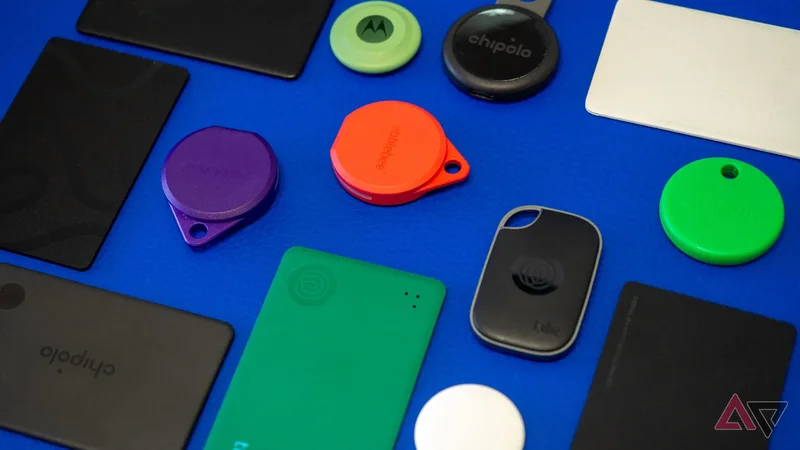
Over the last few years, I've had over 30 different Bluetooth trackers from various companies and ecosystems in my wallet, backpack, luggage, and with my keys. Apple, Samsung, Tile, Motorola, Pebblebee, Chipolo — I tried all of them, dozens of them.
I'm also extremely familiar with Apple's Find My network, Tile's Life360, Samsung's SmartThings Find, and Google's relatively recent entry into the market with its Find Hub. I know where each of them works well, and where they fail.
Over time, I've seen Google's network grow and become more reliable, too. Today, I only use it for my own personal items. So when I saw that Google was ready to release its own Pixel Tag, I was excited. And then worried. Here's why.
The Pixel Tag needs UWB and Channel Sounding
Surpass the competition or go home
For Android users, there are currently several Bluetooth tracker options out there that are as good or as bad as the network they rely on to find missing items when they're far from you.
One thing, though, remains universal: If you want to easily find a tracker when you're within reach, you need Ultra WideBand (UWB) or Bluetooth 6.0 with Channel Sounding for better accuracy. The former uses direction and distance, the latter just distance.
Supporting both is crucial because not every Android phone out there has UWB, whereas most of them already have or will have Bluetooth 6.0 with Channel Sounding. So, if the Pixel Tag wants to be compatible with most phones, it should have both.
Currently, the competition isn't hard. Moto Tags are the only UWB-compatible Google Find Hub trackers, and they work decently well. Close, far, to the left, to the right. Google needs to at least match that, otherwise, what's the point of making its own tracker?
Personally, I haven't needed nearby finding a lot with my AirTag or Galaxy SmartTag 2 or even my Moto Tag, because I usually know where my keys or wallet are. But I know both are essential for everyone else who uses these trackers. Google can't mess up here.
Google Find Hub has to get better
Make offline finding possible, please
My first few months with Google's Find Hub network in 2024 were horrific. It simply was not working. The app wouldn't detect trackers that sat right next to my phone. It wouldn't update locations for hours. It was all-around useless.
In 2025 and beyond, the network became more stable. Today, I can find my "lost" stuff a lot easier and more reliably. I stopped having issues locating nearby trackers. All of my trackers update their location as fast, if not faster, than my AirTag or Galaxy SmartTag 2.
A Pebblebee tracker on Google's Find Hub network even saved my — and other travelers' — luggage at Athens' airport. So things are considerably better, but it's not enough.
The Find Hub app needs to work offline; a nearby Bluetooth tracker should be findable over Bluetooth, without a solid signal or cell reception. That's the whole point of Bluetooth! But the app doesn't allow it now. It shows a blank screen if you're offline.
The app should also have a better way of following a moving tracker. Right now, I get Google Maps directions to get to my lost item, but those don't update once the tracker moves. I have to hop back and forth between Maps and Find Hub to see if I'm still on the right path.
Clearly, that experience is not ideal. And Google needs to fix that if it wants people to have a nice experience with its Pixel Tag. You shouldn't need to be online with an active connection to locate your keys during a remote hike.
The Pixel Tag must tick more boxes
Other trackers are doing better
My current favorite Bluetooth trackers are the Chipolo Loop and the Pebblebee Clip5, mostly the former, though, and I'll explain why in a bit. Both of them charge over USB-C, both have very loud sirens, and both have an excellent Bluetooth range.
I don't think the Pixel Tag will charge over USB-C; the design and thinness don't seem to be in favor of that. But the battery needs to be replaceable at the very least. A CR2032 coin cell is almost the norm — Apple, Samsung, Motorola, and Tile use it — and easy to buy.
It should, however, not have any compromises around siren volume and Bluetooth range. Those are non-negotiable.
Chipolo's Loop also has one feature I haven't seen in many Find Hub trackers: It lets you set the ring volume inside the Google Find Hub app. The Moto Tag does that, too, but not Pebblebee. To set a good example, the Pixel Tag should meet the competition.
What really distinguishes the Loop, though, is that if you install the companion Chipolo app, you unlock a set of extra features that no other tracker has.
I can reverse-ring my phone from my tracker (both Moto and Pebblebee offer that), choose a ringtone (only Moto has it), take a selfie (bit of a gimmick), and most importantly, set up left-behind alerts so that when I walk away from my tracker, I get notified.
The latter is unique to Chipolo among Find Hub-compatible trackers. Moto and Pebblebee don't offer it. But Samsung, Tile, and Apple have this as a default feature on their trackers, so Google should match it as soon as possible — preferably with the Pixel Tag.
I always leave it enabled, and my phone often pings me when I get out of the house and leave my backpack or keys behind.
The competition is fierce, and the Pixel Tag needs to match it
I'm not going to mince my words. There are excellent Google Find Hub-compatible Bluetooth trackers out there, especially for someone like me who doesn't care all that much about UWB. I'd put the Chipolo Loop on top of that list because of everything it offers.
For those who do want UWB, the Moto Tag is a great option with a couple of extras, like a camera remote and reverse phone ringing and finding.
The Pixel Tag is entering this crowded market and, if it wants to make me a convert, it needs to unlock a bunch of features in the Google Find Hub app that aren't currently possible. I hope it does. All the other trackers will benefit, too.
Moto Tag 2
-
**Brand** - Motorola
-
**Connectivity** - Bluetooth 6.0 with Channel Sounding, UWB
-
**Battery** - Over 600 days
-
**Water Resistance** - IP68-rated
-
**Max speaker volume** - 77dB @ 10cm
-
**Weight** - 8.5g