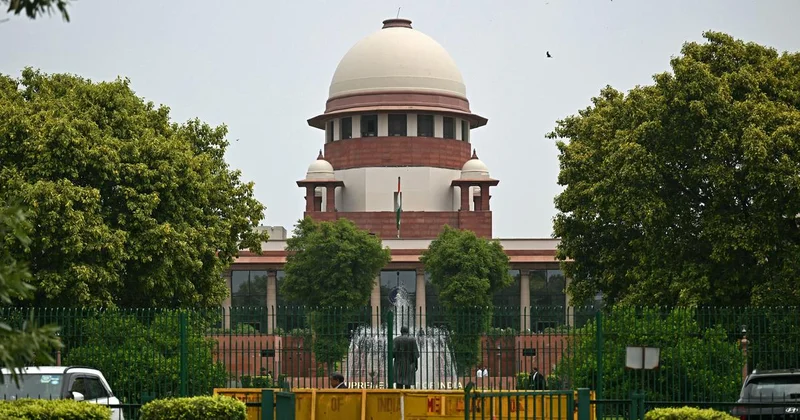
The Union government on Friday claimed before the Supreme Court that the audio clip allegedly linking former Manipur Chief Minister N Biren Singh to the ethnic violence in the state was manipulated, Bar and Bench reported.
The court was hearing a petition filed by the Kuki Organization for Human Rights Trust, which has demanded an independent investigation into the audio clips purportedly featuring Singh’s voice.
The government’s submission came after the National Forensic Sciences University in Gujarat’s Gandhinagar placed on record a forensics report about the authenticity of the clip.
Additional Solicitor General Aishwarya Bhati, representing the Union government, quoted an expert at the separate Central Forensic Science Laboratories as having stated that the full audio clip had 41 alterations, Bar and Bench reported.
The counsel urged the bench of Justices Sanjay Kumar and Sanjeev Sachdeva to dismiss the petition.
However, the bench ordered that a copy of the National Forensic Sciences University’s report be provided to the petitioner and the government, saying that both sides will be given an opportunity to address its content, the legal news outlet reported.
The recording
In the recordings believed to be from 2023, a voice purported to be that of Singh is heard taking credit for “how and why the conflict started”, bragging that he had defied Union Home Minister Amit Shah’s order against the use of “bombs” in the conflict and shielding from arrest persons who snatched thousands of weapons from the state police armouries.
At least 260 persons have been killed and more than 59,000 persons displaced since the ethnic clashes broke out between the Meitei and Kuki-Zo-Hmar communities in May 2023. There were periodic upticks in violence in 2024 and 2025.
Biren Singh had stepped down as the chief minister in February 2025 amid allegations from Kuki-Zomi-Hmar groups that his response to the violence had been partisan and that he had stoked majoritarianism.
On April 30, the Supreme Court asked the National Forensic Sciences University to examine the complete audio clip, which was more than two hours long, instead of a shorter clip that had been analysed earlier. It directed the laboratory to analyse the recording and compare the voice sample in it with that of Singh.
Edited by Tanya Shrivastava.
We welcome your comments at letters@scroll.in.