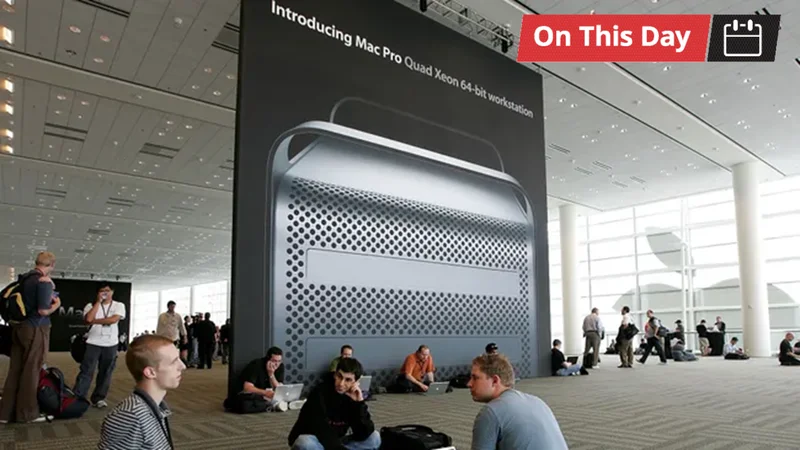
20 years ago today, Steve Jobs took to the Apple WWDC stage to unveil the first-ever Mac Pro desktop computer. As well as marking the beginning of a whole new Mac line, this was the first Apple workstation desktop to transition from PowerPC to Intel x86. Apple had already introduced Intel-powered versions of its iMac, Mac Mini, and MacBook at the start of 2006; now it was replacing the mighty PowerMac G5 tower.
While readers might remember most clearly, and even fondly, Intel-era Mac Pro computers like the ‘trash can’ or the ‘cheese grater,’ the first Mac Pro with an x86 chip looked almost the same as its G5 ancestor.
Of course, the Apple WWDC presentation was all about the new processors, and the new machine was crowned the performance king, claimed to “deliver up to twice the performance of the Power Mac G5 Quad.” The top configuration would come with two new dual-core Intel Xeon processors running up to 3.0 GHz.
“Apple has successfully completed the transition to using Intel processors in just seven months — 210 days to be exact,” boasted Apple CEO Steve Jobs. “And what better product to complete it with than the new Mac Pro, the workstation Mac users have been dreaming about.”
**Key specs of the first Mac Pro were: **
- Two Dual-Core Intel Xeon processors running up to 3.0 GHz, each with 4MB of shared L2 cache and independent 1.33 GHz front-side buses
- Nvidia GeForce 7300 GT with 256MB GDDR3, configurable up to ATI Radeon X1900 XT and the Nvidia Quadro FX 4500, both with 512MB of video memory
- 1GB of DDR2-667 fully buffered memory, expandable to 16GB
- 250GB HDD, expandable to 2TB using the four bays
- 16x SuperDrive with double-layer support (DVD±R DL/DVD±RW/CD-RW), with an extra bay for two ODDs
- 2x Gigabit Ethernet, Optional Wi-Fi 4, Optional 56k V.92 USB modem, Optional Bluetooth 2.0+EDR
- 5x USB 2.0 ports, 2x FireWire 800 ports, 2x FireWire 400 ports, various audio I/O
- 4× PCIe 1.0 slots, one double–wide for the best graphics cards of the time
- Compatible with Mac OS X Tiger at launch, supported to 10.6 Snow Leopard
Three processor choices were available at release in early 2007. As well as the top-end model with a pair of dual-core Core Xeon 5160 CPUs running at 3.0 GHz, there was a Core Xeon 5150 x2 (2.66 GHz), and a Core Xeon 5130 x2 (2.0 GHz) model. If an off-the-peg model wasn't quite right, Apple proudly claimed the online configurator allowed for "more than 4.9 million possible configurations."
To give you some pricing context, Apple released the Mac Pro with a Core Xeon 5150 x2 (2.66 GHz) and base specs bullet-pointed above for $2,499, including a Mighty Mouse and Apple Keyboard.
Get Tom's Hardware's best news and in-depth reviews, straight to your inbox.
Apple’s last Mac Pro was a 2023 model with the M2 Ultra chip. Then, in March this year, Apple confirmed there would be no future revisions of this desktop workstation flagship. The line had been effectively replaced by the Mac Studio, as a key reason for the Mac Pro to exist (upgradeability via PCIe expansion) had been sidelined by Thunderbolt 5.
Mark Tyson is a news editor at Tom's Hardware. He enjoys covering the full breadth of PC tech; from business and semiconductor design to products approaching the edge of reason.