It will be a magnificent day for England's south coast. From Portsmouth's Historic Dockyard and Brighton's Royal Pavilion to Dorset's Jurassic Coast and Cornwall's Land's End, beaches and cliff tops will be plunged into darkness in the day during the U.K.'s first total solar eclipse for almost 91 years. There is, however, a problem — this scenario won't occur until Sept. 23, 2090.
A total solar eclipse visits a location on Earth on average once every 366 years, and the British are currently in no-man's land. Aug. 12, 2026, is particularly cruel, with a path of totality cruising past the British Isles as it surges across the Atlantic Ocean from Iceland to northern Spain. Eclipse chasers in the U.K. are used to traveling, and travel they will, but those left behind will nevertheless experience a very deep partial solar eclipse peaking at 98% in extreme locations. It will be the U.K.'s most significant partial solar eclipse since March 20, 2015, when another path of totality just missed the U.K. to the north.
Related: Total solar eclipse 2026 — Everything you need to know
During a partial solar eclipse, it is NEVER safe to look directly at the sun without solar eclipse glasses designed for solar viewing. Read our guide on how to observe the sun safely.
Where to see the partial solar eclipse in the U.K.
A deep partial eclipse is a compelling sight, and the widespread nature of this one means millions of Brits can experience it without leaving home.
London, Manchester and Glasgow all experience 91.4% coverage, staggered by only a few minutes. Belfast does slightly better at 93.1%, while Cardiff edges ahead among the U.K's capitals at 93.2%. In practice, these differences are subtle — this is a nationwide event that requires no travel. That said, expect crowds at U.K. national parks, such as Snowdonia, the Brecon Beacons and the Pembrokeshire Coast in Wales; the South Downs and the Lake District in England; and the Cairngorms and the Isle of Skye in Scotland.
However, it's in County Kerry, Ireland, that sees the biggest eclipse in the British Isles archipelago, with Great Skellig — Luke Skywalker's island sanctuary in "Star Wars Episode VII: The Force Awakens" and "Star Wars Episode VIII: The Last Jedi" — seeing a whopping 98% partial eclipse.
When to see the partial solar eclipse in the U.K.
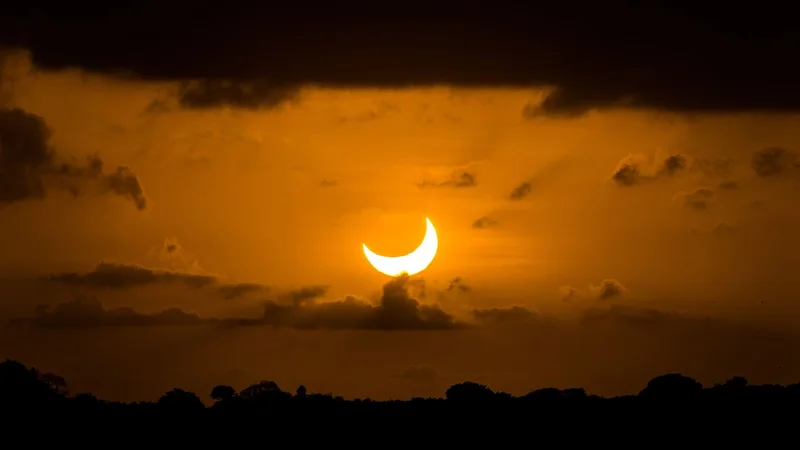
This is a late, low eclipse, and timing matters. The action takes place between 5:59 p.m. and 8:10 p.m. BST, but the main event comes around 7:05-7:13 p.m. BST, when the eclipse reaches its maximum across the U.K. The deeply eclipsed sun will appear above the west-northwest horizon as a thin crescent, hanging like a curved blade, with its tips pointing toward the ground.
It won't get dark — that only happens within the path of totality. However, daylight will feel very subdued with a noticeable dimming.
Location will be crucial. Because the sun will be so low, you'll need a clear, unobstructed horizon — ideally from a coastal viewpoint, hilltop, or open landscape. Get into position early, use proper eclipse glasses and solar filters, and follow the sun as the moon slowly takes its bite.
If you're somewhere rural, it's worth spending the night, which also happens to be the peak of the annual Perseid meteor shower.
Best weather for the partial solar eclipse in the U.K.
Whether the sky is clear on the day is another matter; August may be warm in the U.K., but it's not known for clear skies (as anyone who traveled into the last British path of totality, in Cornwall in 1999, will recall). This is why many British eclipse chasers are perfectly happy that there is no total solar eclipse in the U.K. until 2090, but statistics are not destiny. A single high-pressure system on the day could transform the outlook entirely.
Meanwhile, the path of totality crosses regions with more reliable weather patterns, particularly north-central Spain and the Balearic Islands.
Partial solar eclipse beyond the U.K.
While observers in the U.K. will see a deep partial eclipse, those inside the narrow path of totality — across eastern Greenland, western Iceland and northern Spain — will experience something fundamentally different, if only for a few minutes. In eastern Spain, totality arrives just before sunset, with the fully eclipsed sun hovering only a few degrees above the western horizon. The sun will disappear almost immediately after totality ends.
However, what's been largely overlooked is the scale of the partially eclipsed sunset across Europe and northwest Africa. Across Algeria, France, Germany, Italy, Austria, Poland and beyond, millions will see the sun set while deeply eclipsed. In some locations, maximum eclipse occurs just minutes before sunset; in others, the sun slips below the horizon still significantly covered by the moon. Expect slim crescent suns to be photographed slipping beneath the horizon from across Central Europe.
Consequently, U.K. observers will see the edge of a much larger event — the moon's expansive penumbral shadow stretching across continents. It will be one of the most widely visible and visually striking eclipse phenomena of the decade. According to Time and Date, 283 million people will see at least a 90% partial eclipse.
When is the next partial solar eclipse in the U.K.?
If Aug. 12, 2026, feels like a one-off, it isn't. The U.K. is in the midst of an unusually active spell for partial eclipses, with at least one visible almost every year through the end of the decade. After this deep event comes a more modest partial on the morning of Aug. 2, 2027 — linked to the century's longest total eclipse over North Africa — with a maximum obscuration of 48% in southern England.
On Jan. 26, 2028, attention shifts once again to a partially eclipsed sunset during which up to 56% of the sun will be obscured by the moon. That one will be best seen from western locations such as Cornwall and Wales, while the central path delivers an annular "ring of fire" across Portugal and Spain. The June 12, 2029, eclipse is much more marginal, visible only from northeast England and eastern Scotland as a shallow partial eclipse at sunrise. Finally, on June 1, 2030, another annular eclipse brings a partially eclipsed sunrise to the entire U.K., with up to about 49% of the sun blocked by the moon in the southeast.
Individually, these events are varied — morning, sunset and sunrise eclipses, deep and shallow — but taken together they form a rare sequence for armchair eclipse chasers in the U.K. who likely won't be around for totality 64 years from now.
Want to know how to make the most of your eclipse viewing experience? Our best solar viewing gear for 2026 is here to help. We also have a guide on how to photograph a solar eclipse for those looking to take an even closer look at our star.
Be sure to stay up to date with all the latest news with our total solar eclipse live blog, where skywatching editor Daisy Dobrijevic will be sharing her experience of totality from aboard a HX Expeditions cruise ship in the waters off eastern Greenland. Skywatching writer Anthony Wood will also be bringing reports of each eclipse phase from central Spain, as he watches the eclipse accompanied by citizen scientists from the Dynamic Eclipse Broadcast initiative.
Jamie is an experienced science and travel journalist, stargazer and eclipse chaser who writes about exploring the night sky, solar and lunar eclipses, the Northern Lights, moon-gazing, astro-travel, astronomy and space exploration. He is the editor of WhenIsTheNextEclipse.com, author of A Stargazing Program For Beginners, co-author of The Eclipse Effect, and a senior contributor at Forbes.