Even the Finns have to journey with purpose to get to the Savonlinna Opera Festival, which has been going strong for well over 100 years. There are Londoners who think that the trip down to East Sussex to Glyndebourne is a major outing, but Savonlinna requires a four hour train journey north-east from Helsinki: an intercity train followed by one of those two-carriage local things that trundle for the final leg through forests of pine and birch, with the occasional glimpse of lakes.
On the way the rails run parallel to the Russian border, at one point coming within a few hundred metres. That border is closed now, of course, and the festival no longer has the old influx of visitors from St Petersburg. They have been replaced by the British, Danes and Americans.
When the trees clear and Savonlinna appears, the view is breathtaking. Its 15th century castle dominates the lake, Finland’s largest. In the courtyard, covered for the season, opera plays to an audience of over 2000 for a month (this year 17 July to 9 August, in 2027 from 3 to 31 July). The programme is a mixture of the festival’s own productions, co-productions and each year a guest company from around the world. This year the guest was the company from the other end of the Baltic in Gothenburg.
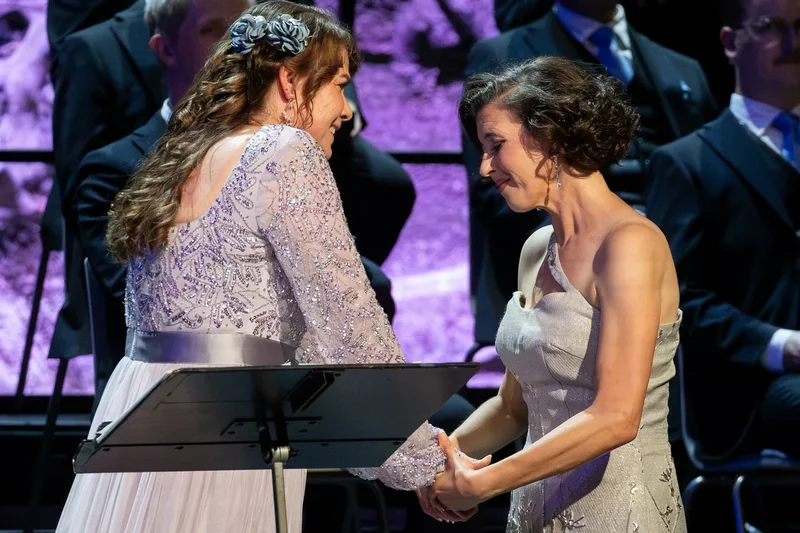
The ensemble, orchestra and chorus proved to be among the finest. The performances they gave of Verdi’s La Traviata and Bellini’s Norma were not remnants of last season but previews of next, and Swedish audiences are in for a treat when the trucks arrive home. Both were musically triumphant. In Norma the title role was sung for the first time in her career by Lisette Oropesa. It requires a soprano at the peak of her powers and believable as a high priestess and young mother at the same time. So, at 42, Oropesa is perfect. This is one of the most vocally challenging roles in opera, but Oropesa has the range and agility to make those demands sound an entirely natural consequence of the libretto.
She did not monopolise the singing honours though. Ann-Kristin Jones (fully Swedish despite the Welsh-looking surname) was Oropesa’s equal, singing Adalgisa, the younger priestess who unwittingly becomes her rival in loving their enemy Roman ruler. Jones is far less famous than she should be. Hers is a voice of power, blending with Oropesa’s with beauty in their duets. This was one of those rare evenings in opera when there were no weak links in the cast or orchestra. The stone walls of the castle act as natural amplifiers so the sound is huge.
Norma was acted but not staged at Savonlinna, unlike La Traviata the previous evening, which turned out to be a bonus. Acting Violetta in the Verdi was Venera Gimadieva, the same age as Oropesa but not singing the main role for anything like the first time. She is something of a specialist, having sung it first at Savonlinna in 2013, the next year at Glyndebourne, and in 2015 at Covent Garden. Not surprisingly she glides through the arias and knows just how to bring the audience’s focus on to her fatal struggle against consumption, whatever the frenzy around her. This was no easy task here, with director Silvia Paoli unable to resist cluttering the stage with unnecessary business: furniture movers wearing rabbit heads; chorus members inventing endless distractions; some particularly disruptive lighting. Luckily Gimadieva’s brilliance shone through and was matched by Yngve Søberg as the misguided and destructive Germont father, his magnificent baritone voice more often to be heard at Norwegian National opera.
The lure of Savonlinna is as much about the castle and its setting as the quality of the music. The first is unchanging and when the music-making is as fine as this, the experience is properly overwhelming. And then, after Norma, strolling back from the castle as the sun went down behind us at midnight and the full moon rose over the lake to the east, the fireworks crashed into the sky to mark Savonlinna’s 385th birthday as a city. I mean, honestly, wow!