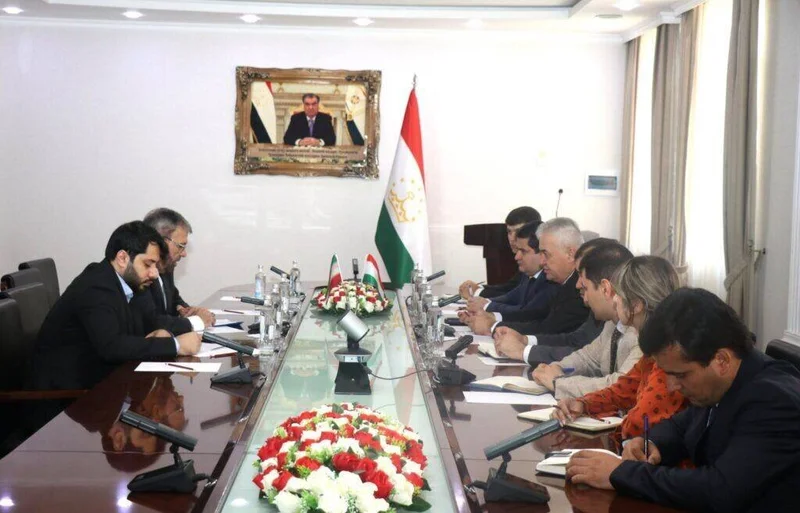
Tehran, Dushanbe discuss ways to deepen scientific, educational co-op
TEHRAN – Iranian Ambassador to Tajikistan, Alireza Haqiqian, and Tajikistan’s Minister of Education and Sciences, Rahim Saidzod, have explored avenues to enhance scientific and educational collaborations, particularly ways to increase the number of scholarships to university students.
Currently, Iran and Tajikistan each award 50 scholarships mainly to medical students from the other country, IRNA reported.
Implementing joint research projects, developing textbooks, academic books, and expanding cooperation between universities of the two countries, as well as expanding the teaching of Persian language and literature were among other discussed issues.
Both parties emphasized education scholarship a key factor in fostering academic and scientific interactions. The increase in scholarship quotas had previously been raised during a meeting between Rustam Emomali, Chairman of the National Assembly of Tajikistan, and Mohammad-Baqer Qalibaf, Parliament Speaker, in 2024.
Establishing joint scientific committee
In November 2025, Tajikistan’s ambassador to Iran, Nizamuddin Zahedi, underlined the need for the establishment of a joint scientific committee between the two countries.
Referring to the expansion of relations between Iran and Tajikistan within recent years, Zahedi said collaborative efforts in educational fields can be further expanded through resuming scholarships to attract more Tajik students and developing a joint scientific committee to hold regular meetings and come up with solutions to benefit from the optimal capacities of the two countries, IRNA reported.
The Tajik official made the remarks in a meeting with Saeed Habiba, the head of the Organization of Student Affairs.
He also proposed exchanging students to improve the quality of education and facilitate learning the Persian language for Tajiks.
Underscoring Iran’s high educational capacity, Zahedi voiced Tajikistan’s interest in promoting scientific ties with Iran and attracting Iranian students in different fields.
For his part, Habiba highlighted cultural, linguistic, and historical commonalities between Iran and Tajikistan, saying that science diplomacy is the most effective means to promote scientific cooperation with Tajikistan.
The official underlined the country’s achievements in science and technology, particularly nanotechnology and biotechnology, noting that Tajikistan’s universities can collaborate directly with Iran’s top universities in various fields.
Habiba went on to say that Iran plans to attract 320,000 foreign students and grant scholarships to Tajik students.
In June, Iranian Foreign Minister Abbas Araghchi, in a meeting with Tajik President Emomali Rahmon at the Palace of Nations in Dushanbe, highlighted Tehran’s commitment to expanding relations with Dushanbe, emphasizing that Iran views cooperation with Tajikistan as a strategic priority.
He pointed to the shared linguistic, cultural, and historical ties between the two nations as a solid foundation for deepening cooperation in key areas, including trade, diplomacy, education, and cultural exchange.
For his part, President Rahmon described Iran-Tajikistan ties as rooted in centuries-old friendship and mutual respect. He called for further efforts to boost cooperation in light of current regional challenges.
The two sides discussed the current state of bilateral relations and exchanged views on expanding collaboration. They also reviewed regional developments, including the evolving situations in the Caucasus, Central Asia, Afghanistan, and West Asia, and shared their perspectives on mutual security concerns.
MT/MG