Various journalists have tried and failed to investigate the origins of turducken, that matryoshka-inspired dish of a chicken nested inside a duck nested inside a turkey. One chef in Louisiana claims to have invented the dish but refused to tell the New York Times when or where he created it, or even his age. But turducken is best understood as a modern combination in an ancient lineage of engastration, a cooking technique in which one animal is stuffed inside another.
Other famous entrants in the genre include haggis, a potpourri of sheep organs stuffed inside its stomach, and kiviak, a wintertime Inuit dish made of little auks that ferment inside sealskin. The most ostentatious engastration may well be Alexandre Balthazar Laurent Grimod de La Reynière's rôti sans pareil, or "roast without equal," which called for "a bustard stuffed with a turkey, a goose, a pheasant, a chicken, a duck, a guinea fowl, a teal, a woodcock, a partridge, a plover, a lapwing, a quail, a thrush, a lark, an ortolan bunting and a garden warbler."
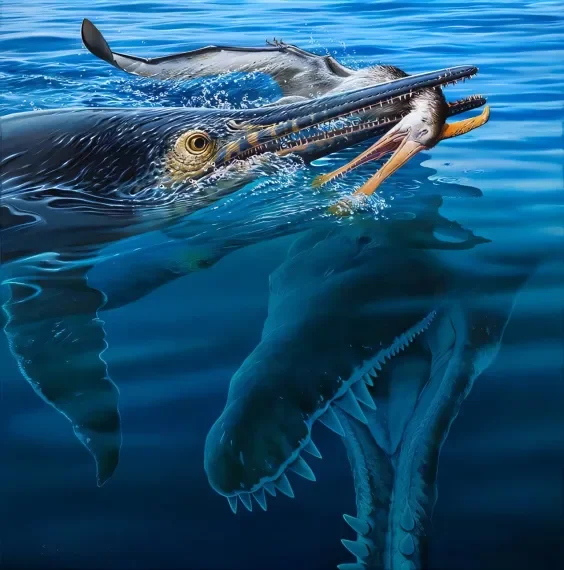
In nature, however, engastration is simply a way of life. To swallow someone whole often also involves swallowing whoever they recently swallowed. Scientists recently discovered an exemplar of this all-natural turducken from around 100 million years ago in the Cretaceous. The recipe is as follows: Stuff some early cephalopods inside a flying reptile called a pterosaur, then stuff that pterosaur inside a marine reptile called an ichthyosaur. As a garnish, feed part of the ichthyosaur to an even larger marine reptile called a pliosaur. The fossil was found in Queensland, in what was once the shallow Eromanga Sea, and described in the journal Gondwana Research.
The fossil was first spotted in the wild by two couples, Mike and Cathy Freeman and Gary and Barb Flewelling, according to a press release. Mike and Cathy and Gary and Barb had come to find fossils at a public site in the outback. The fossil was collected but was not immediately identifiable, and as such was nicknamed BOB, which stood for "Bag of Bones." Three years later, a curator from the Kronosaurus Korner Museum in Richmond, Queensland, returned to the site to discover most of an enormous ichthyosaur. When researchers scanned some rock nodules found near the ichthyosaur's skull, they found the remains of a pterosaur's jaw and its last meal.
To understand how this fossil came to be, imagine, if you will, the waves of the Eromanga sparkling under the sun. A pterosaur skims the surface of the sea like a storm petrel, scooping up unsuspecting prey of fish or squid-like cephalopods called belemnites. Then the pterosaur's beautiful day is rudely interrupted by the gnashing jaws of an ichthyosaur, which lunges out of the water like a dolphin to gobble down the pterosaur. Karma then comes for the ichthyosaur, which does not have enough time to digest its meal before sinking to the seafloor head-first, shattering its jaw upon impact. What, exactly, happened to the ichthyosaur is unclear, but it appears to have involved a giant pliosaur such as Kronosaurus, which could reach lengths of 43 feet. The ichthyosaur's bones were crushed and split in patterns suggesting it was eaten in chunks by the pliosaur, which might have attacked the ichthyosaur in the water column or scavenged its carcass on the seafloor.
In this light, the pliosaur is the phantom fourth, even bigger bird of the turducken, whose bones were not literally present in the found fossil but almost certainly swallowed parts of the ichthyosaur that had swallowed the pterosaur that had swallowed the fish and belemnites. We cannot consider the various critters said fish and belemnites might have consumed, which would multiply the levels of the turducken quite impressively, but also threaten the analogy in this infinite scope, meaning the various worms and shellfish and algal mats that would be so implicated in the food chain. But the fossil does represent a rare piece of evidence of a three-level predator interaction from the Cretaceous, as well as the first evidence of an ichthyosaur eating a pterosaur. In the shallow seas of the Eromanga, even enormous predators themselves became prey.
All of this brings me to back to my question: Would you eat this Cretaceous turducken? The challenge of turducken and any engastration is its preparation. A blog from ThermoWorks, a manufacturer of precision thermometers, dubs the turducken a "thermo-logistical nightmare." A turducken is essentially an enormous orb of meat whose very center must reach food-safe temperatures, which seems a recipe for dry meat. "There is a hard and bitter truth embedded in this: Any enjoyment people get from most turducken is false joy driven by novelty and gravy," per the blog.
Fortunately, this modern turducken problem would not have been a problem for the pliosaur, which would have enjoyed its ichthyosaur meal raw, given the impossibility of making fire in the ocean and the fact that non-human animals both modern and extinct do not cook. One can only imagine the real joy this pliosaur had upon crunching through the meaty flesh of the ichthyosaur to discover, perhaps, the subtle tasting notes of a pterosaur and the small and crunchy skeleton of its fishy breakfast. Bone appétit!