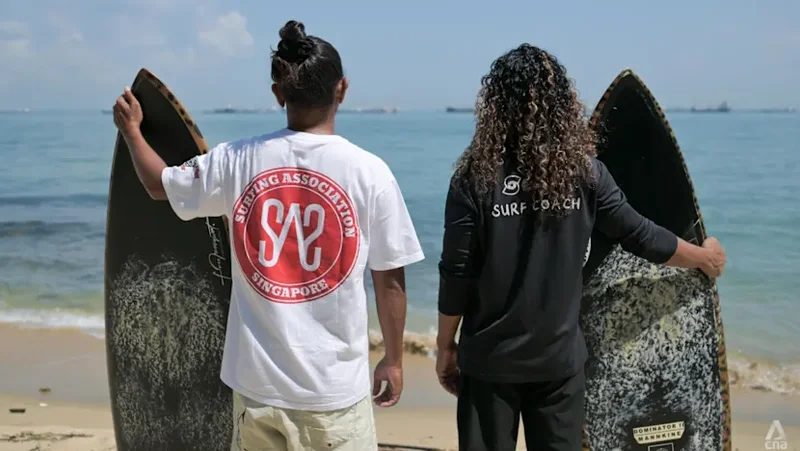
The last wave? How Singapore's only surf break grew a community of more than 100
The spot remained a closely guarded secret for years before a surge in numbers during the COVID-19 pandemic. Now, the impending "Long Island" project clouds the community's future with uncertainty.
Avid surfer Haridzal Arshat was in his 20s when he first heard whispers about a "secret" surfing sanctuary tucked away in Singapore.
This fabled spot was where waves didn't just ripple, but could actually be surfed – something practically unheard of in local waters.
Mr Haridzal, now 47, recalls how the "OG surfers" – a tight-knit group of lifeguards and seasoned surfers who first discovered the break – kept mum about the location, only dropping cryptic hints about its existence.
After some diligent sleuthing, Mr Haridzal and his friends eventually found the spot where waves break right at the mouth of a concrete storm drain, just off Changi Coast Walk.
It was affectionately dubbed "Longkang Point", using the Malay word for drain or canal.
Unlike popular neighbouring surf destinations such as Indonesia's Bali or Malaysia's Desaru, Singapore is sheltered by landmasses that block major ocean swells, leaving the nation's coastal waters mostly flat.
While the waves at Longkang Point are modest by international standards, to surfers like Mr Haridzal, their rarity makes them feel far more special than any swell he has to travel off-island to reach.
"To see waves breaking on our shores ... we were ecstatic," said Mr Haridzal, who works as a lifeguard and swimming instructor. "We are in Singapore, and we get to surf!"
The spot remained a closely guarded secret for years before word finally spread during the COVID-19 pandemic, when borders were closed and surfers were unable to travel to beaches abroad to catch a wave.
Today, Longkang Point is regularly visited by a community of roughly 100 people, ranging from curious novices to seasoned veterans like Mr Haridzal.
It is also set to disappear when the "Long Island" project, Singapore’s long-term land reclamation project to protect against rising sea levels, begins preparatory works in late 2026.
The first phase of the project aims to cover an area of about 570 ha, the size of about 800 football fields, in the waters west of Bedok Jetty. It will span around 7km in length from east to west, and up to 1km wide from north to south.
Physically building over the area will permanently disrupt the seabed mechanics required to generate Singapore's only natural surf waves – leaving the future of its surfing community uncertain.
HOME TO LOCAL SURFERS
Longkang Point surfers told CNA TODAY that the break is active only during the northeast monsoon, from December to early March.
Given the inconstant nature of Longkang Point's waves, timing is everything, said Mr Mohamad Nazir Salleh, president of Surfing Association Singapore.
The 55-year-old is among the few "OG" or "original" surfers who first discovered Longkang Point as a surf spot, a discovery he describes as accidental.
In the late 1990s, Mr Nazir – known locally as Ajill – and a few surfer buddies were working as lifeguards at the National Service Resort and Country Club. During break times, they often ventured out for walks along the Changi coast.
On one such walk, they noticed a stretch of beach just a few hundred metres from the resort where waves were breaking on an otherwise flat coastline – waves that looked "surfable", recalled Mr Nazir.
Excitedly, the group first tried body-surfing – riding the waves with their bodies – before they began bringing their surfboards.
At the beginning, said Mr Nazir, it was just this close-knit group and some of their families visiting the spot.
Over the years, as more people caught wind of the place, their numbers grew, even including non-surfers who didn't venture into the water but wanted to enjoy the action.
"This is the perfect surf spot for families and friends and kids. Even the older folk can enjoy it there."
Mr Nazir has used the spot to teach his own sons to surf. He does not mind that the waves are nothing like Bali's.
"I get the kids out. They get to understand the ocean and what surfing is all about," he said. "I'm happy."
His 21-year-old son, Mr Aniq Kailani, has been surfing at Longkang Point since the age of five and knows well just how mercurial the waves there can be.
"It's a gamble," he said. "Every time there are waves in Longkang Point, it's very special because it's a rare thing to see. It's like seeing a unicorn."
Mr Darimi Mohamed, 44, who was already surfing at famed regional spots, caught on to Longkang Point in 2001.
The personal trainer, who has been surfing since he was 17, said the spot's smaller waves were an asset rather than a drawback: they make the sport far less intimidating for beginners, particularly children. And because it sits on a public beach, anyone can turn up.
Another early regular, Mr Juraimi Jumali, 39, heard about Longkang Point around 2011 from a friend who was working at the chalet fronting the point, and paddled out fresh from a trip to Bali and Desaru.
At the beginning, the stage technician said he could count the other surfers lining up in the water on one hand.
Then, during the pandemic, the numbers exploded.
Among those in this upsurge were Ms Yvonne Chong, 44, and her husband Mr Cody Adnan, 45.
The couple had surfed before overseas, but on their first visit to Longkang Point in 2022, they were unsure if they would be welcome. However, their initial doubts disappeared the moment they stepped on the beach, with strangers all around offering warm smiles and greetings.
"I learnt so much at Longkang Point. It was like back to basics (for surfing) and everyone was so friendly," said Ms Chong, who is the co-owner of the surf brand Salty Attic with Mr Adnan.
For her, the sport was as addictive as the company around her. "I got hooked. I was there almost every day of the season."
But even during monsoon season, swells – sets of waves generated by distant storms – are not guaranteed.
As such, devotees of Longkang Point must also become part-time weather watchers, tracking the size and direction of waves and tide changes via apps and websites.
When all these elements line up just right, they race down to the far eastern end of East Coast Park for a brief but precious two-to-three-hour session on the waves.
In 2024, a rare swell arrived over the Chinese New Year period and held at shoulder height for three days. Mr Adnan and Ms Chong pushed their family reunion dinner to a lunchtime gathering instead, and surfed all three days to fully savour nature's gift.
They were not the only ones, they confessed with a shared laugh.
"(Out on the waves,) there were many Chinese people 'sacrificing' their Chinese New Year as well," said Mr Adnan.
Ms Inez Alsagoff, 27, started surfing at Longkang Point only last year. On her first day at the surf break, she was shocked to find at least 100 people in the water.
"The fact that we even have these small waves that you can actually catch with a board was pretty crazy," she said.
Despite its beginner-friendly appeal, Longkang Point has a unique charm even for more seasoned surfers – including some who have gone pro.
Ms Beckie Liu, 31, who represented Singapore in longboarding at the 2019 SEA Games, is now based in Bali, where a good wave is a given. However, Longkang Point still holds a special place in her heart, even though there might be waves only 10 to 20 days a year.
"When I surfed there for the first time in 2018, I thought it was just magical," said Ms Liu.
What made Longkang Point matter, she said, was never the quality of the surf. It was the fact that it existed at all in the most unlikely of places – the one she called home.
"The city (skyline) is in the background and when the sun is setting, you just don't feel like you're in Singapore."
FOR FAMILY AND FRIENDS
Surfing may be what first brings people to Longkang Point, but many told CNA TODAY that the true magic of the area has become the community that has grown around it.
Ms Alsagoff recounted one occasion when her surfboard was too small to catch any of the waves at Longkang Point, and someone in the line-up readily offered her their board.
"Everybody's laughing and cheering each other on," she said.
This is not always the case at bigger surf breaks, she added, where surfers can sometimes come across as colder and more aggressive.
"There is a beauty to this really tight community, with uncles, aunties and kids (all together)."
Mr Juraimi said that surfing at Longkang Point is, in his experience, less about showing off or stealing the spotlight. "Our surfing is more about sharing the wave, being gentle and friendly with people, and teaching beginners or those who want to become athletes."
"It's never about who catches the best wave or who catches the longest wave," agreed Mr Aniq.
"We are all in this together, for the same passion."
Ms Chong said that at Longkang Point, space constraints often result in surfers having to share waves rather than ride them freely alone. But she, like many others, said that it's never a source of tension or conflict.
"Although it's a lot of people surfing one wave, like five people to one wave, we have so much fun."
There is a beauty to this really tight community, with uncles, aunties and kids (all together).
After the surf, one often sees people setting out deck chairs and snacks, passing around treats like curry puffs as surfers and spectators alike talk animatedly about the day's waves.
Friendships formed at Longkang Point often don't stay within Longkang Point, either.
For Mr Adnan, the place reconnected him with some childhood friends who also became regular visitors to the spot.
It also brought him new friends from Australia and Indonesia, with whom he has since taken overseas trips to Malaysia, Indonesia, and even Thailand to catch waves together.
MORE THAN A SURF SPOT
With the impending loss of Longkang Point, what its devotees stand to lose is not just a surfable wave, but what they call a "home break".
"When you say something is a 'home break', it means it's very special," said Ms Alsagoff.
"(It means) this is where you learnt how to surf, this is where you surfed all the time, or this is where all your friends are."
Dr George Wong, an assistant professor of sociology at the Singapore Management University, said that local surfers may see Longkang Point as a manifestation of their shared identity, which is built around living with nature, and as a precious avenue for them to claim a space of their own in a dense city-state that is becoming more urbanised.
This shared sense of pride and belonging, he noted, has made Longkang Point "a place of significance that cannot be replaced by just another surfing spot".
Dr Rita Padawangi, an associate professor of sociology from the Singapore University of Social Sciences, agreed that the process of making one specific place meaningful can never be wholly replicated elsewhere.
"Social relationships and collective memories formed induce these places to emerge organically, and no two places are ever the same."
Indeed, Longkang Point is laden with cherished memories for many of its regulars.
Upon discovering it in his 20s, the surf spot quickly became a cornerstone of Mr Haridzal's life. When he became a father in his 30s, Longkang Point was also where he taught his first son to surf, followed by his second son a few years later.
For Mr Haridzal, surfing is the primary way he bonds with his children, now aged 15 and nine.
"We'll talk about how good the waves were … It's something to share with my kids."
Mr Nazir's younger son, Aydin Kayani, remembers one Friday afternoon in his Primary 2 year when he walked out of school to find four cars waiting for him, surfboards strapped to the roof of each vehicle. Packed into the seats were Mr Nazir, his surfer buddies, and a pair of surf shorts for Aydin.
"We surfed the entire afternoon (at Longkang Point) until it was dark," said Aydin, now 16 years old.
His older brother, Mr Aniq, said that even though the family lives in the west of Singapore, it's always worth the two-hour journey via public transport to the east for just a couple of hours at Longkang Point.
"Yes, it's very inconvenient (to get there). But every time I hit the spot, it makes my whole damn day."
Surfers told CNA TODAY that while they understood the need to prevent further erosion of Singapore's coastlines, it was hard not to lament the loss of the space and what it means to the community.
"A home break is very important," said Mr Juraimi. "No matter the wave, small or big, at least we have a wave – rather than another country where they don't have waves at all."
Mr Nazir confessed to being "heartbroken", but added that he can see why the "Long Island" project is needed, having himself observed coastal erosion and flooding at East Coast Park.
"There's nothing much we can do except to (voice our sadness)."
Mr Aniq said that besides the surfing itself, he looks forward to seeing the same faces turn up at the beach and out on the waves.
"There are no words that can explain how special Longkang Point is."