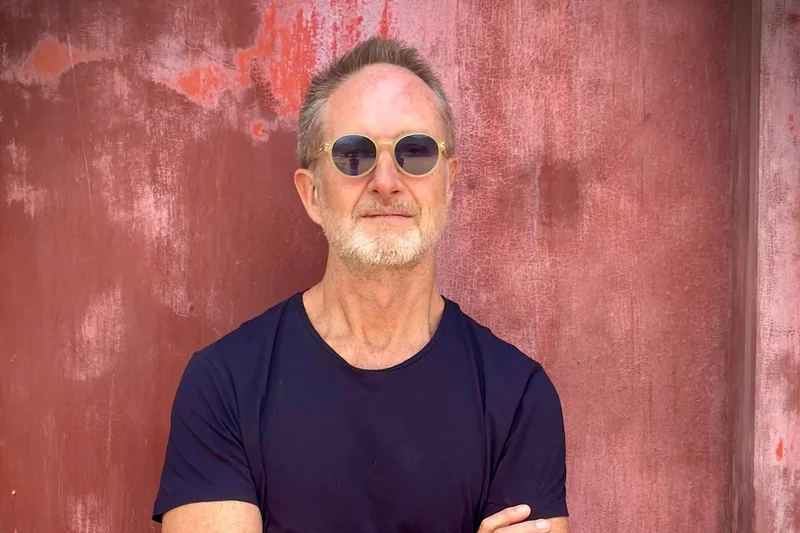
There’s something about sitting poolside on holiday that just seems to encourage big thinking. Maybe you’ll start charting a new course for your life, or you’ll be surprised when a brilliant business idea seems to saunter into your mind fully formed. Perhaps it’s being removed from the stresses of your everyday routine that allows your brain to meander – or just the heady commingled scent of chlorine and sunscreen.
Indeed, Orlebar Brown founder Adam Brown can trace the inspiration for his game-changing swimwear brand back to a trip to northwest India. It was 2005, and he had been working in the voluntary sector before pivoting to photography, but he “hadn’t really found what I wanted to do, and didn't have any particular purpose in life”, he says.
He’d been invited to celebrate a friend’s 40th birthday in Rajasthan, joining a group of “married, single, straight, gay people of various ages”. When they gathered around the pool, Brown noticed that while the women looked chic, even the men who typically appeared stylish and self-assured on their home turf looked a bit, well, underwhelming in their ill-fitting trunks.
Then, when they headed to lunch at the hotel, Brown was asked to change out of his swimming shorts to meet the restaurant’s dress code. Afterwards, he “sat on a sun lounger and started playing with words. And I just thought, ‘I don’t want a swim short, I want a short that I can swim in.’”
What if he could make trunks that actually fitted properly, with traditional tailoring, that men could happily wear from the beach or the pool to the bar in the evening? “Just having a decent fitting pair of shorts would be way better than having some voluminous wet bag draping around my knees, or something far too small and too tight,” he says.
That poolside brainwave would provide something of a mission statement for his future brand. When he returned to London, he did some market research, scoping out what was currently on offer from other brands in the swimwear stakes.
Most of the big names in luxury fashion, he says, would include a pair of swim shorts and perhaps throw in the odd print shirt as part of their summer collection; sports and surf brands had the more practical side of swimwear covered. But “there’d been nothing tailored or stylish or elegant in men’s swimwear since the Fifties and Sixties” – indeed, the whole category “felt like an afterthought”.
Undeterred by his lack of fashion world experience, his next step was “a three-day ‘start your own fashion business course’ at the Portobello Business Centre”, followed by a short drawing course at Central St Martins.
Just having a decent-fitting pair of shorts would be way better than having some voluminous wet bag draping around my knees
Brown’s design for his initial pair of tailored swim shorts was “based on the traditional pattern of a man’s pair of trousers, with side fasteners to adjust, and a tailored waistband”. He found a factory that made 1,000 pairs in four lengths and five colours, stashed them in a storage unit in west London and “just started selling”.
Initial moodboards were full of retro swim and holidaywear references, such as Sean Connery in [James Bond movie] Dr. No, actor Steve McQueen, and the likes of David Bowie and Roxy Music’s Bryan Ferry holidaying in the Seventies. “It was never going to be too slouchy and untidy or messy,” Brown says. “It was always going to be smart and refined and elegant and easy.”
Beyond the aesthetic, though, instilling a sense of confidence in the wearer was a top priority – a factor that received a lot of airtime in conversations around women’s swimwear, but had been seemingly overlooked when it came to men’s options. Brown was 40 when he started the brand; he says, “and when you’re 40 years old, and you go on a beach, and you’ve taken all your clothes off, and you’re standing there, you feel quite exposed”.
A key question for him, then, became: “How do you get men to feel better, and give them more confidence when they’re standing on a beach or they’re going to a beach bar abroad or whatever?” If “the proportions are right”, he concluded, “it’ll ultimately make the person who’s wearing it look better, and that’s regardless of their body shape”.
Since Orlebar Brown launched in 2007, the company has expanded into “a whole collection of holiday and resort wear for men, T-shirts, polos, linen shirts, trousers, outerwear”, all based around the “tailored aesthetic of the original shorts” – “Everything has to relate to that. If it doesn’t, then the brand fundamentally gets pulled out of joint.”
They opened their first brick-and-mortar boutique in Notting Hill in 2011, not too far from that original storage unit. And not too long after that, a breakthrough came when Daniel Craig’s James Bond wore Orlebar Brown’s Sky Setter shorts during a Hong Kong rooftop scene in the 2012 movie Skyfall.
“It was a blink and you’ll miss it moment, but it was a moment that made a fundamental difference to our brand,” Brown says – surely it also felt like coming full circle, given that Connery’s 007 was among the original inspirations. ** **Brown and his team had no idea that they’d received the 007 seal of approval until the film’s release – “somehow we appeared on a sample rail [for the film]” – although they knew that Craig liked to wear their T-shirts off-screen.
Since then, they’ve collaborated with the franchise on pieces inspired by the super-spy’s look, as well as trunks featuring artwork from the series’ archives. And their designs have also cropped up in the third season of HBO’s The White Lotus, worn by the preppy Ratliff brothers on their ill-fated family trip to Thailand. * *
The brand now boasts more than 50 stores around the world, with outposts in cities such as Paris, Los Angeles, Mexico City and Dubai, to name a few; it’s pitched towards the higher-end shopper, with prices for the classic Bulldog swim shorts starting at £225 and T-shirts starting at £95.
There’s just a natural bravery around men’s fashion now
In 2018, the business was acquired by Chanel. “As a founder, you always hope that your brand will be acquired by somebody who understands what you’re trying to create,” Brown says. He’s well aware that another owner might have tried to push the company down a more mass-market, mainstream route of “$50 T-shirts and $20 swim shorts”, so he was very happy that Chanel believe in “longevity”, and that the brand “shouldn’t be a flash in the pan”; they provide more “high level professional guidance” rather than being involved in “day to day operational things”.
In almost two decades since the launch, it’s become “far more of a given than it was 20 years ago” that men will happily take more risks and bigger swings when it comes to their wardrobe, both at home and abroad, Brown says. “There’s just a natural bravery around men’s fashion – you see pictures of Paul Mescal wearing short shorts every day with loafers and socks, and it’s quite the norm now for men to play with the length of trousers and shorts, silhouettes, colour, texture.”
With the 20th anniversary on the horizon, Brown is full of ideas about where the brand could go next. “We’ve barely started accessories – if we’re about holidays, why are we not doing luggage? Why are we not doing sun care?” he says. He’d be keen to see Orlebar Brown expand in South America and in Asia too.
But he’s also still “just sort of amazed” at how the business that started out between his spare room and a storage unit, with him sending out orders at the Post Office in Earls Court, has grown. “I love the fact that we’ve created a category within menswear which wasn’t there before. That’s my really proud thing – that this whole conversation about how men dress on holidays has become a real thing. It’s become a proper, identifiable category within menswear.”