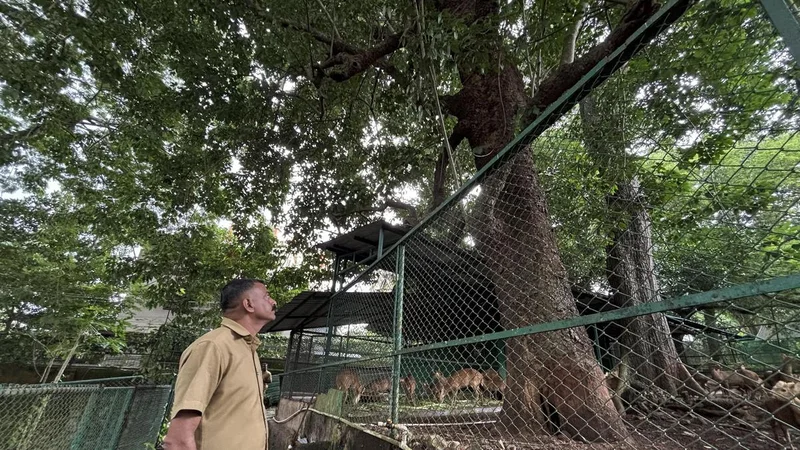
The city zoo has decided to initiate steps to protect a rare Arara nut-tree on its verdant premises.
Arara nut (Joannesia princeps) is a rare tree that is endemic to Brazil in South America. A medium to tall tree with a wide canopy, it belongs to the Euphorbiaceae family, the same as that of the rubber tree.
In Kerala, the Arara nut-tree is known to be found only in the Thiruvananthapuram zoo.
There are no details available in the Thiruvananthapuram zoo and museum archives on this tree, says botanical garden superintendent Vijayalakshmi P.V. That is perhaps the reason why it was thought to be rubber tree till now. However, that assumption was debunked when a team from the Rubber Board visited the museum premises recently to inspect three rubber trees.
Their visit was followed by that of P. Sujanapal, senior principal scientist and head of the department of Silviculture at the Kerala Forest Research Institute. Dr. Sujanapal identified the tree as Arara nut-tree, which is found in botanical gardens and research institutions, besides grown as avenue trees, in very few countries after being brought over from Brazil.
Dr. Sujanapal who inspected the health of the tree found damage to the bark such as cracks and dead and damaged tissue, especially in the part near the soil. Since it is located in a corner of the hog deer enclosure in the zoo, presence of overnutrients in the soil could also be causing problems, he says.
Since the Arara nut-tree is a softwood tree, unless the damage is contained it could topple over, posing a threat to visitors and the animals.
Dr. Sujanapal has recommended going in for tree surgery for its long-term conservation. The damaged tree bark will be removed and medicines used to check further decay and recoup the tissue. Since the tree is heavy, it will be pruned as part of weight management measures. Its germplasm will also be conserved so that it can be maintained in botanical gardens or zoos.
The Arara nut-tree also does not show any physiological or reproductive features that can be seen in other invasive plant species such as too many small seeds or sprouting branches.
In fact, it appears that in all the years it has been standing there only one another Arara nut-tree has managed to take roots and grow. This young tree, standing just a few feet away from the big one, is likely to be five to eight years old, says Dr. Sujanapal.
Published - August 07, 2026 07:04 pm IST