Introduction
In a laboratory 2 kilometers underground, a crane lowers Matt Depatie, a detector technologist, through a hatch into a white-walled cavern filled with about 7,000 tons of ultrapure water that glows as blue as wiper fluid in the light. “Splashdown,” Depatie says over a radio as he steps into an inflatable raft waiting below.
Normally, the cavern is one of the darkest places on Earth, but today, it is lit up for maintenance, offering us a rare chance to see inside. I peer through the hatch at Depatie as he paddles over to examine the submerged experiment. He’s inspecting a house-size detector built to catch some of the most elusive particles known to physics: neutrinos.
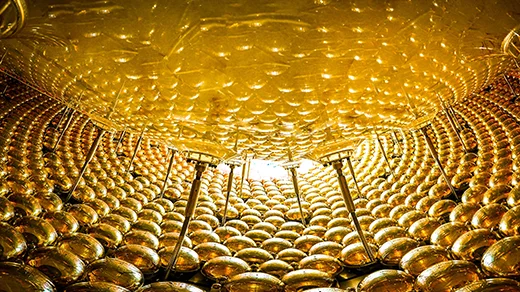
This is the SNO+ neutrino experiment, buried deep within the Creighton mine at Snolab, an underground physics laboratory in Sudbury, Canada. SNO+ consists of an acrylic sphere lined with nearly 10,000 sensitive light detectors and filled with 780 tons of oily liquid scintillator, which flashes when lit up by energetic particles. The water around the device and the rock above it shield the detector from the glare of cosmic radiation, allowing the flickers of less common particle interactions to shine through.
Our whole journey down has been part of the crusade to maintain absolute darkness, even beyond the visible spectrum of light. As we descended the main shaft and walked through a rocky tunnel to the lab, our bodies and clothes collected minute amounts of radioactive radon dust. Before entering the main laboratory space, we tossed our mine clothes, showered, and changed into electric blue jumpsuits and hairnets to minimize the contamination we carried in with us. “The showers aren’t for you,” Depatie said as we changed, “they’re for the science.”
Such extremes are necessary when you’re trying to catch ghosts — in this case, ghosts that may help reveal the secrets of inaccessible regions deep within the Earth.
Radioactive Planet
Neutrinos are the most abundant of all the particles that have mass. But that mass is tiny: just a millionth the mass of an electron. With such little heft and a neutral electromagnetic charge, the particles hardly ever interact with other matter. Trillions of neutrinos — mostly those produced in the sun — pass through our bodies every second, yet after years of hunting them with detectors such as SNO+, researchers have captured only a few hundred thousand of their precious flashes.
Even more elusive — so much so that after decades of searching, scientists have detected only a few hundred of them — are geoneutrinos.
Geoneutrinos are produced in processes that heat the interior of the planet. This heat plays a major role in powering the flow of rocks in the mantle, which shapes everything from plate tectonics to Earth’s magnetic field. It comes from two main sources: heat left over from the planet’s formation, and heat produced by the decay of uranium, thorium, and potassium in the rocks of the mantle and crust. Without this second source, Earth would have long since cooled off and become a tectonically dead planet.
In counting geoneutrinos, physicists can get a direct measure of Earth’s vital heat-producing elements. “It’s the one thing we do that focuses on the Earth,” said Ryan Bayes, a particle astrophysicist at Queen’s University in Ontario who works on SNO+. “Everything else we do is more focused on what we receive from other places in the universe.”
The first detection of geoneutrinos, by an instrument in Japan called Kamland, was reported in 2005. In 2009, the Borexino detector in Italy reported catching several dozen more. In November 2025, SNO+ reported its first detection, bumping up the number of observed geoneutrinos by about 50.
What makes the detections at SNO+ special is the experiment’s location: These are the first geoneutrinos measured in the western hemisphere, offering a new perspective on Earth’s radioactive interior.
Major uncertainties remain in interpreting the results from these experiments, but researchers’ best estimates suggest that each site is measuring a different flux. “It could be that that’s the first hint that the mantle is not uniform,” said Mark Chen, a particle astrophysicist at Queen’s University and director of the SNO+ collaboration.
Geochemists have conventionally assumed that radioactive elements are distributed evenly throughout the mantle, because the flowing rock should mix everything together. But the measurements of geoneutrinos in different locations could hint that this is not the case.
The regions that seem to be producing the most geoneutrinos sit roughly above continent-size blobs of anomalously hot, dense material, known as large low-shear-velocity provinces, or LLSVPs, which seismologists have mapped on either side of the core. One is under Africa, the other under the Pacific Ocean. “There may be deep Earth structures in the mantle that are not understood,” Chen said. “It could be that [they] concentrate some kinds of elements.”
Neutrinos could one day offer new insight into the still mysterious origin of these deep structures and, more broadly, the patterns in the mantle that underlie many aspects of the Earth system. “It really would be a way to make a chemical map of the Earth’s interior,” said William McDonough, a geochemist at the Chinese Academy of Sciences who has long been a leading voice in the search for geoneutrinos.
Catching Geoneutrinos
The outstanding question is whether the geoneutrino measurements reveal differences between the areas of mantle below each experiment, or if the imbalance originates in the way the different experiments count their geoneutrinos. Researchers across the board say there’s still so much uncertainty that it’s impossible to say.
“If we take it at face value, we could say maybe the western hemisphere has a lot more radioactive material in it than the eastern hemisphere,” McDonough said. But there are reasons to be wary of these estimates. “Are the Italians right? Are the Japanese right? Are they both right? Or is something wrong?” he said.
The uncertainties associated with each detector’s results come from the sorting process that physicists go through to identify geoneutrinos, Bayes said. “They don’t just show up and say, ‘Hi, I’m a geoneutrino.’”
Scientists must eliminate signals from particles with too much energy, particles with the wrong measure of a property called helicity, and particles that they expect to see flowing from nuclear reactors. They must also eliminate geoneutrinos coming from Earth’s crust, with the largest contribution coming from the area within a few hundred kilometers of the detector. When those other detections are subtracted from the total count, the geoneutrino signal from the mantle should be all that’s left.
In general terms, the geoneutrino flux from the mantle seems to be very high at Borexino and very low at Kamland, though the uncertainties are great. A detailed geological interpretation of the SNO+ results is still in the works, Chen said, but so far scientists see a “pretty in-between” mantle below Canada.
A particular challenge for SNO+ scientists is understanding the neutrinos coming from the detector’s surroundings, including a basin formed 1.8 billion years ago by a giant impactor. “There are lots of unknowns in this geological area,” said Virginia Strati, a researcher at the University of Ferrara in Italy who helped develop a local model of radioactivity for Snolab.
Uncertainty also comes from estimates of the total amount of radioactive material heating the mantle. The flux of geoneutrinos suggests that these elements could contribute anywhere from just a small percentage of its heat to half of it — a discrepancy equivalent to the output of tens of thousands of nuclear power plants.
Both sources of uncertainty make it even more difficult to detect any differences between the chemical makeup of particular sections of the mantle. The difference in the geoneutrino flux expected from various distributions of radioactive elements “is very small, and is hidden in these uncertainties,” Strati said.
Future Flux
The detection at SNO+ comes at an exciting moment for geoneutrino research: JUNO, another huge neutrino experiment currently collecting data in China, is expected to report its first geoneutrino flux later this year, adding a fourth and notably richer view. With more than 20,000 tons of scintillator, the experiment — buried under a mountain outside the city of Guangzhou — is so large that it is expected to detect more geoneutrinos in its first year than the combined output of Kamland, Borexino, and SNO+ over decades.
Clearer estimates of the geoneutrino flux at each experiment could come from more detailed geological data, as well as further geoneutrino counts at each site. However, McDonough says the best thing would be to build a neutrino detector at the bottom of the ocean. It’s an idea McDonough has championed for decades.
Such a detector would be far from continental rocks, which are rich in radioactive elements; oceanic crust is also thinner and more uniform. Crust-related uncertainties go down so much that “you are in mantle-only territory,” he said.
The idea of an ocean-bottom detector, estimated to cost hundreds of millions of dollars, has seen little take-up from government funders to date. But McDonough is hoping he can make something happen in China, which has given the green light to other big geoscience projects. “It’s very possible,” he said. Until then, physicists will keep paddling around for answers deep underground.