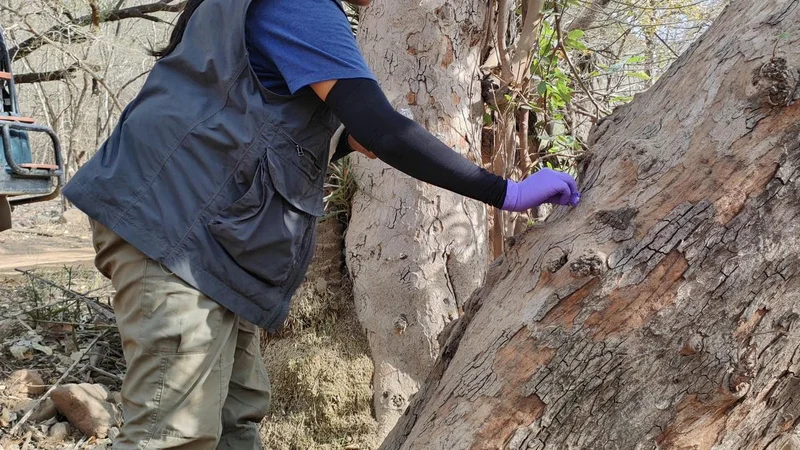
Researchers at the National Centre for Biological Sciences (NCBS) have developed a non-invasive method for identifying the age, sex, and reproductive status of tigers and leopards from the chemical signatures left behind in their urine and scat. This offers conservationists a tool for tracking two most elusive big cats in the wild.
Supported by a grant from the National Geographic Society, the study was recently published in the Journal of Chemical Ecology, in collaboration with Ahmedabad University. The samples were collected from zoos in Bengaluru, Ahmedabad and Vadodara, and Ranthambore Tiger Reserve in Rajasthan.
Tracking odour
Tigers and leopards are elusive, solitary, and endangered, making them difficult to monitor in the wild. Big cats, however, leave a scent when they roam the forests. They mark territory with urine and scat, both laced with volatile organic compounds (VOCs) that carry information to other animals.
“Current monitoring methods, like camera traps and genetic sampling, can estimate how many big cats are out there, but they fall short on the demographic and physiological details such as age, sex, and reproductive status that matter for better monitoring. The VOCs are known to carry this kind of information in other species, which makes our approach promising,” explained B.V. Aditi Prasad, the first author.
“The advantage of our method is its simplicity: samples are easy to collect, and the analysis is much easier than genetic testing. That makes it something field teams on the ground can actually use,” Ms. Prasad added.
Identifying multiple parametres
The research team collected urine and scat from nine captive tigers and 15 captive leopards across three zoos, as well as urine from 28 individually identified wild tigers in the Ranthambore Tiger Reserve. This is the first time tiger odours have been sampled directly from wild individuals. Volatiles were captured on small silicone sorbent tubes and analysed using thermal desorption gas chromatography-mass spectrometry to identify which compounds reliably predicted species, sex, age, and reproductive status.
They found that these samples could reliably identify species using both urine and scat volatiles.
The team could also predict sex and age from specific volatile combinations, though accuracy was lower for males and older individuals, a pattern the researchers link to greater individual variation in these groups.
However, the researchers were able to pinpoint signals of reproductive status in wild cats. They found that a compound, 2-nonanol, was markedly elevated in the urine of pregnant and lactating wild tigresses compared to non-reproductive females.
More possibilities
During the study, the team came across a captive tiger being treated for epilepsy, and the scat of the individual showed elevated levels of dimethyl tetrasulphide. While the instance involved only a single animal, the team feels the finding hints at the potential for the VOCs to flag health complications in captive animals.
“Detecting chemicals in urine and faecal matter has been widely used in nutrition, medicine, and forensics. Applying such techniques to conservation offers researchers and managers the opportunity to directly monitor individual statuses for population health and safety,” said Shannon B. Olsson, supervising author.
“Because collecting fresh samples from wild animals is difficult, our technique offers a simple strategy to detect some of these chemicals after the animal has left the area. Further studies can improve the accuracy of this technique and offer more insights on monitoring a variety of wild animals beyond big cats,” the supervising author said.
Published - August 07, 2026 07:27 pm IST