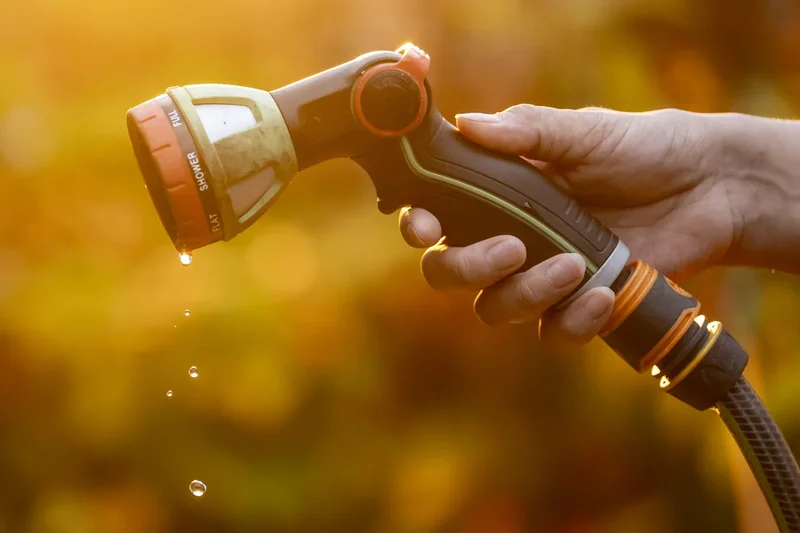
Nearly 26 million people will have their hosepipe use restricted after South West Water (SWW) became the latest supplier to announce an official ban.
Customers across central and south England remain banned from using hosepipes as back-to-back heatwaves and severely low rainfall have led to official drought conditions being declared.
Almost half of England and the entirety of Wales are now in drought, according to authorities.
SWW issued a hosepipe ban in parts of Devon and Dorset last month, but has now confirmed that this has been extended to all customers in Devon, Cornwall, parts of Dorset and Somerset and the Isles of Scilly.
Sam Bottomley, the firm's water services director, said the decision was not taken "lightly", adding: "After an extended period of exceptionally low rainfall, combined with sustained high demand during the warmer weather, our region's rivers and water resources are under significant pressure.
"Every litre saved now will help protect our rivers and water resources while drought conditions continue."
It comes after bans were put in place by nine other providers across southern and eastern regions, including Thames Water, South East Water and Anglian Water.
In Wales, a hosepipe ban has been announced by Welsh Water. It came into effect for around 33,000 customers in Ceredigion, Pembrokeshire and Carmarthenshire from Sunday 19 July.
The bans come as central and south-east England have seen the longest unbroken spell of no recorded rainfall this century, Met Office figures suggest.
It is the second consecutive summer drought, after the dry spell seen in 2025.
July 2026 was provisionally the driest on record, the meteorological authority has said, with southern England experiencing its driest month ever in parts.
June 2026 was the hottest June on record for England, Met Office figures also show, with the highest temperature of 38C set in Lingwood, Norfolk, on 26 June. The previous record of 35.6C was set in Southampton in June 1976.
Anglian Water, which serves most of the East of England, brought in a ban on Saturday 11 July. The company has more than 5 million customers in the region, making it the UK’s largest.
Affinity Water has also introduced a hosepipe ban for most of its customers, which began Saturday 11 July. It covers large areas of Bedfordshire, Berkshire, Buckinghamshire, Hertfordshire and Surrey.
London and Essex, which are served by a number of different water companies, are affected in most areas. Customers can check with their drinking water provider for exact details.
South East Water introduced the first official temporary hosepipe use ban to cover much of the Kent region from Friday 3 July, which has now been extended to all of its regions.
Southern Water also confirmed that a hosepipe ban is in place for its customers in Hampshire and on the Isle of Wight from Friday 10 July.
Cambridge Water’s temporary hosepipe ban for its 350,000 customers marks the first time in three decades that it has introduced the restriction.
Households across the country have been advised to limit their use, with some companies asking customers to pause hosepipe activity where possible, short of a full-on ban.
A hosepipe ban is different to an advisory notice. Anyone caught breaching an official ban can be issued a fine of up to £1,000.
Helen Wakeham, director of water at the Environment Agency and chair of the National Drought Group, said: “The hot and dry weather means we are currently using water faster than nature can replenish it.
“A second consecutive summer drought is an exceptionally serious situation and one that will have long-lasting impacts on our environment, wildlife and the economy.
“We want everyone to stay safe and hydrated during the hot weather but every drop we can save is a drop more for nature and agriculture.”