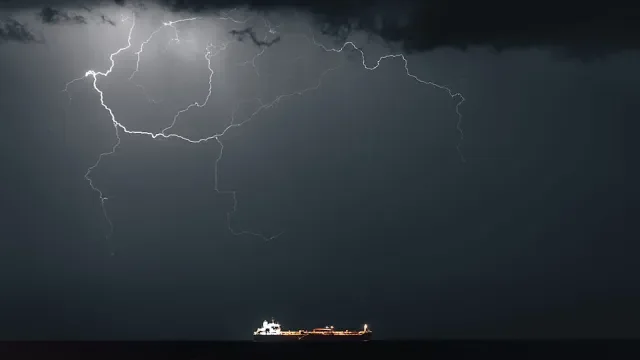
A bolt from the blue that never strikes the same place twice: Lightning is the proverbial placeholder for the unpredictable. Nature’s light show erupts whenever and wherever positive and negative charges within a storm cloud collide with sufficient force. But if lightning is truly place-agnostic, why does it have a thing for cargo ships? Something odd in the skies above the strait Look at these paired maps of where the Indian Ocean and the South China Sea rub shoulders. The lower one shows a bright orange trail of particulate matter that perfectly tracks with one of the world’s busiest sea routes. It skirts Sri Lanka, hugs Sumatra, squeezes through the Strait of Malacca, then heads north past Vietnam toward China. Lightning is not only unevenly distributed, on the top map you can trace the busy sea lane from the bottom map, revealed by the high concentrations of particulate matter emitted by ships’ engines. (Credit: Joel A. Thornton e.a.: “Lightning enhancement over major oceanic shipping lanes”, in Geophysical Research Letter – CC BY-NC-ND 4.0) The top map shows annual lightning strikes and immediately contradicts the assumption that these strikes are randomly distributed. The redder shades blanket land masses, confirming that lightning overwhelmingly prefers terra firma. Land heats up much faster than seas and oceans, generating the strong upward currents that fuel thunderstorms. In fact, researchers have found that 90% of all lightning occurs over land, which covers just 30% of the planet’s surface. Yet, something odd happens in the skies above the Strait of Malacca. It’s a genuine lightning magnet. So are the waters that fan out in straight red lines to the west and northeast. Taken together, they form a near-perfect doppelgänger for the shipping lane traced on the lower map. Lightning, it would seem, enjoys the company of large, ocean-going vessels stuffed with commodities, consumables, and consumer goods. And the missing link between shipping and lightning is the particulate matter on the lower map. Clouds are needy creatures Clouds aren’t just decorative puffs of vapor looking for a place to rain on. They’re needy creatures. That vapor requires microscopic specks of something to condense into tiny airborne droplets that can eventually become rain. Over the open ocean, the air is comparatively clean. But then come those cargo ships, burning bunker fuel that contains 3.5% sulfur. Their smokestacks vent an invisible confetti of sulfate particles into the air above that give the moisture exactly what it needs to go from a wispy coastal haze to a churning stack of convective cloud: structure. The trillions of tiny droplets formed by the pairing of particles and moisture fatten the clouds, which climb higher, past the altitude where temperatures drop below freezing. Those droplets then turn into ice crystals. Pretty soon, the turbulence in those clouds sorts itself out into positive charges in the frozen upstairs and negative ones in the merely chilly downstairs. When that tension becomes intolerable, it is evened out by the discharge of hundreds of millions of volts. Kapow! Once you know the connection, it all seems obvious. But scientists didn’t recognize just how neatly lightning follows global shipping lanes — as if someone had taken a marker pen to a nautical chart — until a 2017 paper published in Geophysical Research Letters pointed it out. Unintended effect of a cap on sulfur Did we say follows? We meant followed. In 2020, the International Maritime Organization (IMO) capped sulfur content in marine fuel at 0.5%, down from 3.5%. The measure was aimed at reducing respiratory disease and acid rain in port cities. Any effect on lightning was entirely unintended, but dramatic and immediate nonetheless. A study published in Atmospheric Chemistry and Physics in 2025 found that lightning over shipping lanes has dropped by more than 40%. Even more dramatically, anomalous lightning — the surplus that scientists couldn’t explain by normal weather phenomena — fell by 67%, from an average of 3.9 strikes per square kilometer per year to just 1.25. Lightning flashes as the USS Abraham Lincoln transits the Strait of Malacca back in 2010. These days, lightning storms in the narrow waterway between Sumatra (Indonesia) and the Malay Peninsula (Malaysia) are a lot less common, thanks to cleaner maritime fuels. (Credit: Colby K. Neal/U.S. Navy) Fewer polluting particles means fewer (but larger) droplets. More of those clouds rain themselves out before they go electric. In short: less sulfur, less lightning. Nature’s way of saying “Thank you” There is something satisfying about that chain of evidence. Not because there are now fewer fireworks over the Strait of Malacca; who doesn’t like a good light show? But because it confirms that reducing one particular source of pollution can have a measurable, real-world effect. Even if by accident. With shipping lanes serving as nature’s Leyden jar, the IMO’s inadvertent science experiment proves that dirty skies are electrically more productive, and vice versa. Those large, ocean-going vessels are still out there, churning along under considerably cleaner skies. As a result, they’re a lot less likely to be hit by Thor’s hammer. That may be the atmosphere’s way of saying: Thank you for not making a mess. Strange Maps #1297 Got a strange map? Let me know at strangemaps@gmail.com. Follow Strange Maps on X and Facebook. This article Ends with a bang: Why lightning stopped stalking the Strait of Malacca is featured on Big Think.
Ends with a bang: Why lightning stopped stalking the Strait of Malacca