German politicians praise bus driver's risky move with explosive drone at airport
Counterterrorism probe looking into circumstances of Tuesday's incident at Leipzig/Halle Airport
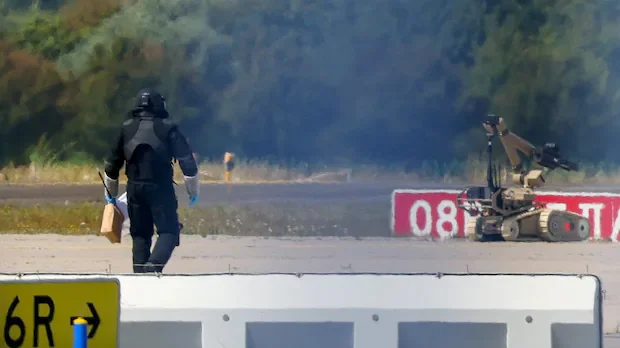
Chancellor Friedrich Merz held a call to discuss the drone incident earlier this week at a German airport, a government spokesperson said on Friday, a day after federal prosecutors launched a counterterrorism probe into what they said was a serious attack that could have impacted domestic security.
The spokesperson added that Merz was in constant contact with Interior Minister Alexander Dobrindt and other cabinet members about the incident on Tuesday at Leipzig/Halle Airport. The drone was defused by experts after it crashed into the ground, but prosecutors say the device was equipped with professional explosives and a detonator.
Meanwhile, a senior lawmaker from the governing conservative Christian Democratic Union Party gave the most detailed account yet of how the drone was spotted and stopped, which included a remarkable claim.
"A bus driver kicked the drone away while it was flying low. It then crashed and came to rest on the ground," Detlef Seif, who is a member of the parliamentary interior committee, said.
"The bus driver's action was very daring and courageous, but also very dangerous. It is possible that his intervention prevented the intended attack."
Authorities have not named the man or said where the drone came from and how it managed to get into a restricted part of the airport.
Site known as a NATO hub
Armin Schuster, the interior minister for the state of Saxony, where Leipzig/Halle Airport is located, praised the bus driver's actions.
"But it's not a model to be emulated. Letting us know would be enough," Schuster told regional broadcaster MDR.
Leipzig/Halle is the main operational base for NATO's Strategic Airlift International Solution, known as SALIS, which uses Ukrainian Antonov An-124 cargo airplanes to deliver equipment to strengthen the defence pact's eastern flank, among other missions. It is also used by some logistics companies.
German authorities have in the past accused Moscow of carrying out hybrid attacks — incidents of aggression that fall short of acts of war.
Moscow has denied those accusations. Russia's embassy in Berlin did not respond to a Reuters request for comment on the Leipzig/Halle drone incident.
"I assume this was a targeted hybrid attack — an attempted act of terror — orchestrated from Russia," Roderich Kiesewetter, a German lawmaker and parliamentary intelligence committee member, told a German newspaper earlier this week.
- AnalysisEurope says Russia is ramping up a sabotage campaign. It just doesn’t know how to deal with it
- VideoWhy Russia is worried about Germany’s Taurus missile
German media reported that the drone was found close to several Antonovs, among the world's biggest freighters. A Reuters journalist saw police collecting evidence near one of the planes early on Wednesday.
But the Interior Ministry later denied the drone was near cargo aircraft packed with munitions destined for Ukraine.
Tensions have mounted between Germany and Russia over the war in Ukraine and allegations of Moscow's interference elsewhere in Europe.
WATCH | NATO tracks for suspicious drones (2025):European security agencies have been investigating a series of incendiary devices in parcels that caught fire in 2024, raising concerns about sabotage of air cargo operators.
German airports, meanwhile, are on high alert after a series of unauthorized drone overflights at sites including military facilities, energy terminals, seaports and logistics companies.
Russia has denied any involvement in the 2024 incidents and overflights.
Located in Schkeuditz, between the cities of Leipzig and Halle, the airport opened in 1927. It was largely destroyed by Allied bombing during the Second World War and was rebuilt in the former East Germany.