In the early hours of Wednesday morning, astronomers around the world fixed their gaze on the Moon. They were hoping to see a flash of light, a puff of moondust, and a crater left behind by a SpaceX rocket set to crash-land on the lunar surface. Sadly, it doesn’t appear that they saw much, but this Korean spacecraft sure did.
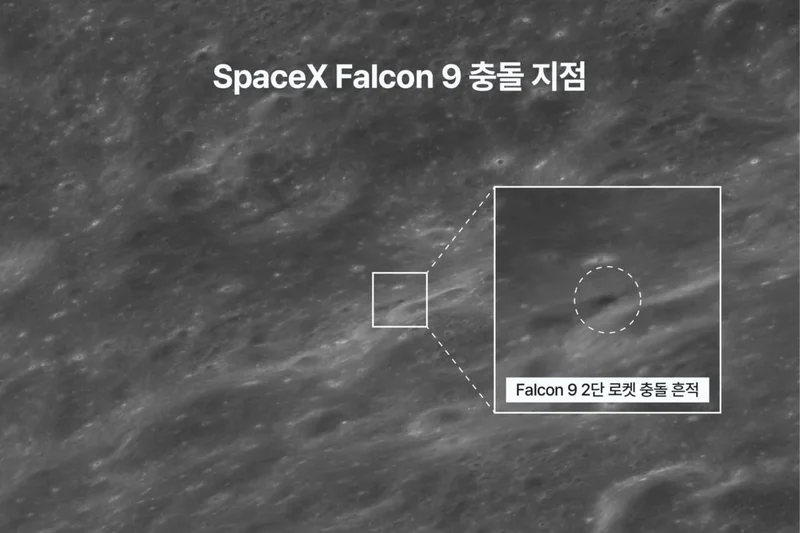
On Thursday, the Korean AeroSpace Agency shared the first images of the hole the wayward Falcon 9 upper stage punched into the Moon. KASA’s Danuri lunar orbiter took the photos as it made several passes over the impact site, snapping before and after shots. Using its Lunar Terrain Imager and its Wide-Angle Polarimetric Camera, the satellite captured a splotch of lunar terrain that appeared much darker after the impact with a bright spot in the middle, suggesting a new crater had formed.
“This observation offers a valuable opportunity to conduct in-depth research on lunar surface changes and impact mechanisms,” KASA said in a statement translated by Google.
The rocket that never came home
Coincidentally, the Danuri orbiter launched aboard a different Falcon 9 rocket exactly four years prior to capturing these new images. The spacecraft is KASA’s first lunar probe, designed to gather data and images of the Moon’s surface that will help scout locations for future landing missions.
Scientists had a feeling Danuri would come in handy during this unusual impact event. The spacecraft’s orbit  allowed to pass directly over the crash site before and after the 8,800-pound (4,000-kilogram) rocket slammed into the surface near the Einstein crater at 5,400 miles per hour (8,700 kilometers per hour), according to calculations that Bill Gray, independent orbital analyst and creator of the Project Pluto object-tracking software, made in April.
Based on his calculations, Gray and colleagues estimated that the resulting impact crater would be 66 to 98 feet (20 to 30 meters) wide. Now that Danuri has imaged it, scientists should be able to refine this estimation. NASA also planned to observe the crash site with its Lunar Reconnaissance Orbiter, so we will likely see more photos in the coming days.
The European Southern Observatoryâs Very Large Telescope, located at the Paranal Observatory in Chile, detected the impact too. âWe can confirm that the telescope detected spectral lines of sodium and lithium gas in the impact plume lasting for 5-10 minutes after impact,â Bárbara Ferreira, media manager for ESOâs department of communication, told CNN. âThe sodium likely originated from the lunar soil, whereas the lithium could come from the rocket itself.â
Carl Schmidt, a research assistant professor of astronomy at Boston University who led the Very Large Telescope observations, told CNN the sodium and lithium plume was a few tens of kilometers in size.
The data scientists have gathered from this crash will help them learn more about the dust and plume dynamics of lunar impact events, as well as the hazards of artificial space debris. The latter will become much more important if NASA achieves its goal of establishing a sustained human presence on the Moon.