In the latest twist in one of the strangest ongoing scandals in Washington, D.C., U.S. Attorney for the District of Columbia Jeanine Pirro announced that the government would be dropping charges against the four people accused of vandalizing the Lincoln Memorial Reflecting Pool, the 2,000-foot long water basin that connects the Lincoln Memorial to the Washington Monument. Pirro said faulty construction – not vandalism, as President Donald Trump had claimed – caused the pool’s liner to peel off in June 2026.
As I’ve followed this bizarre saga, I’ve found myself reflecting on the history of the pool itself. It was built in the 1920s, when Washington was transformed by ambitious construction projects, even as the nation grappled with political division, racial conflict and clashes between religion and secularism.
To me, everything about the pool’s early history – the debates over its placement, the innovative engineering techniques used during its construction, and its proponents’ longing for something visually and metaphorically unifying – stands in stark contrast to the slapdash renovations, blame games and abuses of power playing out today.
Coming to a consensus
In 1901, the U.S. Senate formed the McMillan Commission, a group of architects, landscape designers and artists, to develop a parks system for the nation’s capital.
The commission’s 1902 report also recommended a location for the future Lincoln Memorial. Although proposals for a memorial had emerged shortly after Lincoln’s assassination in 1865, decades of political disagreement over its design, location and purpose had delayed construction.
The report proposed situating it at the western end of the Mall, near the Potomac River. Inspired by the waterways of Versailles and the reflecting basins of the Taj Mahal, the commission envisioned a reflecting pool linking the future memorial to the Washington Monument. In this way, these two magnificent monuments could be reflected in a huge mirror of water, framed by manicured, green grass.
Over the ensuing decade, the plans continued to elicit debate and controversy, pitting supporters of the commission’s vision against members of Congress, railroad interests and real estate developers.
The American Institute of Architects and American Federation of Arts backed the report, arguing that isolation from the city’s bustle created a dignified space for reflection. They also called attention to the qualifications of the artists on the commission, and to the economic viability of the site: The land was owned by the federal government, so the project’s funds could go toward the memorial itself rather than acquiring land.
But some House leaders insisted that the memorial be built on Capitol Hill, two miles to the east, since Lincoln had preserved the Union and worked closely with Congress during the Civil War.
Railroad interests wanted the memorial near the soon-to-be-completed Union Station, a proposal backed by some real estate developers. Even the National Highways Association joined the fray, arguing that the US$2 million Congress had authorized for the memorial in 1911 would be better spent on a memorial highway named for Lincoln linking Washington and Gettysburg, Pennsylvania.
The Union Station plan drew ridicule in the Washington press and failed to gain congressional support. When the proposal to replace the memorial with a highway came before Congress in 1912, the House of Representatives rejected the idea, too – despite some fears that moneyed interests would win out – and moved ahead with plans for a traditional monument.
Around the same period, plans were also put forward for Lee Highway. Named for Confederate General Robert E. Lee, the road reflected the era’s ongoing debates over how Americans memorialized the Civil War.
A pool on a swamp
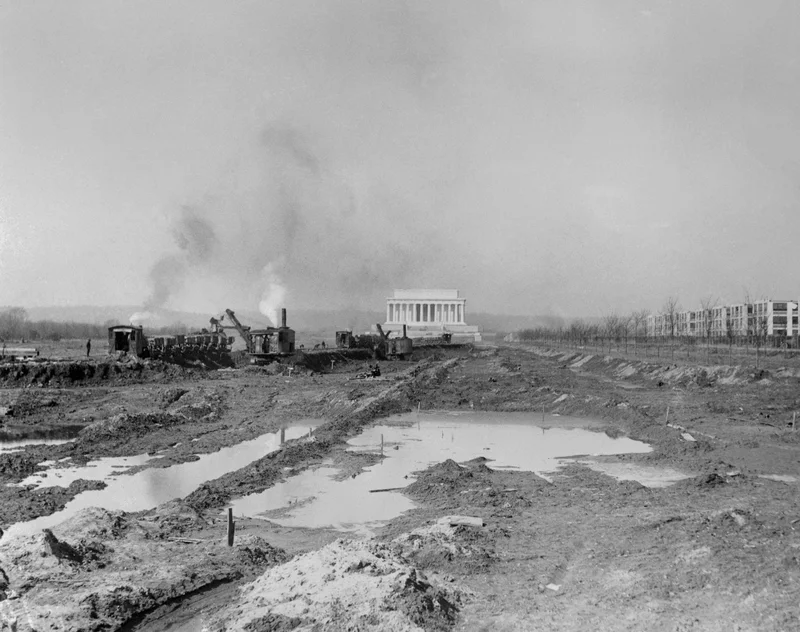
With the riverside location for the monument settled, construction of the Lincoln Memorial began in 1914. The excavation of the basin for the reflecting pool started in 1920, two years before the memorial itself was completed.
Author J.W. Duffield, writing in 1922, compared the Lincoln Memorial Reflecting Pool to the one in front of the Taj Mahal, that “exhalation of a dream.”
“It is in accord with the eternal fitness of things,” he continued, “that these memorials to America’s two greatest Presidents – Washington, under whom the nation came into being; Lincoln, by whose labors it was preserved and by whose blood it was hallowed – should stand in close proximity, as shrines to which posterity may pay pilgrimage and tribute.”
Yet there were several obstacles involved in the construction of the pool – namely, the area was swampland, so the settling of the ground and the drainage presented practical construction challenges.
Engineer Charles A. Peters Jr. worked on the pool. In a 1923 article for the journal The Military Engineer, he described some of the creative solutions.
To deal with the settling, Peters and his team developed flexible flooring lined with an impervious three-ply fabric. The drainage system had to empty the pool in less than 24 hours without leaving puddles. So it was designed with a sloped basin and drainage system that allowed crews to empty the pool for maintenance while preventing water from collecting in low spots.
An additional consideration was cold weather. Engineers had to account for the stresses of freeze-thaw cycles, which can gradually damage waterproofing layers, crack concrete and masonry, and create leaks.
The waterproofing worked: It held up for decades, and in its early years, members of the public could be seen ice skating on the frozen reflecting pool.
From Lincoln to Trump
On May 30, 1922, 50,000 people – including Robert Todd Lincoln, the late president’s only surviving son – gathered on the National Mall for the unveiling of the monument for the man whom some call “America’s secular saint.”
During the ceremony, President Warren Harding declared Lincoln’s accomplishments “so colossal that none will dispute that he was incomparably the greatest of our Presidents” due to “the greatness of his intellect, his honesty of purpose, and his kindness and gentleness.”
The same year that the Lincoln Memorial was inaugurated, the tomb of Tutankhamum was discovered in Egypt, fueling a broader fascination with ancient civilizations, monuments and the ways societies preserved memories of powerful figures. The Egyptian pharaoh Menes appears first among the lawgivers represented in the interior frieze on the South Wall of the U.S. Supreme Court building, completed in 1935. These friezes reflected the aspirations of the nation’s leaders to place America on the continuum of great civilizations.
The deliberative, thoughtful process of remaking the nation’s capital in the early 20th century bears little resemblance to Trump’s insistence on remaking the capital in his image.
After Trump announced his wish to change the color of the pool to what he calls “American flag blue,” the National Park Service awarded a no-bid contract to a politically connected firm, Atlantic Industrial Coatings, to repair leaks and paint the pool. It signed another no-bid contract to install a filtration system with Greenwater Services, a construction company whose owner had donated to Trump.
The rushed renovation that ensued – and the squabbling over whether the peeling liner was the result of vandalism – led to charges against four suspects that were eventually dropped.
The pool debacle came on the heels of other attempts to modify the nation’s capital, from a new White House ballroom to a proposed monumental arch. In October 2025, Trump dismissed all six members of the U.S. Commission of Fine Arts in order to circumvent the independent design review board.
The 1920s weren’t devoid of partisanship, graft and scandal. Far from it. But unlike Trump’s top-down approach, the process for building monuments and civic spaces involved Congress, artists, architects, engineers and city planners who debated, offered their expertise and listened to public.