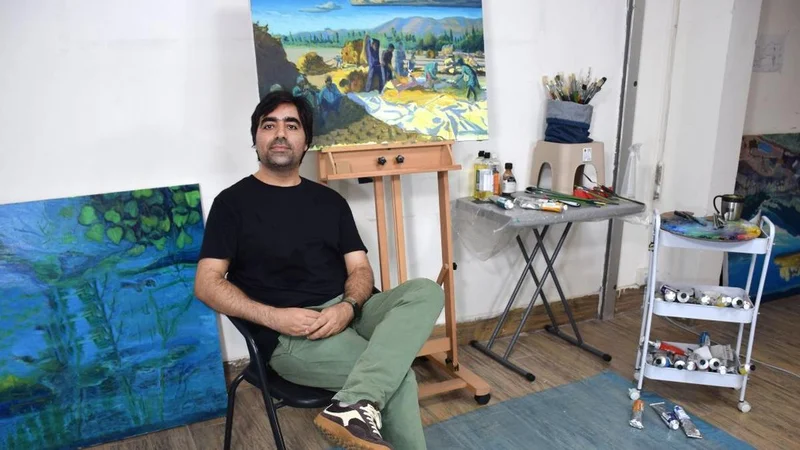
“Many of my paintings feature solitary figures looking at vast landscapes, reflecting on change and uncertainty,” says 41-year-old Kashmiri artist Azim Hassan. “I try to paint erasure. I try to paint such emotional realities.”
Time spent in Hangzhou, and now in Foshan in nearby Guangdong province, China, has given him a more nuanced perspective on his native Anantnag. Its panoramic landscapes are now patrolled by soldiers, and older buildings are gradually giving way to trendy restaurants, yet parts of the region seem suspended in time.
When I visit the Valley over the summer, I find myself seeing its dreamy meadows, water-filled vistas and sombre protagonists through Hassan’s eyes. His body of work — over 200 paintings, exhibited in solo and group exhibitions across India, China, South Korea, Pakistan, Portugal and the United States — is the starting point for a long virtual conversation.
An earnest young man with a pensive demeanour, Hassan left home for the first time in 2010. The influence of those formative years is evident in every facet of his work. We discuss the dubb, the old-fashioned wooden balcony that features in his painting, The Dubb and the Nab, but which is no longer seen in the palatial American classical-style houses that are now coming up across the Valley. These architectural details remain integral to Hassan’s ‘dream-like, sublime landscape’ (nab means sky in Kashmiri).
Creating art away from one’s homeland offers both restrictions and freedoms, making reinvention — and the emergence of a new visual idiom — possible. The Dubb and the Nab, for instance, brings together the region’s diverse communities in an otherworldly marketplace scene. “The main characters in this painting are the Bakarwals, a nomadic pastoral community. In some ways, their journeys resonated with my own experience of living in China and returning to Kashmir for short periods,” says Hassan.
Of blue and chiaroscuro
Hassan describes the works in his first solo exhibition, Four Shadows (2021), as a “confrontation between beauty and hardship, vulnerability and resilience”. The interiority of pathos — an old man losing his eyesight while weaving a shawl — finds an echo in his vivid imagery, wherein recurring clouds carry considerable emotional weight.
Like the American painter Edward Hopper, whose work explored urban loneliness, Hassan is preoccupied with the interplay of light and shadow. “I’m fascinated by chiaroscuro [a technique that uses strong, bold contrasts between light and dark]. In the Baroque period, they used it to create drama and intensity through contrast,” he says.
Over time, a pervasive blue has steeped into many of his canvases, becoming an integral part of his visual language. “It is connected to spirituality, melancholy, silence, and stillness,” he explains. “Kashmir has always felt like a deeply spiritual and mystical place.”
Hassan admires the work of Kashmiri artists such as Shafi Chaman and graphic novelist Malik Sajad, although he does not consider himself stylistically influenced by any artists from the region. As a struggling art student pursuing a Master’s degree at Jamia Millia Islamia in Delhi, he covered his expenses through commissioned illustrations and received support from benefactors such as Nighat Shafi, who runs an NGO in Srinagar and funded his studies while he was at Kashmir University. A competitive scholarship to the China Academy of Art in Hangzhou further honed his technical skills.
Today, Hassan teaches IB (International Baccalaureate) art in China, a steady job that has enabled him to contribute to Shafi’s NGO. Although he briefly tried living in Anantnag again, he ultimately returned to China and recently married a woman from Zhejiang province.
Legacy of conflict
Growing up, newspapers often arrived at Hassan’s home several days late. “I haven’t understood the conflict in its entirety, but I’ve always felt it in everyday life,” he says. “As a painter, I’m equally drawn to another side of Kashmir — the landscapes, the beauty, and the cultural traditions I grew up with. Many of those traditions and memories are slowly fading away.”
Yet, the conflict in Kashmir forms an inescapable backdrop, shaping decades of unrest — and some of Hassan’s most evocative paintings. His ‘Boy by the Windowside’ responds to the seven months of violence and curfew that engulfed the Valley in 2016. The painting’s haunting image of a boy and his blinded cat bears the unmistakable marks of violence, yet also suggests a fragile moment of temporary peace, in repose. In ‘Beyond the Broken’, the same boy stands before a window, with a candle.
“Life could be challenging growing up,” says Hassan. His parents were not a part of his artistic journey, yet, raised by his maternal uncle, who encouraged his vocation, he grew up in a loving, liberal family steeped in the arts.
In Anantnag, I visit his uncle’s farm and the house where Hassan lived as a child, spending time with his three charismatic younger cousin brothers.
Seated in the family kitchen, we sip pink, salty nun chai and eat traditional Kashmiri bread, cross-legged on the floor before the dastarkhan, the cloth laid out for meals. Kittens dart about outside.
This is the life Hassan may never fully return to: one that gathers his family within its warmth, even as it may limit the opportunities available to these young men beyond Kashmir. They look up to their older brother, who left home in order to show it to the world, in all its beautiful complexity.
The writer-editor is based in South India.
Published - August 07, 2026 08:22 pm IST